Review: Don’t Start the Revolution Without Me!

5 Star, Culture, DVD - Light, Democracy, Philosophy, Values, Ethics, Sustainable Evolution
0Shares
Dont Start
Amazon Page

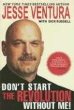
The Real Deal–He Should Campaign on Substance in 2008, April 20, 2008

Jesse Ventura

This is my first Jesse Ventura book and I am deeply impressed. This man is the real deal, honest, straight-up, with plenty of common sense. His ideal running mate is not John McCain or Robert Kennedy Jr. but rather the star of The Average American: The Extraordinary Search for the Nation's Most Ordinary Citizen. I would gladly serve these solid citizens in a staff capacity.

The book lacks an index, while offering plenty of balanced outrage. This is a serious person who sees all that is wrong with America, and who would have no problem agreeing with the authors of Running On Empty: How The Democratic and Republican Parties Are Bankrupting Our Future and What Americans Can Do About It; or Breach of Trust: How Washington Turns Outsiders Into Insiders.

A few of my notes from this captivating book and personality:

+ “Special interests have a stranglehold on our reality. Nobody is being told the truth.”

+ Castro told him JFK assassination was an inside job. See Someone Would Have Talked: The Assassination of President John F. Kennedy and the Conspiracy to Mislead History for confirmation–CIA trained team of Cuban exiles in revenge for Bay of Pigs

+ Reform Party was bogus, Perot let his ego run away with his brain

+ Buchanan hijacked the Reform Party and looted its treasury to pay off his old campaign debts

+ Both political parties are gangs

+ Organized religion is a business milking people like cows for their milk (money)

+ Down on NAFTA

+ Bush-Cheney passing federal laws that prevent states from protecting their own citizens properly from corporate predation

+ 9/11 Commission a cover-up, just as the Warren Commission was–government lies to the people (e.g. Gulf of Tonkin incident, simply cannot be trusted

+ CIA has embedded case officers within state and local governments

+ Positive on Ralph Nader as an honest person bringing up issues the two criminal parties will not raise

+ Properly faults Bush-Cheney for ignoring intelligence and privatizing war while bankrupting the Nation—if not impeachable, should at least be commitable to an insane asylum (see my lists on impeachment and holding Dick Cheney accountable, at least take a look at Vice: Dick Cheney and the Hijacking of the American Presidency

+ There IS a ruling class, not sure of its composition, we have to take the country back from them

+ Electoral college is long overdue for termination.

+ O'Reilly, all of those talking heads are scripted, media is about generating cash through entertainment, not about informing the citizenry

+ FCC fines broadcasters and others but they are appointed, not elected, and not accountable for their subjective definition of what is obscene

+ “Revisionist history troubles me deeply.” page 265. This is the point where I decide this guy is a serious and qualified candidate to be our president.

+ 27 years of Bushes and Clintons, time for an independent party nominee to win and lead

+ National Guard should stay home.

+ Citing Mussolini, fascism is the marriage of corporations and religion. We have that here, now.

+ Need term limits on reporters, not just politicians. Reflects a profound disdain for Minnesota reporters.

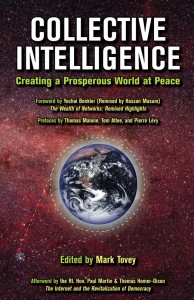
I put the book down at the end of a very long very rainy day feeling good about this author, his independence of mind, his integrity. In combination with Blessed Unrest: How the Largest Social Movement in History Is Restoring Grace, Justice, and Beau; Society's Breakthrough!: Releasing Essential Wisdom and Virtue in All the People; The Tao of Democracy: Using Co-Intelligence to Create a World That Works for All; and Collective Intelligence: Creating a Prosperous World at Peace, I have a very strong feeling that the national immune system is going to kick in and finally out these frauds that pretend our elections are honest and meaningful.

It's a real shame Ralph Nader does not play well with others. I'm going to get in touch with Jesse Ventura and urge him to form a Transpartisan Sunshine Cabinet that can create a balanced budget by the 4th of July 2008. He does not have to run for President, all he has to do is set the standard by which we can judge the fradulence of “the system” candidates. For those enchanted by Barack Obama, as I was until I saw his dishonest advisors, see Obama – The Postmodern Coup: Making of a Manchurian Candidate.


Vote on Review

Who’s Who in Collective Intelligence: Jim Rough

Alpha Q-U, Collective Intelligence
0Shares
Jim Rough
Jim Rough

Jim Rough is a seminar leader, speaker, consultant, and social innovator (www.DynamicFacilitation.com). He is co-founder of the Center for Wise Democracy (www.WiseDemocracy.org) and author of Society’s Breakthrough: Releasing Essential Wisdom and Virtue in All the People (www.SocietysBreakthrough.com).

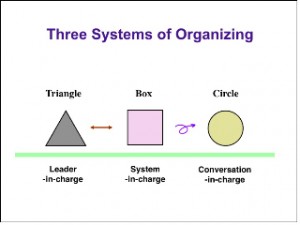
Below is an illustration from the first page of his historic contribution, it also leads to the chapter; and the cover of his book, Society's Breakthrough: Releasing Essential Wisdom and Virtue in All the People leading to the Amazon Page.  Jim Rough epitomizes the very best of the American pioneer spirit of common sense and good intention.  He is, along with Tom Atlee and others in the Collective Intelligence movement, a center of gravity for restoring America.

The Circle Organization:

Structuring for collective wisdom

The Book
The Book
From Pyramid to Circle


Amazon Page
Amazon Page

Continue reading “Who's Who in Collective Intelligence: Jim Rough”

Review: Beyond Civilization–Humanity’s Next Great Adventure

5 Star, Change & Innovation, Civil Society, Culture, DVD - Light, Future, Values, Ethics, Sustainable Evolution
0Shares

Beyond CivilizationPointer to Other Relevant Works, April 13, 2008

Daniel Quinn

I considered this book, and found the reviews so very informative, as well as negative on what the “next steps” should be, that I enter this contribution not as a review of the book, but as a pointer to other books that go beyond this book. Epoch B Swarm B Leadership, Transpartisanship, and bottom-up Citizen Wisdom Councils is what comes after civilization deconstructs and the nation-state model is finally devolved to tighter regional alliances and the end of predatory immoral capitalism (in favor of moral green capitalism).

Here are ten books I have read and reviewed that I believe readers and admirers of this author will find most beneficial:
The leadership of civilization building: Administrative and civilization theory, symbolic dialogue, and citizen skills for the 21st century
How to Change the World: Social Entrepreneurs and the Power of New Ideas, Updated Edition
The Handbook of Large Group Methods: Creating Systemic Change in Organizations and Communities (Jossey-Bass Business & Management)
The Change Handbook: The Definitive Resource on Today's Best Methods for Engaging Whole Systems
Society's Breakthrough!: Releasing Essential Wisdom and Virtue in All the People
The Tao of Democracy: Using Co-Intelligence to Create a World That Works for All
Finding Our Way: Leadership for an Uncertain Time
The World Cafe: Shaping Our Futures Through Conversations That Matter
Collective Intelligence: Creating a Prosperous World at Peace

My thanks again to the reviewers. I buy and read a great many books, and the reviews help me make tough choices within my limit of five books a week. I hope the links above are considered helpful.

Review: Fixing Failed States–A Framework for Rebuilding a Fractured World

5 Star, Stabilization & Reconstruction
0Shares
Amazon Page
Amazon Page

Ashraf Ghani, Claire Lockhart

5.0 out of 5.0 Stars Utterly brilliant on the half the author's understand best, April 12, 2008

This is an utterly brilliant book that has held my attention all morning. Although the authors do not integrate the thinking in the ten books below, I am totally, deeply, impressed by their intelligence, knowledge, and good intention.

They set out to develop understanding in five areas:

1. What State needs to do
2. How international community can help
3. How timelines and interdependencies should define sequencing
4. Why one size does NOT fit all
5. Why we must accept our shared responsibility and recognize the need for both proactive intervention, and coproduction (and sharing) of wealth.

I started with the endnotes and index, which is where I begin the most intelligent books in my reading program. I immediately detected the gaps that I address with the ten annotated links, but I was also immediately won over in seeing their appreciation for the report of the High Level Threat Panel of the UN, for Singapore under Lee Kwan Yew, for the balanced score card approach (some call for a triple bottom line), for Paul Collier's focus on the bottom billion, for Paul Hawkin's et al on natural capitalism.

Within the notes, I was shocked to learn that it has been reported that the United Nations deprived Afghanistan of the first two and a half years of all donor contribution, “by agreement” with US Government and World Bank. Since one of the author's has served as Finance Minister in Afghanistan, not only do I believe this–it must never happen again.

I find in this book one of the most original, refreshing, relevant, and therefore essential reviews on the matter of the State. Although the author's do not cite McIver, the original master on the origins and functions of the state, I consider them to be the new thought leaders and essential to any discussion of how to improve the inter-relationships among the eight tribes of governance: states, militaries, law enforcement authorities, academics, businesses, media, non-governmental organizations, and civil society including labor unions and religions. They are wrong-headed in thinking that “only sovereign states…will allow human progress to continue,” and that “illegitimate networks will not be conquered except through hierarchical organizations,” but in no way does this diminish the extreme importance of their deep thinking on the role of the state and the need to change both our concepts of sovereignty and our rules of the road for international organizations.

A useful early idea is that of the “double compact” between the country leadership and the international community on the one hand, and with the citizens on the other. It becomes obvious very quickly that corruption in government service is the single cancer that must be removed before states can achieve legitimacy and efficacy.

The authors have many gifted turns of phrase to include “harnessing our collective energies and readjusting to emerging patterns.”

The authors recognize early on that legitimacy comes from below, from citizens, and must be earned.

I am not going to summarize each chapter, but I want to point readers toward the Army War College Strategy Conference, just concluded, on “Rebalancing the Instruments of National Power.” I have posted both 29 pages of notes and an 8-page draft article for the Joint Forces Quarterly. Singapore got it early and is the world's first “smart nation.” They understood early on that education powers economics, economics powers security, and so on.

Today, the authors document ably, stewardship of the environment, respect for social entrepreneurship, fair trade, and innovation in applying information technology to create wealth are all coming to the fore with honest leaders.

They identify five aspects of the networked world that are of note:

1. Framework for balancing activities of diverse stakeholders
2. Rule of law at a strategic level, with freedom of action at a tactical level (not quite true in the USA where the corrupt federal Congress establishes federal CEILINGS for regulatory action).
3. Massive investment–one reads repeatedly of the glut of money available for emerging markets (and I would add, the absence of both commercial intelligence and co-investment planning with charitable foundations)
4. World is evolving according to open systems (super point, see my keytone briefing to Gnomedex 2008, “Open Everything.”
5. World is finally starting to evolve past rote memorization and toward recognizing patterns (the adaptive complex system and panarchy literature covers this well).

In the middle of the book they have six themes, each developed in a manner that makes this book quite valuable for any library, personal or organizational.

1. Conflict causes polarization of identities *and* ungovernability of aid subject to black market rules.
2. Peacemaking has been geared to compromise rather than strategic planning for a long-term outcome
3. This means that state dysfunctionality is highest immediately after the peace accord.
4. Even if civil war does not break out, cost of failed politics and poor policies is immense.
5. Lack of money is not the driver for poverty, but rather corrupt politics that enrich the few at the expense of the many.
6. Dysfunctional states spawn the rise and spread of networks of criminality and wealth confiscation instead of networks of social wealth creation and sharing.

The book concludes with “A New Agenda for State Building”

1. International compacts
2. Sovereignty strategy
3. Shared rules of the game
4. Mobilization of resources (this would be better titled harmonization of resources–we need Global Range of Gifts Tables for every country down to the village hut level, online, updated by national call centers
4. New leadership styles–this is a superb overview of what it takes to migrate from industrial era pyramidal leadership to Epoch B swarm leadership (see the image I am loading above).
5. Reflexive monitoring at every step of the implementation process
6. Double compact in practice

The final two chapters focus on national programs, and in conclusion, on “Collective Power.”

I put the book down feeling GREAT. This book is a seminal reference.

Now for ten books (and my reviews) that round out this one book:
The Health of Nations: Society and Law beyond the State
High Noon 20 Global Problems, 20 Years to Solve Them
Plan B 3.0: Mobilizing to Save Civilization, Third Edition
The leadership of civilization building: Administrative and civilization theory, symbolic dialogue, and citizen skills for the 21st century
Global Assemblages: Technology, Politics, and Ethics as Anthropological Problems
The Fortune at the Bottom of the Pyramid: Eradicating Poverty Through Profits (Wharton School Publishing Paperbacks)
The Wealth of Networks: How Social Production Transforms Markets and Freedom
Teaching to Transgress: Education as the Practice of Freedom
How to Change the World: Social Entrepreneurs and the Power of New Ideas, Updated Edition
Collective Intelligence: Creating a Prosperous World at Peace

Review DVD: National Geographic: Six Degrees Could Change the World

5 Star, Complexity & Catastrophe, Environment (Problems), Nature, Diet, Memetics, Design, Reviews (DVD Only), Survival & Sustainment, Water, Energy, Oil, Scarcity
0Shares

Six DegreesSpectacular. Professional. Visually Powerful. Life Changing., April 12, 2008

Alec Baldwin

This is a spectacular piece of professional work and so compelling as to be inspirational.

I watched this with my wife with no lights, and decided to take no notes. Here are the highlights from my memory.

1) Brilliant, utterly brilliant, history, photography, personalities (such as the Indian guru that has photographed the source of the Ganges for 50 years) and sequencing. I don't want to overdo it, but this may well be the single most important DVD of the century, and so worthy of both buying, showing to groups, and giving as a gift to others.

2) We are well on our way to 2-3 degrees rise, and if we do not begin to act sensibly now, toward six degrees. I absolutely loved the way this film developed, showing the changes one degree at a time. My wife had to point out the computer simulations, the producers and editors of this film are world class–they should share the Nobel with Herman Daly, Lester Brown, Paul Hawkin, and Anthony Lovin, Gore's Nobel was an ill-advised politicized award, he is in the fourth grade compared to this film and the serious people it focused upon.

3) Oceans as the critical carbon absorbing element, and coral as the “canary in the coal mine” really grabbed me The overall screenplay, photography, voice overs, everything about this is spectacularly professional and rivieting.

4) Amazon as the next most critical element, with riveting views of the Amazon river drying up in 2005, and the potential scenarios of drought, fires, more drought.

5) Increasing destructiveness of weather. Katrina as the first of what could become every month storms, instead of 100 year storms. In passing, the film shows the world-class levies built by the Europeans, and they do not show the downright retarded cement levees of the US Army Corps of Engineers, levees that are the laughing stock of the rest of the (sophisticated) world.

A highlight of the film was its focus on the one man that has figured out the total carbon footprint of the cheeseburger, to include the methane farts of the cows. I am not making this up. This film is AMAZING, it is spectacular, it is professional, it is precisely the kind of well-crafted material that We the People need to begin self-governing rather than entrusting war criminals and and cronies (both parties) who sell us out.

Here are ten links that augment the deep insight and value that this DVD provides to anyone able to see it.

High Noon 20 Global Problems, 20 Years to Solve Them
The Future of Life
Plan B 3.0: Mobilizing to Save Civilization, Third Edition
The leadership of civilization building: Administrative and civilization theory, symbolic dialogue, and citizen skills for the 21st century
How to Change the World: Social Entrepreneurs and the Power of New Ideas, Updated Edition
Green to Gold: How Smart Companies Use Environmental Strategy to Innovate, Create Value, and Build Competitive Advantage
Natural Capitalism: Creating the Next Industrial Revolution
The Philosophy of Sustainable Design
Running On Empty: How The Democratic and Republican Parties Are Bankrupting Our Future and What Americans Can Do About It
Collective Intelligence: Creating a Prosperous World at Peace

Apart from these, allowed by Amazon, I recommend the many books on climate, catastrophe, etcetera. See my many lists.

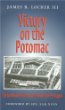
Review: Victory On The Potomac–The Goldwater-Nichols Act Unifies The Pentagon

5 Star, Budget Process & Politics, Congress (Failure, Reform), Executive (Partisan Failure, Reform), Politics, Security (Including Immigration)
0Shares

Victory PotomacSetting the Stage for the NEXT Reform of National Security, April 10, 2008

James R., III Locher

I bought this book at the Army War College after hearing its author speak to the Army Strategy Conference on “Rebalancing the Instruments of National Power.” I have posted 29 pages of notes at Earth Intelligence Network, with a page or two from Jim Locher's brilliant luncheon presentation.

Having spent the evening with this book, and with an understanding of what the Project on National Security Reform will be providing to the next President of the United States, I found the book totally inspiring, and most important for what it represents as proof that “Phase II” of national security reform is not just possible, but likely in 2009.

A few highlights:

1) The service chiefs fought this bitterly, to include lies and deceptions and fabricated studies.

2) Chairman of the Joint Chiefs Jones, and later Crowe, get high praise for having the gumption to call for reform in the first case, and agree with reform in the second, but they were virtual outcasts for doing so.

3) Senator Sam Nunn will be back. As I look at the make-up of the Project, which also benefits from Newt Gingrich's brilliance and his mastery of history and House protocol, I have a very strong feeling that the follow-on to Goldwater-Nichols, a National Security Act of 2009, is not just viable, but undefeatable.

4) I've known Jim Locher as a thoughtful and courteous person for over a decade, and this book confirms my personal view that he is one of the most loyal, dedicated, intelligent, and responsible individuals we have, totally committed to public service in the purest sense of the word. The reviewer who demeans the author has no basis, in my view, for his negative judgement.

I have just one worry: everyone is beginning to realize that neither John McCain nor Barack Obama have a strong bench, and at the same time everyone I talk to seems to believe they will repeat the long-standing mistake of seeking to implement a single-party executive. This they must not be allowed to do. Please visit Reuniting America to understand the concept of Transpartisanship, in which ALL parties (including Libertarians, Reforms, Greens, and others) share leadership positions so that we might harness the COMPLETE distributed intelligence of the entire Nation.

The Project will provide a preliminary report on Phase II of national security reform in early July 2008, and a longer report in September 2008. Once a President is elected, a complete set of Presidential directives, draft legislation, and recommended amendments to Congressional jurisdictions and protocols, will be provided so that the President might be ready to implement national security reform within 100 days of taking office. We cannot wait for the Quadrennial Defense Review in the second year of the Presidency; those focusing their time on influencing that document would be well-advised to contribute shorter versions of their work sooner to the Project. By 1 May 2008.

In his comments today at the Army War College, the author told us that everyone said this would be impossible; that it was lunatic, and so on. This book is a deep historical account of how good intentions across party lines can achieve the impossible and serve the public. While I disrespect both party machines for failing to control a reckless and arrogant presidency hijacked by the vice president, I do believe that we can create a narrative on the need for reform that the public will accept and then demand of its Congress.

I will miss Barry Goldwater, the last true conservative I remember, but I am, in putting this book down, confident that John McCain and Sam Nunn and others can find common ground. This book proves the impossible can be achieved, and I believe this book is essential substantiation that the next step: civilian professionalization, inter-agency operations and authorities, multinational information sharing, a robust “white hat” capability, and a national open source agency that can influence how $2 trillion a year in other people's money is spent eradicating the ten high level threats to humanity, are all achievable in the near term.

See also my reviews of the following books that complement this one:
On the Psychology of Military Incompetence
Flawed by Design: The Evolution of the CIA, JCS, and NSC
The Rules of the Game: Jutland and British Naval Command
Bureaucratic Politics And Foreign Policy
The Pathology of Power
The Sorrows of Empire: Militarism, Secrecy, and the End of the Republic (The American Empire Project)
The Unconquerable World: Power, Nonviolence, and the Will of the People
Wilson's Ghost: Reducing the Risk of Conflict, Killing, and Catastrophe in the 21st Century
Breach of Trust: How Washington Turns Outsiders Into Insiders
Vice: Dick Cheney and the Hijacking of the American Presidency