Review: Dreaming War–Blood for Oil and the Cheney-Bush Junta

5 Star, Congress (Failure, Reform), Corruption, Crime (Government), Empire, Sorrows, Hubris, Blowback, Executive (Partisan Failure, Reform), Iraq, Military & Pentagon Power, Secrecy & Politics of Secrecy, War & Face of Battle
0Shares

Amazon Page
Amazon Page

5.0 out of 5 stars Jeffersonian Voice of the People–Not Wearing Blinders,

January 23, 2003
Gore Vidal
Gore Vidal speaks truth bluntly and clearly. He addresses points that need to be addresses by every voter, for the people of America are losing their birthrights–their freedoms, their power over their own fate, their control of the resources of the nation that have been–quite literally–hijacked by a mandarin wealthy elite that would sooner cut deals with terrorists and their oil-field sponsors, than look after the best interests of the American public.Interestingly, this book emphasizes something I had not considered that bears emphasis: although there were numerous intelligence failures in detail, Vidal suggests that the Director of Central Intelligence is correct when he claims that 9-11 was not (at root) an intelligence failure–but then leaves unsaid what Vidal says explicitly: it was a policy failure in that Bush-Cheney decided not to alarm the people and not to share the warning information, in part to avoid turbulence and in part because such an attack would be welcome–as Pearl Harbor was welcome–as a means to remilitarize foreign policy.

Indeed, Vidal focuses relentless on the fact that all of the terrorist planes were allowed to run their course, without being intercepted and shot down by any of the military aircraft in the area. Although it would have taken a “strip alert” aircraft to be really effective, and it may not have been possible to load and launch aircraft on standby status in a hanger, it does appear that both the civilian and military chains of command avoided any active efforts to stop the airplanes from hitting their intended targets.

There are some extraordinary truths in this book that bear public discussion during the forthcoming Presidential campaign. I list just a few:

1) It is the US, in its obsessive anti-communism (perhaps aided by the desire of those in power to accummulate wealth and extend their power) which really kicked off the Cold War and were willing to support any dictator, commit any crime, violate any oath, in pursuit of anti-communism. The number of US attacks within an *undeclared* war status is over 250–and this does not count the secret bombing runs into the Soviet Union in the early years when we were just testing their vulnerability.

2) Japan was trying to sue for peace, and the US not only refused to receive their emissaries, but chose to drop the atomic bombs (two of them) to intimate the Russians rather than finalize the Japanese. He also addresses measures the US undertook to force the Japanese to attack Pearl Harbor.

3) Vidal talks about the number of covert wars that have been fought using taxpayer dollars, but without the knowledge or the approval of the taxpayer-voter. This is really a vital point–the people, and their elected representatives in Congress, have lost both the power of the purse and the power over war.

3) Coming further forward, Vidal addresses some stark truths about the current American condition that include the incredible percentage of the population that is either in prison or on parole; the continuing abuse of black citizens, especially in Florida; the continuing censorship of the media in relation to the interests of its advertisers–to include the deceptive and manipulated findings of the polls sponsored by the media; the erosion of individual rights; and the continuing gutting of the US economy by the combined emphasis on arms sales (including to ourselves) and cheap oil that the elite managers of the commonwealth persist in pursuing.

Vidal ends with two notes: first, that a Constitutional Convention, demanded by the people, would allow a complete overhaul of the system–once “we the people” are assembled, they have all the power and can recast the system as they wish–what an exciting idea; and second, that the logical direction for a free people is toward a Swiss like confederation of cantons or city-states (or, as Joel Garreau suggested, “Nine Nations of North America”).

In my view, Vidal stands alone, with Chomsky, in terms of speaking truth to power. Others, like Joe Nye, Jeffrey Garten, Max Manwaring, and Howard Rheingold dance around the issues of policy, credibility, and survivability in capable ways, but Vidal cuts to the heart of the matter: do the people wish to think for themselves and take back the power, or cower as slaves in the gutter? This is very refreshing reading.

Vote on Review
Vote on Review

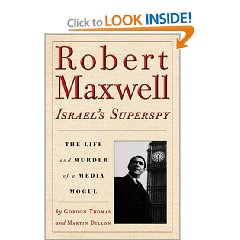
Review: Robert Maxwell, Israel’s Superspy–The Life and Murder of a Media Mogul

5 Star, Crime (Government), Intelligence (Government/Secret), Threats (Emerging & Perennial)
6Shares

Amazon Page
Amazon Page

5.0 out of 5 stars Riveting, Shocking, Eye-Opening, and Credible,

January 23, 2003
Martin Dillon
This book is anything but boring–calling this book boring strikes me as a desperate subterfuge by someone who want to keep its explosive contents from fuller circulation. This book is *fascinating* and explosive, not least because of the very well documented coverage it provides of how Israel's intelligence service, the Mossad, used Robert Maxwell to penetrate not just the U.S. government, including the Department of Justice, the military, and the national laboratories, but many foreign governments including the Chinese, Canadians, Australians, and many others, with substantial penetration of their intelligence service databases, all through his sale of a software called PROMIS that had a back door enabling the Mossad to access everything it touched (in simplistic terms).Also shocking, at least to me, was the extensive detail in this book about how the Israeli intelligence service is able to mobilize Jews everywhere as “sayanim,” volunteer helpers who carry out operational (that is to say, clandestine) support tasks to include spying on their government and business employers, stealing documents, operating safehouses, making pretext calls, and so on. I am a simple person: if you are a Jew and a US citizen, and you do this for the Israeli intelligence service, then you are a traitor, plain and simple. This practice is evidently world-wide, but especially strong in the US and the UK.

The book draws heavily on just a couple of former Israeli intelligence specialists to address Israeli use of assassination as a normal technique (and implicitly raises the possibility that it was used against Senator John Tower, who died in small airplane crash and was the primary “agent” for Maxwell and Israel in getting PROMIS installed for millions of dollars in fees all over the US Government).

Finally, the book has a great deal of detail about the interplay between governments, crime families, Goldman Sachs and other major investors, and independent operators like Robert Maxwell who play fast and loose with their employee pension funds.

This book is not boring. Far from it. It is shocking, and if it is only half-right and half-accurate, that is more than enough to warrant its being read by every American, whatever their faith.

Vote on Review
Vote on Review

Review: National Defense

5 Star, Force Structure (Military), Military & Pentagon Power
0Shares

Amazon Page
Amazon Page

5.0 out of 5 stars Still Relevant Because NOTHING HAS CHANGED,

January 19, 2003
James Fallows
I bought this book, used, after it was recommended as a key source to a just-published book by Robert Coram, “BOYD: The Fighter Pilot Who Changed the Art of War,” which I recommend very strongly, together with this book for historical perspective.Although there may be a few inaccuracies (I did not notice anything substantial) what really matters about this book are two things: the author is a very serious critic with both Public Citizen and Atlantic Monthly credits, and the taxpayer's best interests in mind; and NOTHING HAS CHANGED since this book was published in 1981. If anything, it has gotten worse. One page (43) really jumped out at me, as it contains a chart showing how many planes can be bought for the same amount of money (1000 F-5s, 500 F-4s, 250 F-15s) and then now many sorties per day they can do because of complex logistics and other constraints (2.5/day for F-5's, 1.5 per day for F-4s, 1 per day for F-15s), finally concluding on the “real force” numbers: 2,500 for the F-5, 750 for the F-4, and 250 for the F-15.

As General Wes Clark noted in his book of lessons learned as NATO Commander during the Kosovo crisis (“Waging Modern War”), he found the new USAF airplanes so unresponsive that they needed a full 24 hours notice to shift from one pre-planned task to another.

The author is equally effective in criticizing the Navy for its obsession with carriers and other big ships; and the Army for complex helicopter systems that–as General Clark documents in his book–they are loath to actually use in combat because they might not work as advertised or might be blown out of the sky.

In this book, the author gets the “constants” right, and they are still with us. First, he focuses on the rapidly changing nature of external threats, and the importance of having a military–we do not–that is agile and able to surge in varied directions. The Cold War “one size fits all” military simply will not do….yet the current Administration continues to spend in that direction, with $7 billion for a lunatic anti-missile defense (we would be better off detecting cargo containers with nuclear bombs in them), and another $72 billion for ultra-modern (code for ultra-expensive) weapons systems that a) have not been defined, b) do not provide for the intelligence support needed to make them effective and c) have no connection to the real world of sub-state violence and instability.

The second thing he gets right is the importance of both oil, and instability, as the twin threats to American prosperity–with our over-dependence on cheap oil being a form of Achilles' heel, and our ignorance and tolerance of Arab and other instability and repression being the other side of that same coin.

The third thing he gets right is the need for an independent test authority, because the US military services have proven over and over again that they are corrupt when it comes to weapon acquisition. Whether it is the Navy or the Air Force or the Army is irrelevant–they all fail to do proper requirements analysis and concept development before jumping into bigger more expensive weapons systems that are both not needed for the kinds of threats we have today (America spends as much on national security as the next *twenty* countries, including Russia and China, *combined*), and that do not work as advertised. The taxpayer needs and must demand an Independent Test Authority for all military as well as intelligence systems.

I found this book, and one other, by Paul Seabury and Angelo Codevilla, “WAR: Ends and Means,” to be very helpful starting points in thinking about whether the taxpayer's $500 billion a year that is spent on national defense, is spent wisely. The other two, mentioned above, are the four book beginning to a 100+ book list on making America safe that I will be reviewing here on Amazon over the next 18 months.

Vote on Review
Vote on Review

Review: Selling Out

5 Star, Congress (Failure, Reform), Crime (Corporate), Crime (Government), Culture, Research, Democracy, Impeachment & Treason, Misinformation & Propaganda, Politics, Power (Pathologies & Utilization)
0Shares
Amazon Page
Amazon Page

5.0 out of 5 stars Nitty Gritty, Worth Every Penny to Any Voter,

January 19, 2003

Mark Green

I've chosen this book, together with Michael Moore's “Stupid White Men” and Greg Palast's “The Best Democracy Money Can Buy” to end a lecture I give on the top 50 books every American should read in order to understand why America is not safe today and will not become safe anytime soon, unless the people take back the power and restore common sense to how we spend the $500 billion a year that is now *mis-spent* on the military-industrial complex instead of real capabilities for a real world threat.Mark Green knows as much as anyone could know about the intricate ways in which the existing system provides for *legally* buying elected representatives away from the citizens' best interests. The details he provides in this book–as well as the moderate success stories where reforms have worked–are necessary.The bottom line is clear: until the 60% of America that is eligible to vote but does not vote, comes back into the democracy as active participants who question candidates, vote for candidates, and hold elected representatives accountable *in detail and day to day,* then corporate corruption will continue to rule the roost and will continue to concentrate wealth in the hands of an unreasonably wealthy few at the expense of the general public.

Although I found the book inspiring, I also found it depressing. Absent another 9-11 (or two–or suicidal shooters in an elementary school in every state of the union, or cataclysmic failure in Iraq and North Korea) I see no immediate prospects for America's dropped-out citizens “awakening” and taking back the power. There is still time for corporate money to get smart, pump a little more down to the poor, and avoid a revolution at the polls.

Vote on Review
Vote on Review

Review: Tomorrow Now–Envisioning the Next Fifty Years

5 Star, Future
0Shares

Amazon Page
Amazon Page

5.0 out of 5 stars Some Real Gems,

January 19, 2003
Bruce Sterling
I know and admire the author, whose other non-fiction book, “Hacker Crackdown” was an extraordinary contribution to social understanding, of both the abuse of uninformed government power, and the potential enlightenment that could be achieved by hackers (who are like astronauts, pushing the envelope in cyberspace).This book is uneven. There are some truly brilliant gems, but there is also a lot of rambling, and I fear that the author's brilliance as a science fiction writer may have intimidated the publisher and editor into settling for what they got, instead of what the author is truly capable of producing when diligently managed. However, after thoroughly reviewing the book to write the review, I ended up going for 5 instead of 4 stars because this kind of writing is uncommon and provocative and my lack of patience may be the external limiting factor.

There are a number of gifted turns of phrase and ideas, and so I do recommend this book for purchase, for reading, and for recurring review. The author focuses on generic engineering, imagining an order of magnitude of achievement beyond what is now conceptualized; he properly redefines education in the future as being disconnected from the schools that today are socializing institutions, beating creativity out of children and doing nothing for adults that need to learn, unlearn, and relearn across their lifetimes; he is brilliant in conceptualizing both crime as necessary and exported instability as tacitly deliberate–Africa as the whorehouse and Skid Row of the world; he recognizes oil as the primary source of instability and inequality, sees all politicians as devoid of grand vision (and we would surmise, character as well); he is hugely successful in talking about the mythical “American people” that do not exist, about moral panics after Enron or 9-11 that achieve no true reform; and his focus on the information age basics that make it cheaper to migrate business than people, that make it essential for the Germans to see through Microsoft's insecure code and thus to opt for LINUX or open source code for their military as well as their government systems in general.

He ends brilliantly in conceptualizing a new world order within a new world disorder, in which very rich individuals combine with very poor recruits from a nationless diaspora, a new network that looks like Al Qaeda but has opposite objectives.

In the larger scheme of things, as the author concludes, Earth is debris and the humans are on their way to being the Sixth Extinction. Party while you can.

Vote on Review
Vote on Review

Review: U.S. National Security: A Reference Handbook (Contemporary World Issues)

2 Star, Diplomacy, Intelligence (Government/Secret), Military & Pentagon Power
0Shares

Amazon Page
Amazon Page

2.0 out of 5 stars Lowest Common Denominator–Old Think–High School,

January 14, 2003
Cynthia A. Watson
Although–or perhaps because–the author is a reputable and accepted member of the US national security “club,” and fully capable of writing innovative and ground-breaking materials, this book is horridly old think, even pedestrian, to the point that I was quite disappointed in having spent the time and money on it. The “author” is responsible for just 39 pages of overview, and what a superficial overview it is–without substantive reference to asymmetric warfare, environmental security, public health, or any of a myriad of emerging threats that are vastly more important to the future of US national security that a rehash of the Cold War.The balance of the book is a mind-glazing and largely useless chronology, list of personalities, and list of references and organizations that is both uninspiring, and severely constrained by the US-centric and beltway-centric perspectives of the author. The US Institute of Peace, among many, many other vital organizations, is not listed, and the eight web sites that appear to have been hastily added make a mockery of the concept of a book as a vehicle for imparting information.

With all due respect to the accomplishments and good intentions of the author and the sponsoring publisher, one would be better off browsing Amazon (or to be more specific, the 300+ books on national security and intelligence that I have reviewed) for a couple of hours, than in attempting to find any deep thoughts of lasting value in this reference work. In all respects, it is the lowest common denominator. Instead, I strongly recommend Joe Nye's book on understanding international relations, and the Schultz Godson et al book on security studies.

Vote on Review
Vote on Review

Review: Understanding International Conflicts–An Introduction to Theory and History

5 Star, Atlases & State of the World, Country/Regional, Diplomacy, Games, Models, & Simulations, Intelligence (Public), Peace, Poverty, & Middle Class, Terrorism & Jihad, Threats (Emerging & Perennial)
0Shares

Amazon Page
Amazon Page

5.0 out of 5 stars Superb, Post 9-11 Update, Excellent Adult Foundation,

January 10, 2003
Joseph S. Nye
First, it is vital for prospective buyers to understand that the existing reviews are three years out of date–this is a five-star tutorial on international relations that has been most recently updated after 9-11. If I were to recommend only two books on international relations, for any adult including nominally sophisticated world travelers, this would be the first book; the second would be Shultz, Godson, & Quester's wonderful edited work, “Security Studies for the 21st Century.”I really want to stress the utility of this work to adults, including those like myself who earned a couple of graduate degrees in the last century (smile). I was surprised to find no mention of the author's stellar service as Chairman of the National Intelligence Council–not only has he had full access to everything that can be known by secret as well as non-secret means, but he has kept current, and this undergraduate and affordable paperback was a great way for me–despite the 400+ books I've read (most of them reviewed on Amazon.com) in the past four plus years–to come up to speed on the rigorous methodical scholarly understanding of both historical and current theories and practices in international relations. This book is worth anyone's time, no matter how experienced or educated.

Each chapter has a very satisfactory mix of figures, maps, chronologies, and photos–a special value is a block chart showing the causes for major wars or periods of conflict at the three levels of analysis–international system, national, and key individual personalities, and I found these quite original and helpful.

Excellent reference and orientation work. Took five hours to read, with annotation–this is not a mind-glazer, it's a mind-exerciser.

Vote on Review
Vote on Review