Reference: Personal Aggregate, Filter & Connect Strategies

Blog Wisdom, Collective Intelligence, Communities of Practice

Full Reference Online

Personal Aggregate, Filter & Connect Strategies

by Jeff Jarvis

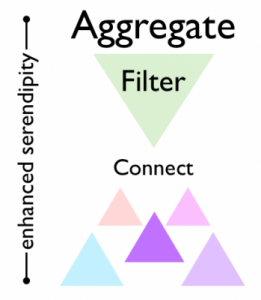
A while back my PhD student Sam and I were talking, and he asked me about my RSS feed. His question was something along the lines of ‘what blogs would I have to read if I wanted to be able to make the connections that you do on your blog?’ As we talked, I realised that it didn’t matter if I gave anyone else my exact RSS feed, they wouldn’t be able to replicate my blog – and the reason for this is aggregate, filter and connect.

When I first thought about aggregate, filter and connect as a framework, it was in an attempt to explain why Amazon’s business model worked better than that of other online bookstores. The first time I talked about it in public, it was to explain how open education might work. I’ve been working on making it in to a general model of how we create something unique when we’re primarily dealing with information.

As such, it can be used to explain business models, like Amazon’s, or blogs, like mine. The more I’ve talked about the model, the more other people are picking it up, which is great. Some of these recent discusssions have gotten me thinking about how aggregate, filter and connect works at a personal level. This was really Sam’s question. I’ve talked about how Charles Darwin basically used an aggregate, filter and connect strategy, Phil Long talks about it as part of personal knowledge management, Harold Jarche has discussed it as both a general model for business and for personal knowledge management (an idea that Jack Vinson picked up, and connected to the concept of enhanced serendipity from Ross Dawson), and Glenn Wiebe used the framework to discuss both Joseph Priestly’s inventions and teaching. So we’re starting to get a bit of discussion Today I’d like to illustrate the concept by discussing how I use it.

Phi Beta Iota: Full reading recommended!  These folks are redefining both the meaning and the practice of being in harmony with reality, with others, and with relevant information.

Reference: How to Use Twitter to Build Intelligence

Blog Wisdom, Collective Intelligence, Communities of Practice
Venessa Miemis

emergent by design

2009 December 21

by Venessa Miemis

1. What is Twitter?

Getting started on Twitter is like walking into a crowded room blindfolded: you know there’s somebody out there, but you’re not quite sure who they are, where they are, or why you should care.

Full Story Online

My initial Twitter experience was kind of like this: The 46 Stages of Twitter (here’s the educator’s version)

After digging deeper, I started to see patterns in the way information was traveling, and in the connections between the people I was following. Based on those observations, this is my current opinion:

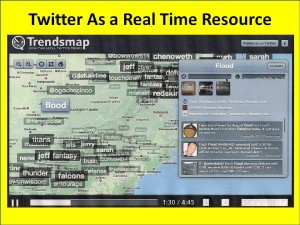
Twitter is a massive Idea & Information Exchange.

Granted, there is a TON of noise. I’m not suggesting that Twitter is a utopia where it’s possible to get 100% pure relevant content to what you want to know all the time. BUT, there is a tremendous wealth of information and human capital out there that is certainly worth exploring. Businesses are finding it’s useful for interacting with customers and gauging public opinion, educators are collaborating with one another and integrating it into their “personal learning networks (PLNs),” and individuals are using it to find out more about specific interest areas.

I read a piece recently by Howard Rheingold titled Twitter Literacy, in which he said:

Twitter is not a community, but its an ecology in which communities can emerge.

Phi Beta Iota: Tip of the hat to  Who’s Who in Collective Intelligence: Pierre Levy for the tip-off.  As Haiti demonstrated recently, Twitter was the only intelligence-communications system that worked in the first hours and days, followed by texting.  The US Embassy and CIA fired blanks.  See Journal: Haiti Rolling Directory from 12 January 2010.

Journal: Politics of Fear–Spending on National Insecurity

10 Security, Analysis, Budgets & Funding, Collective Intelligence, Military, Peace Intelligence, Reform, Threats
Chuck Spinney

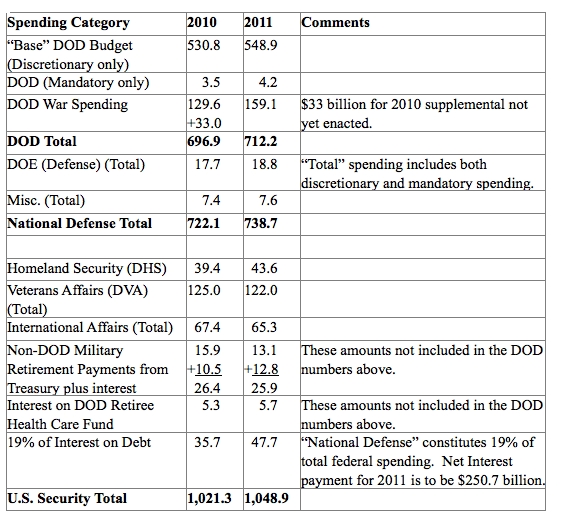
Answer: It all depends on what you think should be included, but once this is clear — this spending will be be exempt from any cutbacks needed to reduce the deficit.

The Table prepared by Winslow Wheeler, Director, Straus Military Reform Project within the Center for Defense Information.

Chuck

Winslow Wheeler, Straus Military Reform Project.

Worth a Look: GeoChat (SMS Plotted on Map)

Collective Intelligence, Communities of Practice, Geospatial, Mobile, Peace Intelligence, Policies, Real Time, Technologies, Threats, Tools, Worth A Look
Collaboration Tool

GeoChat emerged from a simple concept – can I send an SMS message and see it on a map?

From there the concept has evolved, and geochat has become a project to build a collaboration platform from the lowest common denominator communication tools, considering as highest priorities the needs of workers of humanitarian aid, international health and disaster response.

The main drivers for the project are the feedback of the InSTEDD programs in South East Asia, exercises such as GoldenShadow, and a growing community of humanitarian and health workers who spend their days in technologically austere environments. We invite anyone from any line of work to use and contribute user experience, technical, and any other kind of feedback.

Phi Beta Iota: InSTEDD [Innovative Support to Emergencies Diseases Disasters] is blessed with the participation of Cdr Eric Rasmussen, USN, a co-founder of STRONG ANGEL which has been allowed to die for all the wrong reasons.  He and Dr. Dr. Dave Warner are pioneers in M4IS2 [Multinational Multiagency Multidisciplinary Multidomain Information-Sharing and Sense-Making.]  See also UNICEF's RapidSMS.

Event: 16-18 July 2010 NYC NY The Next Hope

Collective Intelligence, Communities of Practice, Computer/online security, Cultural Intelligence, Ethics, Geospatial, InfoOps (IO), Key Players, Methods & Process, Mobile, Policies, Real Time, Strategy, Technologies, Threats, Tools

HACKERS ON PLANET EARTH (HOPE)

The Next Hope (2010)

Pre-Registration Now Open

Call for Speakers

Links to Past HOPE Events

Phi Beta Iota: Hackers are like astronauts, pushing the bleeding edge of the envelope.  If the US Government had listened to us in 1991-1994, cyberspace would be secure today, and we would not be spending $12 billion a year on the cyber-scam game–outsourcing to beltway bandits fighting for the 100 folks that actually know how to do this stuff and can qualify for clearances.  Our solution for the regional networks is gong to be multinational and open everything.  This event is specifically recommended for young teens who show signs of intelligence and curiosity, and for mid-career officers beginning to realize that 80% of what they do is without merit, seeking a better way.  This is where we do the right things righter, not the wrong things righter.
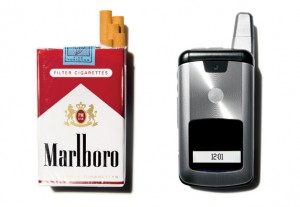
Photo Gallery (Yahoo) Photo Gallery (Google)

See also:

Continue reading “Event: 16-18 July 2010 NYC NY The Next Hope”

Journal: Europe is Reading…

Collective Intelligence

NeoOpticon: the EU Security-Industrial Complex (Transnational Institute)

As the title communicates.

Prevention of WMD Proliferation and Terrorism Report Card (WMD Commission)

Failing grade in isolation from all the more pressing threats (poverty, disease, environment).

Al Qaeda Weapons of Mass Destruction Threat: Hype or Reality? (Harvard)

More focus on the symptom instead of the problem (US virtual invasion of Middile East)

Continue reading “Journal: Europe is Reading…”

Journal: Cellphones, Your Brain, and Spectrum

Civil Society, Collective Intelligence, Commerce, Commercial Intelligence, Ethics, Government, Technologies, Tools
Full Story Online

Warning: Your Cell Phone May Be Hazardous to Your Health (GQ)

Christopher Ketcham
Ever worry that that gadget you spend hours holding next to your head might be damaging your brain? Well, the evidence is starting to pour in, and it's not pretty. So why isn't anyone in America doing anything about it?

Phi Beta Iota: This is “old” news that is still news because neither the government nor the public actually pay attention.  We've known since the 1980's that Soviet emission controls were ten times tougher than ours, and now in Afghanistan as we find UAVs and all other devices conflicting with each other across old “dumb” (assigned) spectrum, we are learning, AGAIN, why spectrum consciousness matters.  Open Spectrum and smart devices are the way to go, along with public truth-telling about electromagnetic emissions as part of the “true cost” of all devices.

noble gold