Basically, the bill eliminates most of the legal barriers (restriction on the number of investors, the type of investors, etc.) to raising small amounts (
Of course, this new capability (if it passes) is going to be abused (bucket shops across the country are gearing up in anticipation). However, most of that will be sorted out in time.
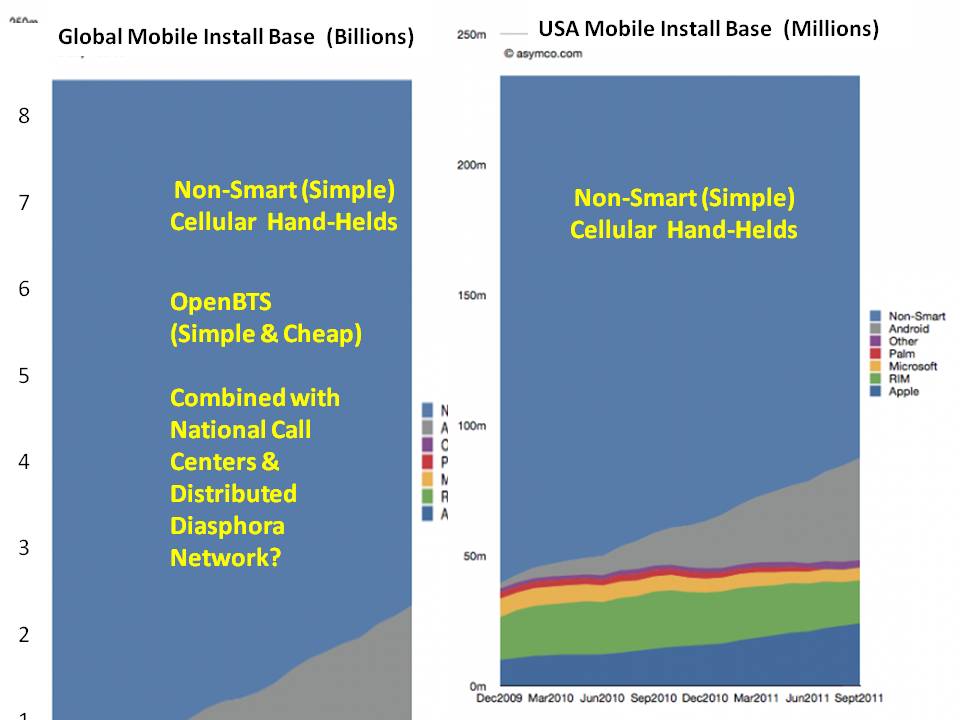
Phi Beta Iota: Disintermediation is proceeding apace. The big challenge right now is that it is still turgidly centered on the one billion rich with one trillion a year in income — until OpenBTS and free cell phone service / free access to the Internet reach the five billion poor with their four trillion a year in income, the current economic malaise will persist.
Note: Use Google translate for a readable but ugly English version that in some cases flips meaning. Where the French is translated as “bastard” the original English quote offered up “runt.”
Les espions s’ouvrent au public
OWNI France, 10 novembre 2011
Au début du mois et pour la première fois de son histoire, la CIA a ouvert les portes de son centre dédié à l’étude des sources ouvertes, localisé en Virginie. Seule invitée, la journaliste d’Associated Press, Kimberly Dozier. Elle a ainsi pu décrire [en] le fonctionnement de l’Open Source Center (OSC)[en], et de ses activités depuis 2005 consistant à analyser en profondeur “les sources ouvertes”.
1. Decline of the United States
2. Cyber Threats
3. Fiscal Sustainability
4. Transnational Organized Crime
5. Environmental Degradation and Resource Scarcity
6. Energy Crisis
7. Global Pandemic
How can you help your community build a resilient energy system? One of the first steps is to buy back the energy system from the regional power company by condemning it and then municipalizing it (it can be run as a power co-op or as a standard company … The structure really depends on the community.). This moves provides you with the control of the local grid so that your community can:
Ensure higher levels of maintenance (tree trimming, etc.) and faster response to failure. During the two big power outages on the east coast this summer/fall, power was out for much of the region for nearly a week. In many cases, the municipal power companies get power back on to all of their customers in 1/2 the time of the big regional companies.
Cut rates and change energy mix. As a municipal company, you can select the different types of energy you will use locally.
Add advanced micro-grid features. Everything from community energy markets to local energy backup to power smoothing. Extra benefit of this approach: it will prevent the regional power company from using smart grid tech to snoop on everyone in the community by micro-analyzing energy use (which they will then resell to marketing companies or provide to the government w/o warrant for “signature” sniffing).
All of the benefits listed above will double or treble in importance as the global economy nose dives into depression over the next couple of years. So, it's better to get started early than later.
Here's a few links from the Boulder Colorado effort to condemn and municipalize it's power. A combo of bad service and a low level of renewables use prompted the effort (use whatever hooks you need to get it done, but get it done):
Citizen groups do the hard work. A technical group does the modelling and analysis for a municipal grid. They compare rates, costs, and energy mix Here's an amazingly video of a member of that team, Sam Weaver.
Homer software. The software you need to model a municipal grid from rate analysis to energy mix. The numbers.
NOTE: Great article in the NYTimes today on how the big regional companies are so focused on acquisitions, regulatory gaming, and extractative finance; they are delivering terrible service.
NOTE: Great pushback in the comments on how tough it is to do this. Basically, crony capitalism (revolving door, bribes, etc.) + regulatory capture (same mindset) + gov't granted monopoly = lots of opposition.