Ten days into the uprising in Benghazi, Libya, the United Nations’ Human Rights Council established the International Commission of Inquiry on Libya. The purpose of the Commission was to “investigate all alleged violations of international human rights law in Libya.” The broad agenda was to establish the facts of the violations and crimes and to take such actions as to hold the identified perpetrators accountable. On June 15, the Commission presented its first report to the Council. This report was provisional, since the conflict was still ongoing and access to the country was minimal. The June report was no more conclusive than the work of the human rights non-governmental organizations (such as Amnesty International and Human Rights Watch). In some instances, the work of investigators for these NGOs (such as Donatella Rovera of Amnesty) was of higher quality than that of the Commission.
Due to the uncompleted war and then the unsettled security state in the country in its aftermath, the Commission did not return to the field till October 2011, and did not begin any real investigation before December 2011. On March 2, 2012, the Commission finally produced a two hundred-page document that was presented to the Human Rights Council in Geneva. Little fanfare greeted this report’s publication, and the HRC’s deliberation on it was equally restrained.
Nonetheless, the report is fairly revelatory, making two important points:
Some important connections drawn between aid, corruption, and positive change; and also important omissions — conflicts out of the news where paying attention could make a difference.
A popular method for identifying which conflicts necessitate more attention from the international community is to estimate the difference between supply and demand of humanitarian assistance in these conflicts. Supply and demand, however, are very hard to measure in emergencies. This has led to the development of several indicators used to measure ‘forgotten conflicts’.
These indicators are often applied on an annual basis and are intended to generate media attention (to increase donations) and/or support donor operations (to comply with impartiality). Have these efforts been successful? Have they effectively singled out and buttressed forgotten conflicts? Looking back on the past decade, in this blog post I’ll assess which conflicts received the least (and most) attention from international actors.
Date & Time:
Tuesday, March 20th, 2012
12:00 – 1:30 p.m.
How should the United States deal with the jihadist challenge and other religious imperatives that permeate today's geopolitical landscape? Religion, Terror, and Error: U.S. Foreign Policy and the Challenge of Spiritual Engagement argues that what is required is a longer‐term strategy of cultural engagement, backed by a deeper understanding of how others view the world and what important to them. The means by which that can be accomplished are the subject of this book.
This work achieves three important goals. It shows how religious considerations can be incorporated into the practice of U.S. foreign policy; offers a successor to the rational‐actor model of decision‐making that has heretofore excluded “irrational” factors like religion; and suggests a new paradigm for U.S. leadership in anticipation of tomorrow's multipolar world. In describing how the United States should realign itself to deal more effectively with the causal factors underlying religious extremism, this innovative treatise explains how existing capabilities can be redirected to respond to the challenge and identifies additional capabilities that will be needed to complete the task.
Syria: Deputy Oil Minister Abdo Hussameddin announced his resignation and departure from the Ba'ath Party to side with the opposition against President Al-Asad's regime. If confirmed, he would be the highest-ranking official to defect, and the third member of the administration to do so. A video of his declaration was posted on YouTube and repeated around the world.
Comment: Most news outlets reported this man as the highest-level official to defect, which means very little. A lengthy search showed the man was a Baath Party member for a long time, but failed to discover whether the defector was a Christian, Druze, Sunni, Alawite or member of another group. The implications of the defection hinge largely on details not available in the public domain.
Syria celebrated the 49th anniversary of the Syrian coup by Hafez al-Asad on 8 March 1963. Revolution Day is 8 March.
Correction: The place names cited by the Red Crescent official and reported in the 7 March edition of NightWatch are governates, not cities and towns. Syria has 14 governates – often translated as provinces – which administer 61 districts.
It is important to enter an instability problem at the right level, meaning at the level of political organization that provides diagnostic and prognostic results. The international press persists in describing unrest in terms of governates. Entering the instability problem at this level results in distorted narratives and exaggerated reports about the strength of the opposition and the weakness of the government.
Readers are justified in wondering why the government in Damascus has not collapsed. The reason is that the government is not now and has never been threatened by a governate-level insurrection. The fight is in local neighborhoods and most are on the political or geographic periphery of the governates, posing little threat to central authority.
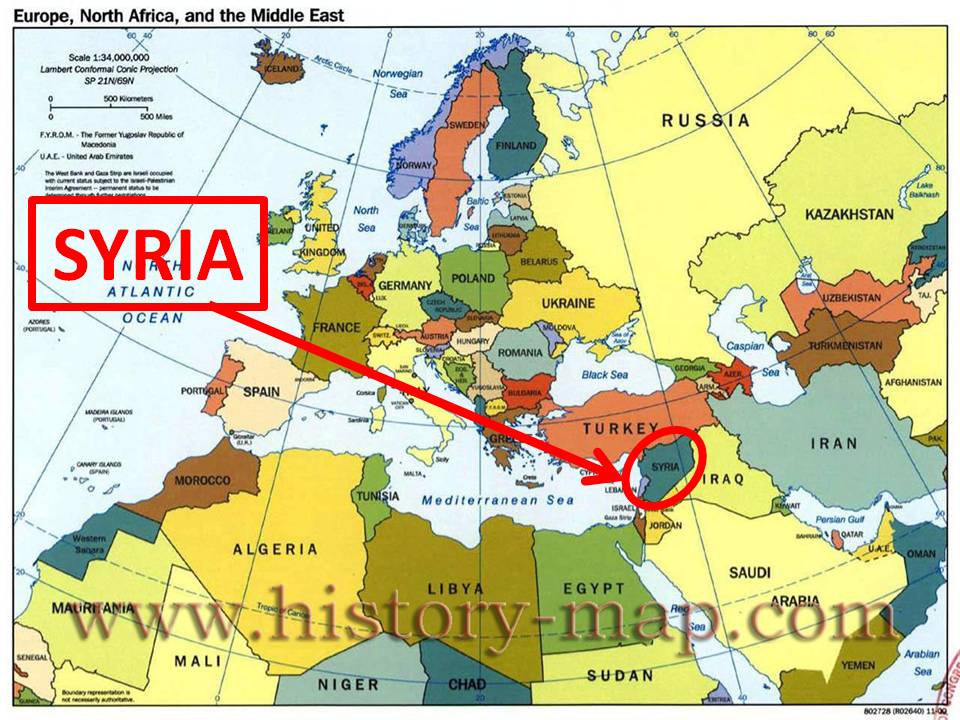
Syria is about the size of North Dakota, according to the CIA World Factbook, with a few differences. Syria has 61 districts which more or less correspond to North Dakota's 53 counties. North Dakota's counties, however, are not organized into governates or provinces.
Syria supports more than 22.5 million people in the same space that North Dakota supports just under 700,000, but with a lot less water. North Dakota has no cities as populous as Syria's Homs which contains over a million people. North Dakota has no sea ports or borders with hostile enemy states.
NightWatch has sought to enter the Syrian instability problem at the district or sub-district level so as to guard against bias and get finer ground truth granularity about just what is happening in Syrian neighborhoods.
For example, a careful survey shows that today the Free Syrian Army and its supporting web sites posted situation reports indicating that this force engaged in six operations in five different governates on 7 March. Several were exchanges of gunfire in which no one was injured and one was erection of a roadblock, in a territory the size of North Dakota.
This data supports leaked information attributed to US intelligence persons that there isn't much of a Free Syrian Army. There is unrest in Syria, but there really isn't much of an insurgency. For the purposes of comparison, in Iraq in 2006, more than 300 firefights occurred daily. In Afghanistan last spring, there were around 50 firefights daily and hundreds of incidents involving makeshift explosives.
Syrian security forces were busy. Opposition sources reported dozens of activities in nine of the 14 governates. A closer look showed that the activities were concentrated in about a dozen of the 61 districts.
Nine governates sounds like a big insurrection. Unrest in 12 districts presents a far more manageable security problem than nine governates supposedly out of control, but in fact not. No governates are out of control and apparently neither are any of the 61 districts.
A still finer focus showed that most of the opposition activities were small, brief street demonstrations (which were not further defined), according to the opposition's own postings. There were no clashes except as noted above; no bombings and no terror attacks on 7 March.
Most of the government operations were local neighborhood sweeps that encountered no resistance. Other reported government actions included over flights of aircraft, some vague armor movements and shelling. The opposition sources that posted the reports were not careful to distinguish whether the operations were by law enforcement and police personnel, paramilitary militias or the Syrian armed forces. Most were attributed to “thugs,” which suggests the paramilitary militias.
Unfortunately the sources also were not specific about which sub-districts or neighborhoods were under stress from government operations. Each of the 61 Syrian districts has multiple sub-districts what are called, nawahi. It is not yet possible to track activity at the nawahi level, but it would show a more fine grained definition of the status of the instability problem in Syria.
Phi Beta Iota: CNN and BBC both appear to be taking direction from US covert operations / media influence staffs. Both appear unintelligent and dishonest. We hold NIGHTWATCH and its editor in the highest regard, consistently superior to the larger organizations that lack both intelligence and integrity. We note with interest that the Syrian Diaspora and the crisis mapping communities are relatively silent on this matter.
Europe's World is proud to be a partner of the 2012 Security Jam, a massive online brainstorm from 19 – 23 March 2012, bringing together thousands around the world to find concrete solutions to global security issues, and encourages you to register now to interact with VIPs such as Adm. James Stavridis, NATO SACEUR; Csaba Hende, Hungarian Minister of Defence; David Heyman, US DHS Assistant Secretary for Policy; Maciej Popowski, EEAS Deputy Secretary General for Inter-institutional Affairs; Claude-France Arnould, EDA Chief Executive; Gen. Stéphane Abrial, NATO SACT and thousands of experts from the broadest possible security and defence spectrum. Registration is free of charge and takes just a minute.
Syria- Arab Red Crescent: Over the past few days, the Syrian Arab Red Crescent has distributed aid provided by the ICRC to the Bab Amr district of Homs, to Hama, Idlib, Deraa, rural Damascus and the eastern city of Raqqa, a spokesman said. “The situation as we see it today is that unrest is still taking place mainly in Hama, Deraa, Rural Damascus, Homs and Idlib,” Hassan said.
Opposition spokespeople said fighting was continuing in Homs, but a Red Crescent spokesman said that it was not. The Red Crescent teams found that the population had evacuated the Baba Amr district of Homs and the rest of the city was quiet.
Comment: The arrival of Red Crescent teams has provided some much needed ground truth reporting. The fighting in Homs has been concentrated in the Baba Amr district, which the government seized, but the residents apparently had already left along with the fighters. It remains difficult to develop a relatively unbiased view of the struggle. The Red Crescent statements suggest actual confrontations are occuring in neighborhoods of five towns and cities. That is far more limited than international media suggest.
Syria-UK: British Prime Minister David Cameron told a hearing at the House of Commons Liaison Committee on 6 March that his government provided cash and equipment to foreign-backed rebels in Syria under such names as “aid agencies” operating on the ground to help deliver food and emergency medical supplies, Press TV reported.
Comment: Cameron's admission in conjunction with the capture of the 13 French officers tends to confirm the Syrian government's consistent contention that the opposition is made up of outside troublemakers. The Syrian situation in no way resembles Libya and accurate information is just not available, except one fact. There are no significant and sustained operations in Damascus. Until they occur, the regime will survive.
Brought forward from 22 December 2011 because of mention of Vice Presidential option for Mitt Romney (or Jeb Bush if the brokered convention takes place as many have suggested is planned).
Phi Beta Iota: Three observations must be made here. The first is that that intelligence was not faulty — Charlie Allen got it right with line crossers and the debriefing of the defecting son-in-law. George Tenet prostituted his office and betrayed the public trust. The second is that the book does not do justice to Dick Cheney and his shadow government behind the President's back. Finally, the third observation, that no secretary of state in recent memory seems to have a strategic analytic model or the ability to actually address the ten high-level threats to humanity. They are, instead, in the immortal words of Madeline Albright (we do not make this stuff up), “a gerbil on a wheel.” We can do better. A good start would be a foreign policy of peace, commerce, and friendship, a rejection of secret agendas, and a pursuit of a prosperous world at peace — a world that works for all. Anything less is, in our collective view, a betrayal of the public trust.