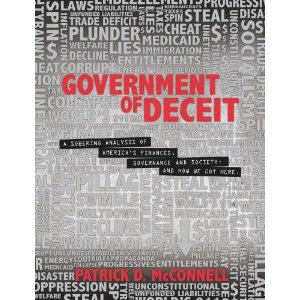
It is a question asked repeatedly across America: why, in the aftermath of a financial mess that generated hundreds of billions in losses, have no high-profile participants in the disaster been prosecuted?
To me the moral of this story is that Washington has created a vast immoral hazard. We are all truly in a world of peril when regulators and law enforcers believe our financial institutions are too big to be brought to justice—and when our leadership in Washington is so gutless that its response is to let these same institutions emerge bigger and more beyond challenge than ever.
Tip of the Hat to Lynn Wheeler at LinkedIn for the clean links.
Phi Beta Iota: It is our view that the President, the Attorney General, the Secretary of the Treasury, and most Senators and Representatives are immediately impeachable for failing to uphold their oaths to the Constitution and failing to represent the public interest in the face of massive legalized fraud on the part of Wall Street.
What’s the difference between Barry Bonds and Goldman Sachs executives? The later was fortunate enough to be questioned by incompetent lawmakers while Bonds ended up in a courthouse with an actual jury and prosecutors.
. . . . . .
“The Goldman guys may have worse batting average than Barry Bonds but they were better educated by their lawyers about they should shouldn’t say. They also had the benefit of being questioned by incompetent people who had no idea about the financial nomenclature at the heart of their allegations,” Singer says.
WASHINGTON — When Eric Smith, 26, returned home after his second tour in Iraq serving as a Navy medic, he didn't expect to have a difficult time finding work.
While on tour, Smith had worked as a physician's assistant in the intensive care unit (ICU), caring for patients undergoing everything from cancer to recent brain surgery. At times, he served on the front lines treating infections. He never thought the expertise he had developed in the field wouldn’t amount to a job back home — but when he returned he found that he couldn't get a job in medicine without the right certifications.
• The “entitlement programs” have an unfunded liability of greater than $104 trillion. Your share is $367,000. (Every man, woman and child owes the same.)
• At the end of 2009, $3.2 trillion of the $12.9 trillion National Debt was spent, but never on the government's general budget. Where did 3.2 Trillion dollars go?
• In 2010, the federal government is borrowing 52 cents of every dollar that it spends on general operations. Just to balance the budget, spending will have to be cut by 52%.
• Over the next four years, the federal government needs to borrow at least $3.9 trillion and the world is basically running out of money for us.
Washington, meanwhile, doesn't want to sound the economic alarm. The White House and most Democrats want Americans to believe the economy is on an upswing.
Republicans, for their part, worry that if they tell it like it is Americans will want government to do more rather than less. They'd rather not talk about jobs and wages, and put the focus instead on deficit reduction (or spread the lie that by reducing the deficit we'll get more jobs and higher wages).
I believe the Bowles Simpson recommendations represent, to too large an extent, a set of unprincipled political compromises that would lead to a weaker America — with slower growth and a more divided society.
We now have an economy in which five banks control over 50 percent of the entire banking industry, four or five corporations own most of the mainstream media, and the top one percent of families hold a greater share of the nation’s wealth than any time since 1930. This sort of concentration of wealth and power is a classic setup for the failure of a democratic republic and the stifling of organic economic growth.
The government has nearly convinced the public they have everything under control, when that’s far from the case. In fact, everything could go downhill fast. Here are ten all-too-likely scenarios I look at in my book, It Takes a Pillage:
1. The actual bailout has quietly ballooned to $16 trillion dollars (not including over $3 trillion set aside for money market funds), most of it given out with no strings attached. Wall Street firms could continue to tout the myth that ‘talent’ must be paid for – now with stupid sums of bonus money, funded by the American People.
2. The stock market, which has rallied substantially since the government started giving out free money to the banking industry, could tank on the realization that if that money needed to be paid back any time soon, the banks wouldn’t be good for it.
3. Because bigger is better still seems to be Fed policy, JPM Chase could acquire Bank of America – Merrill Lynch, creating one of the largest, federally subsidized banking firms in the world.
4. Because the bigger just can’t help getting badder, JPM Chase could also acquire Citigroup, and we’d be living with a monopoly economy.
5. We could sink into the delusion that the Obama administration has actually done something to restrain Wall Street, lulling us into a false sense of security. Then the remaining big banks will screw us again.
6. Congress could continue to ignore history and never reinstate the Glass-Steagall Act. That act made banks smaller, more specialized, easier to regulate and less expensive to bail out. Repealing it lead to this mess, and there’s barely a whisper heard in Washington of bringing it back.
7. As a Fed approved bank holding company, Goldman Sachs could buy a lot of small banks just to get access to all the money in savings and checking accounts to gamble with. Plus they’d have that great $250,000 FDIC guarantee they get per account. This would make them the biggest bank in the country.
8. Every bank and government agency with access to some aspect of a federal bailout could max out their subsidies chips at once – pushing the full bailout cost to over $26 trillion.
9. Many mid-sized and smaller banks didn’t need a bailout and have been better at allowing consumers access to credit. The largest banks, flush with federal funding and a poor record of helping average Americans, could buy them all up.
10. The Fed could continue to operate in secrecy, despite multiple moves by Congress to push for a full audit of its largesse. Right now, only the Fed knows what the real worst case scenarios might actually be.
Iowa and Florida are considering bills that make it illegal to film or photograph inside factory farms without permission. Are the CAFOs afraid their unhealthy conditions and animal cruelty will be exposed? Help us put a stop to this madness!
Two weeks ago we reported on the way the FDA is blocking journalistic freedom of speech through the information embargoes they impose. Freedom of speech is taking another hit, this time from state legislatures. Read more….
Phi Beta Iota: It appears that some governments now believe that they have a right to legislate the censorship of truth. Arsenic and antibiotics and other toxins associated with the industrialization of agriculture are a major cause of human illness, deformity, allergies, and other unnatural conditions. This is all part of the “true cost” paradigm for the redesign of society to emphasize the wellness of humans and the sustainability of the Earth. Governments so foolish as to deny that the truth at any cost reduces all other costs should be voted out of office or ignored. Truth is a public power, a public good, and a public right.
This how the influencers are influenced to justify to the “prol's that rule of law properly means nothing. All in place before Obama sent in Special ops and claimed that there were no boots on the ground.
It is not just Libya that now risks long-term division. Telltale signs of fragmentation in the international community’s approach are opening up. Not for the first time Muammer Gaddafi may be on the verge of securing a public relations coup against his western opponents. Now we must declare humanitarian victory, and regroup.
Tuesday’s London conference was a confused affair. The Germans and the Italians touted a ceasefire and exile for Colonel Gaddafi. Others, notably Saudi Arabia and the African Union, stayed away. The US and the UK, meanwhile, insisted the military job was not done, with David Cameron, the UK prime minister, noting on Wednesday that UN Security Council resolution 1973 might give the allies a legal basis to arm the Libyan opposition.
Forget U.N. resolutions! After decades of Gaddafi's deadly attacks and his support for terrorist groups across the world, America has every right to seek revenge, says Andrew Roberts.
In all the discussion of where, if anywhere, American strategic interests lie in regard to Libya, one very obvious motivation for U.S. action seems to be being ignored: Vengeance. Yet the certain knowledge that the West will eventually take revenge for terrorist crimes committed even as long ago as the 1970s and 1980s is itself a vital strategic interest. Rogue states must always know that there is no such thing as a statute of limitations on murder, and that even after four decades, the slate has not been wiped clean.
I don't think this is so much about Google as it is about fostering innovation and good overall business practices, taken from the standpoint of a former Google employee.
There are many good nuggets in here — my favorite being the “NIH” (Not Invented Here) Syndrome and the like.
I worked at Google from 2005-2010, and saw the company go through many changes, and a huge increase in staff. Most importantly, I saw the company go from a place where engineers were seen as violent disruptors and innovators, to a place where doing things “The Google Way” was king, and where thinking outside the box was discouraged and even chastised. So, here’s a quick list of things I think Larry could do to bring the startup feel back to Google:
Phi Beta Iota: The post is not only credible, but the comments are spectacularly reinforcing. It is also with sadness that we observe how quickly Google acquired all of the bad habits of its start-up funding partner and continuing co-conspirator in institutionalized ineptitude, the US secret intelligence community. We continue to emphasize that Corruption–and Integrity–are about much more than individual honor or good intent–they are systemic. Corrupt feedback–and losses of integrity in small things–are cumulative.