Cynthia McKinney: Don DeBar With Truth on Libya

03 Economy, 04 Inter-State Conflict, 05 Civil War, 06 Genocide, 07 Other Atrocities, 08 Wild Cards, 09 Terrorism, 10 Security, 10 Transnational Crime, 11 Society, Articles & Chapters, Civil Society, Commerce, Corruption, Cultural Intelligence, Government, IO Deeds of War, Media, Military
Cynthia McKinney

Don DeBar has been instrumental in sharing the truth on Libya.  Here is his latest interview.

BSNews interviews Don DeBar

Don DeBar is an independent journalist who has recently travelled to Libya before the NATO invasion. BSNews emailed him some questions regarding the conflict.

1/  We know that the intervention in Libya was not humanitarian – some suggest oil others, including Ellen Brown, have suggested it was more to do with money and central banking. Do you have a theory on the real reasons for the invasion?

Don DeBar, Morning News Headlines Editor-in-Exile

There is first and foremost the geopolitical consideration – that the US and EU are determined to take direct control of Africa's resources. Libya was – and, thus far, remains – the single largest impediment to this effort, with Gadhaffi personally being the single human being who is the largest obstacle.

Begin with the fact that one of Gadhaffi's first acts after deposing the western puppet King Idris was to evict the US from its only military base on the continent. This act, taken four decades ago, left the US in the position of having to base its AFRICOM force, established in October, 2008, in Stuttgart, Germany, laying bare the nature of this “alliance.”

More immediately, in terms of geopolitical irritations, Libya has heavily invested in African infrastructure, such as telecom system construction, an African satellite, and other communications projects. The revenue which now stays in Africa – hundreds of millions of dollars a month – comes directly out of the pockets of US, EU and other global telecom companies, a trend that is in exactly the opposite direction sought by US/EU power elites.

Even more to the point is that Gadhaffi has been pushing for – and funding the enabling of – an independent and united African economic entity that could rival the EU and other global economic powers. Among the tasks underway at the time of the invasion was the creation of an African sovereign bank and an African currency printed in Africa under African control. This would wrest control over African resources from the French and others whose power to print African currency translates into economic and, ultimately, political control.

One more extremely important point: Libya since 1969 has offered an economic and political model to Africans and others suffering colonial control that stands in stark contrast to the models of such as Nigeria and South Africa. The country's natural wealth has been directly applied to the economic needs of the population, with the result that every Libyan owns their home – without mortgage encumbrance or rent or property tax burdens; a first-rate health care system was built and operated that is free and available to all; a first-rate education system was built and operated through the post-graduate level that is free and available to all; the oil revenues are distributed to the people in the form of a monthly stipend in the thousands of dollars; and public infrastructure – such as roads, water systems, electricity, etc., were constructed and operated efficiently and made available to all.

So the threat is a.) a plan to democratize control of Africa's wealth and b.) a successful example of doing this in Libya, demonstrating that it is possible and offering a “how-to” model to the people of the continent. A serious threat to colonial ambition that is perhaps unmatched in the world at present.


Chuck Spinney: Remaking the Arab State w/o the US

08 Wild Cards, Civil Society, Counter-Oppression/Counter-Dictatorship Practices, Cultural Intelligence, Government, Peace Intelligence
Chuck Spinney

A good summary of the Arab Revolt and explanation of why the West ought to let Arabs sort out things for themselves

Remaking the Arab State

by Patrick Seale

Agence Global, 30 Aug 2011

The Arabs face a formidable task — nothing less than rebuilding the entire state structure and system of government in countries as diverse as Tunisia and Egypt, Libya and Yemen. In Syria, too, the Ba‘thist state is almost certainly doomed, whether President Bashar al-Asad survives at its head or not. It has lasted 48 years, ever since the Ba‘th party seized power in 1963. If it is to outlast the present uprising, it would need to be profoundly recast and remade in order to accommodate several neglected forces in Syrian society — sects, ethnicities, tribes, disgruntled intellectuals and the rural poor among others.

What form of government will replace the rickety Arab structures, some of which have already been brought down it, while others are still fighting to survive? What state structures will replace the old autocracies, with their bankrupt one-party rule and their all-powerful military and security apparatus? This is the key question posed by events not only in Damascus, but also in Tunis, Cairo, Tripoli and Sanaa. This is the great unknown.

The monarchies of the Arabian Peninsula (with the exception of Bahrain) stand out as islands of relative stability in the current upheaval — possibly the most radical since the fall of the Ottoman Empire. They are protected by their oil wealth, but not by that alone.

Modernised and reformed over the years, their traditional systems of government have, in most cases, proved responsive to the needs of their citizens. They have provided reasonably good governance, whether in the United Arab Emirates or Qatar, in Kuwait or Oman, or indeed in Saudi Arabia itself, the dominant power in the Peninsula. Good governance would seem to be the secret of their continued legitimacy.

We all know — because it has been said so often — that the revolutionaries of the Arab Spring want social justice, jobs, freedom from police brutality and arbitrary arrest, a chance to advance in life, better prospects for themselves and their families, a fairer distribution of their country’s resources, an end to corruption by a privileged elite, dignity and respect from their rulers. In a word, good governance.

That, above all, is what the Arab world would seem to want, rather than democracy on the Western model, of which the Arabs have had little experience; and for which they have little appetite, if it means any form of Western tutelage.

Read rest of article….

Penguin: MI5 Former Chief Slams War on Terror

04 Inter-State Conflict, 05 Civil War, 09 Terrorism, Advanced Cyber/IO, Cultural Intelligence, Ethics, Government, Law Enforcement
Who, Me?

Better late than never.  Do I sense people catching up with the emphasis on intelligence with integrity?

MI5 former chief decries ‘war on terror'

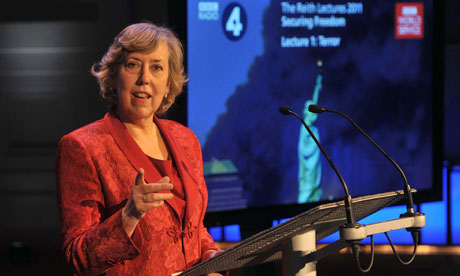
Lady Eliza Manningham-Buller uses BBC lecture to criticise ‘unhelpful' term, attack Iraq invasion and suggest al-Qaida talks

Lady Eliza Manningham-Buller, the former head of MI5, delivered a withering attack on the invasion of Iraq, decried the term “war on terror”, and held out the prospect of talks with al-Qaida.

MI5's former director general Lady Eliza Manningham-Buller during her 2011 BBC Reith lecture. Photograph: Jeff Overs/BBC/PA

Recording her first BBC Reith lecture on the theme, Securing Freedom, she made clear she believed the UK and US governments had not sufficiently understood the resentment that had been building up among Arab people, which was only compounded by the war against Iraq.

Before an audience which included Theresa May, the home secretary, she also said the 9/11 attacks were “a crime, not an act of war”. “So I never felt it helpful to refer to a war on terror”.

Read full article…

Paul Fernhout: Open Letter to the Intelligence Advanced Programs Research Agency (IARPA)

10 Security, 11 Society, Advanced Cyber/IO, Blog Wisdom, Cultural Intelligence, Government
Paul FernhoutE

EDIT 4 Sep 2011: Link and misc. fixed.

Dear IARPA staff-

The greatest threat facing the USA is the irony inherent in our current defense posture, like for example planning to use nuclear energy embodied in missiles to fight over oil fields that nuclear energy could replace. This irony arises in part because the USA’s current security logic is still based on essentially 19th century and earlier (second millennium) thinking that becomes inappropriate applied to 21st century (third millennium) technological threats and opportunities. That situation represents a systematic intelligence failure of the highest magnitude. There remains time to correct this failure, but time grows short as various exponential trends continue.

To address that pervasive threat from unrecognized irony, it would help to re-envision the CIA as a non-ironic post-scarcity institution. Then the CIA could help others (including in the White House) make more informed decisions to move past this irony as well.
Continue reading “Paul Fernhout: Open Letter to the Intelligence Advanced Programs Research Agency (IARPA)”

Cynthia McKinney: Libya Eyewitness Tour Final Report

04 Inter-State Conflict, 05 Civil War, 07 Other Atrocities, 08 Wild Cards, 09 Justice, 10 Security, 11 Society, Blog Wisdom, Civil Society, Corruption, Counter-Oppression/Counter-Dictatorship Practices, Cultural Intelligence, Government, IO Deeds of War, IO Impotency, Military, Misinformation & Propaganda, Money, Banks & Concentrated Wealth, Peace Intelligence, Power Behind-the-Scenes/Special Interests, Secrecy & Politics of Secrecy, Waste (materials, food, etc)
Cynthia McKinney

On today, the anniversary of the overthrow of King Idris in Libya, the neo-colonial powers met in France to continue their drive at the new carve-up of Africa. This set of circumstances makes many of us very sad.

I had a dream last night.  I was caught in the midst of intense fighting–street fighting:  house to house.  I guess I was channeling what the typical Libyan is feeling and has been feeling for the past 6 months.  In my chats with DIGNITY Delegation members, one thing is clear:  we are traumatized by what is happening to the lovely people of Libya.  But imagine, if we feel that way, how must they feel?  Terrorized and worse.

When the DIGNITY Delegation of journalists was there, we could already see the impact of the bombing on patients in the hospital, children trying to understand what was happening, women trying to soothe their families, men trying to carry on with their normal activities, shopkeepers trying to eke out a living despite fighting and bombing all around them, Black Libyans who felt threatened by their fellow countrymen and the outsiders who have streamed into the country, siding with NATO and openly boasted of killing dark-skinned Libyans (who number between 50% and 58% of the population, according to one of the Libyans who joined us on the tour, now returned to his country, not the 30% written in the special interest press) and non-Libyan Africans.
Continue reading “Cynthia McKinney: Libya Eyewitness Tour Final Report”

Steven Aftergood: Top Secret America–Totally Dysfunctional

Analysis, Commerce, Corruption, Counter-Oppression/Counter-Dictatorship Practices, Cultural Intelligence, Government, InfoOps (IO), Intelligence (government), IO Deeds of War, IO Impotency, Methods & Process, Officers Call, Policies, Threats
Steven Aftergood

A SPOTLIGHT ON “TOP SECRET AMERICA”

Most people can vaguely recall that there was once no U.S. Department of Homeland Security and that there was a time when you didn't have to take your shoes off before boarding an airplane or submit to other dubious security practices.

But hardly anyone truly comprehends the enormous expansion of the military, intelligence and homeland security bureaucracy that has occurred over the past decade, and the often irrational transformation of American life that has accompanied it.

The great virtue of the new book Top Secret America by Dana Priest and William M. Arkin (Little Brown, September 2011) is that it illuminates various facets of our secret government, lifting them from the periphery of awareness to full, sustained attention.

Top Secret America, which builds on the series of stories the authors produced for the Washington Post in July 2010, delineates the contours of “the  new American security state.”  Since 9/11, for example, some 33 large office complexes for top secret intelligence work have been completed in the Washington DC area, the equivalent in size of nearly three Pentagons.  More than 250,000 contractors are working on top secret programs.  A bewildering number of agencies – more than a thousand — have been created to execute security policy, including at least 24 new organizations last year alone.  And so on.

But the vast scale of this activity says nothing about its quality or utility.  The authors, who are scrupulous in their presentation of the facts, are critical in their evaluation:

“One of the greatest secrets of Top Secret America is its disturbing dysfunction.”

Continue reading “Steven Aftergood: Top Secret America–Totally Dysfunctional”

Koko: WikiLeaks Uncensored–Redactions Blown

Advanced Cyber/IO, Cultural Intelligence, Government
Koko

In the end, the full truth comes out…

Exposed: Uncensored WikiLeaks cables posted to Web

USA Today, 1 September 2011

LONDON (AP) – Uncensored copies of WikiLeaks' massive tome of U.S. State Department cables were circulating freely across the Internet on Thursday, a dramatic development which leaves a new batch of U.S. sources vulnerable to embarrassment and potential retribution.

. . . . . .

Until recently, WikiLeaks released relatively small batches of files to its partner organizations — composed of dozens of international media and human rights groups — so that they could remove information which could put innocent people in jeopardy. Only then were the files posted online.

But with the unredacted cables now being sloshed around in the public domain, all that work has effectively been thrown out the window.

Read entire article….

Continue reading “Koko: WikiLeaks Uncensored–Redactions Blown”

noble gold