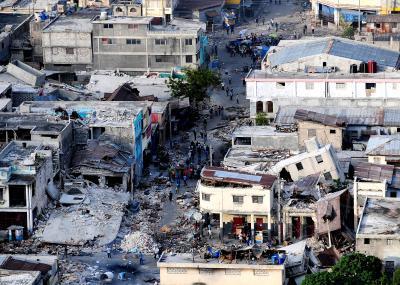
ScienceDaily (Jan. 16, 2011) — A new assessment of global earthquake fatalities over the past three decades indicates that 83 percent of all deaths caused by the collapse of buildings during earthquakes occurred in countries considered to be unusually corrupt.
The 2010 Haiti earthquake is believed to have caused hundreds of thousands of deaths, primarily due to shoddy building construction. (Credit: U.S. Air Force)
www.goodjobsfirst.org
Good Jobs First is a national policy resource center for grassroots groups and public officials, promoting corporate and government accountability in economic development and smart growth for working families. We provide timely, accurate information on best practices in state and local job subsidies, and on the many ties between smart growth and good jobs. Good Jobs First works with a very broad spectrum of organizations, providing research, training, communications and consulting assistance.
EXTRACT: As in the recent so-called “Twitter Revolutions” in Moldova and Iran, there was clearly lots wrong with Tunisia before Julian Assange ever got hold of the diplomatic cables. Rather, WikiLeaks acted as a catalyst: both a trigger and a tool for political outcry. Which is probably the best compliment one could give the whistle-blower site.
Phi Beta Iota: This is a good time to bring up the Davies J-Curve again. Wikileaks is a precipitant of revolution; the preconditions exist in most places outside the Nordic region and a few other special countries. The preconditions assuredly exist in the USA but in our view, the precipitant is most likely to be some really outrageous US Government action, such as federalizing all state and local police forces and then start trying to confiscate personal weapons. However, if the two party system continues to think that changing its “tone” matters, while it does nothing about the substance of poverty, economy, education, health and so on, then we will see a mix of widespread poverty and apathy with pockets of extreme violence and random attacks on elected officials and perhaps uniformed law enforcement professionals. America is, in our view, very volatile right now. 2011-2012 are not going to be subject to the usual pre-election “damping down.” The situation is now “out of control.” Nothing less than a comprehensive approach to meeting the needs of the larger public will do, if we are to avoid a cascade of socio-economic and ideo-cultural uprisings and individual “random” acts of violence in the next two years.
Consider the extremes. President Obama is redesigning his administration to make it even friendlier toward big business and the megabanks, which is to say the rich, who flourish no matter what is going on with the economy in this country. (They flourish even when they’re hard at work destroying the economy.) Meanwhile, we hear not a word — not so much as a peep — about the poor, whose ranks are spreading like a wildfire in a drought.
The politicians and the media behave as if the poor don’t exist. But with jobs still absurdly scarce and the bottom falling out of the middle class, the poor are becoming an ever more significant and increasingly desperate segment of the population.
How do you imagine a family of four would live if its annual income was $11,000 or less?
Votetocracy is a place where every citizen can see every bill currently in congress, vote on those bills and send those votes to thier representatives. The site has been created by three regular citizens that felt it was time to get engaged with American politics. During our efforts to become more educated about our government we discovered that it was not all that easy. We found plenty of information. But it is written in difficult to understand political speak. We also found that it was not particularly easy to act on this information. When we found bills on government websites we had no measurable way to act on it. Sure, you could write a letter or contact our representatives, but had no real way of knowing that it would actually accomplish anything. These things felt like barriers. It was then that we dicided that there had to be a better way and Votetocracy is the the result of our efforts.
The site has the features neccesary for any citizen to find out what congress is working on. More importantly however is the ability to act on that information. We have created the site so that citizens can vote on the same bills as congress, send their vote to thier representatives with the click of the button.
We felt that there are three major areas that we could help citizens.
Access to information
Education about that information
And to provide the ability to act on that information and measure the results
A new study released today by America 2050 identifies the high-speed rail corridors with the greatest potential to attract ridership in each of the nation's megaregions. Corridors connecting populous regions with large job centers, rail transit networks, and existing air markets scored best. The study also recommends that the federal government adopt a quantitative approach to evaluating future investment in high-speed rail.
The 56-page study, entitled, “High-Speed Rail in America,” cites ridership potential as the number one factor in determining if a corridor is suitable for investment, identifies the specific conditions that generate ridership demand, and scores each corridor according to strength in those areas. The top performing corridors in each region determined to have the greatest potential demand for high-speed rail ridership include corridors such as: New York-Washington, DC; Chicago-Milwaukee; Los Angeles-San Diego; Tampa (via Orlando) to Miami; Dallas-Houston; Atlanta-Birmingham; Portland-Seattle; and Denver-Pueblo.



 Thursday, January 13, 2011 – 6:17 PM