John Steiner: The Righteous Mind – A Book Review

Civil Society, Cultural Intelligence
John Steiner

Why Won’t They Listen? ‘The Righteous Mind,’ by Jonathan Haidt

REVIEW By WILLIAM SALETANPublished:

NY Times Review of Books, March 23, 2012

You’re smart. You’re liberal. You’re well informed. You think conservatives are narrow-minded. You can’t understand why working-class Americans vote Republican. You figure they’re being duped. You’re wrong.

This isn’t an accusation from the right. It’s a friendly warning from Jonathan Haidt, a social psychologist at the University of Virginia who, until 2009, considered himself a partisan liberal. In “The ­Righteous Mind,” Haidt seeks to enrich liberalism, and political discourse generally, with a deeper awareness of human nature. Like other psychologists who have ventured into political coaching, such as George Lakoff and Drew Westen, Haidt argues that people are fundamentally intuitive, not rational. If you want to persuade others, you have to appeal to their sentiments. But Haidt is looking for more than victory. He’s looking for wisdom. That’s what makes “The Righteous Mind” well worth reading. Politics isn’t just about ­manipulating people who disagree with you. It’s about learning from them.

Haidt seems to delight in mischief. Drawing on ethnography, evolutionary theory and experimental psychology, he sets out to trash the modern faith in reason. In Haidt’s retelling, all the fools, foils and villains of intellectual history are recast as heroes. David Hume, the Scottish philosopher who notoriously said reason was fit only to be “the slave of the passions,” was largely correct. E. O. Wilson, the ecologist who was branded a fascist for stressing the biological origins of human behavior, has been vindicated by the study of moral emotions. Even Glaucon, the cynic in Plato’s “Republic” who told Socrates that people would behave ethically only if they thought they were being watched, was “the guy who got it right.”

Continue reading “John Steiner: The Righteous Mind – A Book Review”
NIGHTWATCH: Saudi Arabia Begins to Absorb Bahrain — Is Qatar Next?

03 India, 04 Indonesia, 04 Inter-State Conflict, 05 Civil War, 05 Iran, 07 Other Atrocities, 08 Wild Cards, 11 Society, Blog Wisdom, Cultural Intelligence, Government, IO Deeds of War
Click on Image to Enlarge

Saudi Arabia: Saudi Arabia and Bahrain discussed a political union at a meeting in Riyadh on 13 May. The arrangement under discussion would allow Bahrain to retain its seat at the United Nations, but the two states would merge foreign relations, defense and economic policy, according to press sources. The details have not been released.

Bahrain's Prime Minister, the Army Chief of Staff and the Foreign Minister – all members of the al-Khalifa royal family — have stated their support for the union.

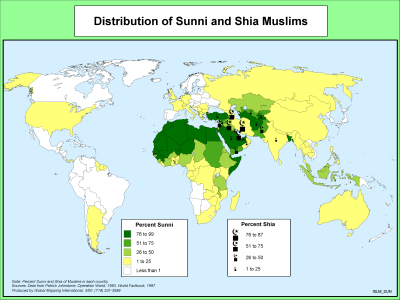
Comment: The King of Bahrain and the royal family are Sunni Muslims who govern a population of mostly Shiite Muslims. Thus, the news that a union with Saudi Arabia is under discussion has prompted widespread criticism that Saudi Arabia intends to make Bahrain a vassal state so as to keep the Shiites disenfranchised and subjugated.

On the other hand, the limited information in the public domain suggests Bahrain's administration of internal affairs will not be changed by the union proposal. Bahrain, by itself, is not defensible against an Iranian attack or subversion, but in a union arrangement with Saudi Arabia it would not be alone.

Saudi King Abdallah has warned Iran repeatedly against meddling in Arab affairs. This union is consistent with his policy decision to stop Iranian meddling in Arab countries as well as the spread of Shi'i Islam which the Sunnis consider a heresy.

One advantage of the union would be that it would bypass tricky conditions attached to US foreign military sales. Conditions of the sales include that US military equipment can only be used for defense, cannot be resold without US permission and cannot be used outside the recipient country without US permission. Under a union arrangement, the Saudis would not need to consult the US before sending Saudi forces equipped with US tanks and armored personnel carriers back to Bahrain, unless they chose to.

NIGHTWATCH KGS Home

Phi Beta Iota:  It is entirely possible that Saudi Arabia is moving to a whole new level of global diplomacy, information-sharing, military alliances, and economic entanglements (DIME).  Qatar is similar to Bahrain in multiple ways.  Below is a map of the Sunni – Shi'ite spread.  A religious war is brewing, not just Sunni – Shi'ite, but Pentecostals against Islam, Jews against everyone, Catholics in a panic, and so on.  We say it again:  counter-intelligence generally, and religious counter-intelligence specifically, is the ONE 21st Century aspect of the craft of intelligence that must continue to be secret and that must *explode* in the near-term.  Note:  within the eight “tribes” or communities, we include religion and labor organizations within the Civil Society tribe.  The others are academic, commerce, government at all levels, law enforcement, media, military, and non-government/non-profit.

See Also:

Graphic: Muslim Sunni – Shi’ite Distribution (Global)

2012 PREPRINT AS SUBMITTED: The Craft of Intelligence

DefDog: USSR First, Then USA — Losers in Afghanistan — But the British Still the Most Hated

04 Inter-State Conflict, 05 Civil War, 08 Wild Cards, Civil Society, Corruption, Cultural Intelligence, Government, Military
DefDog

I often ask folks who the Afghan hates the most. The most common answer, the Russians….that is not true.  It is the British and it is reminded to them in their flag:

The current Afghanistan flag is contained three solid colors such as black, red and green and each color represents a different page in the history of Afghanistan.

The black represents the 19th century era when Afghanistan was occupied and did not have independence. The red color means blood shed and fights for independence and the green means the independence achieved as well as hope and prosperity for the future. This three stripe flag was designed during King Amanullah Khan after he returned from a visit of Europe in 1928.

Also, a couple of articles from NPS…..

2012-05-14 Comparing USSR and US Losses in AF

2012-05-14 Deja Vu 22 Years After USSR Quits US Follows

Mini-Me: Cash, and Time, Runs Out for Afghanistan’s Wi-Fi City

Advanced Cyber/IO, Civil Society, Collective Intelligence, Cultural Intelligence, Ethics, Hacking
Who? Mini-Me?

Huh?

Cash, and Time, Runs Out for Afghanistan’s Wi-Fi City

It was a project that symbolized America’s grand ambitions to rebuild Afghanistan: a DIY Wi-Fi network, free for Afghans to use, powering the aid projects and business ventures of the eastern city of Jalalabad. But now funding for the JLink network has run dry, and like so much of the Afghanistan war, it’s run out of time. Most of Jalalabad is about to go offline.

The sudden collapse of the network is causing local aid workers, entrepreneurs and the entire city to adjust to the prospect of life without a freely available internet. JLink is woven into the fabric of Jalalabad: It took about two years for high-speed internet to become available through JLink in the city’s public hospital, local elementary schools and the women’s dorm at Nangarhar University. After one of JLink’s two satellite connections went dark on May 1, some in the city’s aid community considered it a prelude to a larger international withdrawal from Afghanistan.

JLink is not something the Taliban destroyed. Its impending collapse illustrates what happens when grand ambitions lead to grand achievements that ultimately prove unsustainable — perhaps because they proceeded from unstable, utopian premises. And like the war itself, the group that created JLink is out of time to salvage its project.

Continue reading “Mini-Me: Cash, and Time, Runs Out for Afghanistan’s Wi-Fi City”

Patrick Meier: Departing for Qatar

08 Wild Cards, Advanced Cyber/IO, Blog Wisdom, Civil Society, Collective Intelligence, Commerce, Commercial Intelligence, Cultural Intelligence, Earth Intelligence, Ethics, Government, Media, Mobile
Patrick Meier

Joining the Qatar Foundation to Advance Humanitarian Technology

Big news! I'll be taking a senior level position at the Qatar Foundation to work on the next generation of humanitarian technology solutions. I'll be based at the Foundation's Computing Research Institute (QCRI) and be working alongside some truly amazing minds defining the cutting edge of social and scientific computing, computational linguistics, big data, etc. My role at QCRI will be to leverage the expertise within the Institute, the region and beyond to drive technology solutions for humanitarian and social impact globally—think of it as Computing for Good backed by some serious resources.  I'll spend just part of the time in Doha. The rest of my time will be based wherever necessary to have the greatest impact. Needless to say, I'm excited!

My mission over the past five years has been to catalyze strategic linkages between the technology and humanitarian space to promote both innovation and change, so this new adventure feels like the perfect next chapter in this exciting adventure. I've had the good fortune and distinct honor of working with some truly inspiring and knowledgeable colleagues who have helped me define and pursue my passions over the years. Needless to say, I've learned a great deal from these colleagues; knowledge, contacts and partnerships that I plan to fully leverage at the Qatar Foundation.

It really has been an amazing five years. I joined the Harvard Humanitarian Initiative (HHI) in 2007 to co-found and co-direct the Program on Crisis Mapping and Early Warning. The purpose of the program was to assess how new technologies were changing the humanitarian space and how these could be deliberately leveraged to yield more significant impact. As part of my time at HHI, I consulted on a number of cutting-edge projects including the UNDP's Crisis and Risk Mapping Analysis (CRMA) Program in the Sudan. I also leveraged this iRevolution blog extensively to share my findings and learnings with both the humanitarian and technology communities. In addition, I co-authored the UN Foundation & Vodafone Foundation Report on “New Technologies in Emergen-cies and Conflicts” (PDF).

Continue reading “Patrick Meier: Departing for Qatar”

Reference: NUCLEAR FAMINE – A BILLION PEOPLE AT RISK Global Impacts of Limited Nuclear War on Agriculture, Food Supplies, and Human Nutrition + Eugenics RECAP

01 Agriculture, 01 Brazil, 02 China, 03 India, 04 Indonesia, 04 Inter-State Conflict, 06 Russia, 07 Health, 07 Other Atrocities, 07 Venezuela, 08 Proliferation, 08 Wild Cards, 11 Society, Earth Intelligence, Government, Military, White Papers

NUCLEAR FAMINE: A BILLION PEOPLE AT RISK

Global Impacts of Limited Nuclear War on Agriculture, Food Supplies, and Human Nutrition

Ira Helfand, MD
International Physicians for the Prevention of Nuclear War
Physicians for Social Responsibility

Credits and Acknowledgements
The publication of this briefing paper was made possible
thanks to the generous financial support of the Swiss Federal
Department of Foreign Affairs.

Executive Summary

Over the last several years, a number of studies have shown that a limited, regional nuclear war between India and Pakistan would cause significant climate disruption worldwide.

Two studies published this year examine the impact on agricultural output that would result from this climate disruption.  In the US, corn production would decline by an average of 10% for an entire decade, with the most severe decline, about 20% in year 5. There would be a similar decline in soybean production, with, again, the most severe loss, about 20%, in year 5.

A second study found a significant decline in Chinese middle season rice production. During the first 4 years, rice production would decline by an average of 21%; over the next 6 years the decline would average 10%.

Continue reading “Reference: NUCLEAR FAMINE – A BILLION PEOPLE AT RISK Global Impacts of Limited Nuclear War on Agriculture, Food Supplies, and Human Nutrition + Eugenics RECAP”

Marcus Aurelius: US SOF Seeks Global SOF Network Including Regional Multinational Op-Intel Centers — What Regional Commands SHOULD Have Created

Advanced Cyber/IO, Military
Marcus Aurelius

U.S. [SOF Commander] Seeks Global Spec Ops Network

1st ‘Node' to Stand Up in '13

Defense News, May 14, 2012, Pg. 1

By Barbara Opall-Rome

AMMAN — U.S. Special Operations Command (SOCOM) wants to establish a worldwide network linking special operations forces (SOF) of allied and partner nations to combat terrorism.

Championed by SOCOM commander Adm. Bill McRaven and Deputy Director of Operations Brig. Gen. Sean Mulholland, the network would comprise regional security coordination centers, organized and structured similarly to NATO SOF Headquarters in Mons, Belgium.

“Imagine the power a confederation of SOF interests could have. It could collectively increase its influence and operational reach around the globe,” Mulholland told participants at a May 7 Middle East Special Operations Commanders Conference here.

Continue reading “Marcus Aurelius: US SOF Seeks Global SOF Network Including Regional Multinational Op-Intel Centers — What Regional Commands SHOULD Have Created”