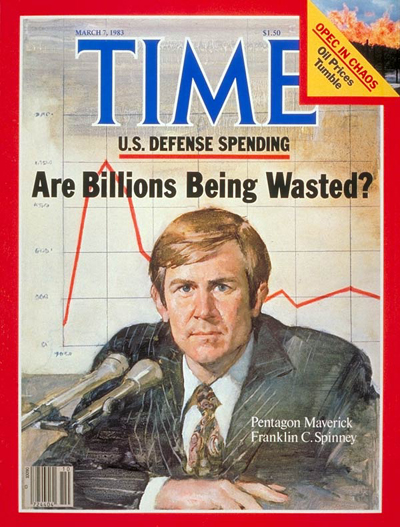
Much of how DOD will respond to falling budgets and the challenges of 2013 will depend on who President Obama selects to be SecDef. This is why I am hoping that Senator Chuck Hagel will be chosen. Yet he alone will be unable to do much of anything to solve DOD’s systemic problems of incompetence, corruption, and dereliction of duty. He will need to fire the existing senior civilian and military bureaucrats who have made maintaining the dysfunctional status quo an art form and who will fight any change tooth and nail. The senator in short needs to surround himself with people like yourself who will not be afraid to change the moribund operations and culture of DOD.
So what are the Senator’s chances of becoming SecDef? I don’t think they are very good at all. Although I don’t normally agree with Gordon Duff’s opinions, I think he is right about how the pro-Israeli lobbies and neo-cons will oppose the conformation of Senator Hagel. There will also be considerable opposition to him from the military-industrial-congressional complex (MICC), who correctly see him as a treat to their gravy train. In addition the DOD military and civilian bureaucracy would fight against his nomination, even if the MICC were not threatened — they KNOW they are over-staffed at the top. Finally the self-referentials that occupy so many seats in the U.S. Congress will oppose him on so-called principles based on paranoid fears, adherence to rigid ideologies, and general opposition to anything the President attempts.
This is a shame because it will cost us yet another good public servant and a thinker who could actually transform U.S. National Security.
Robert David STEELE Vivas Click on Image for Personal Page
Telling the truth to those who have replaced intelligence with ideology and integrity with loyalty to something other than their Republic is most difficult and more often than not will get you fired, because those without integrity tend to be promoted in corrupt systems, and they see clearly the threat to their world-view — and their perks — of someone who persists in pointing out that the truth at any cost reduces all other costs.
Reform can be job and revenue neutral from state to state and district to district — and is of course subject to Congressional oversight via the authorization and appropriations process. Below are seven truths about the US military that I would like to see introduced into the hearings on the confirmation of the next Secretary of Defense, and ideally also tasked to the Congressional Research Service (CRS), where the senior specialist for each of the major services is capable of validating my views.
Summary: Today GI Wilson writes about the great game of the 21st century — the US government vs. our 4GW foes. Once called “low intensity war”, our foes have taught us the ability of sustained 4GW produces only a series of expensive defeats for foreign armies (no matter how powerful). A slow bleeding, until we either adapt or give up.
The recent article, “7 Absurd Ways the Military Wastes Taxpayer Dollars” by Laura Gottesdiene at Salon shines a bright light on military waste and the smarmy behavior of general officers. This smarmy behavior is just the tip of a national security iceberg. The personal foibles of these general officers are symptoms of a much deeper problem. In the wake of 9-11 we are witnessing the costly ineffectiveness our Titanic government bureaucracies. Today, a report by the Independent Accountability Review Board on Benghazi slammed senior level leadership and management laying bare national security miscalculations and incompetence. (Chicago Tribune)
What our national security apparatchiks are missing is that we live in a world where we are seeing sub-national “bad actors” use 4th generation warfare (4GW), which embodies low-tech tactics, techniques procedures (TTPs) together with insurrection, sabotage, espionage, and terrorism, to subvert nation-states. In effect, 4GW has emerged to challenge the established international system. While 4GW is not new, as some critics would have you believe, 4GW has emerged over several decades as the dominant style of warfare in the first part of the 21st Century.
The United States Government (USG) has not adapted to this change. Driven by conventional mentality and bureaucratic inertia, the Military Industrial Congressional Complex (MICC) and the US military has responded to the 4th generation warfare (4GW) threats with a conventional techno strategy of fielding high cost acquisition programs that created the MICC in the first place during the Cold War. The acquisition-programmatic approach to strategy led to a welter of highly complex programs and associated complex organizational relationships that force-fits the fighting man into a technological strait-jacket.
Phi Beta Iota: No holds the US Government accountable for high crimes and misdemeanors — including being terribly irresponsible about everything that the government is supposed to be doing in the public interest. There is absolutely no question about the urgency of cutting the Pentagon budget in half (as well as reducing by at least 50% the number of flag officers and senior executives), but at the same time, we need intelligence with integrity in order to create a 450-ship Navy, a long-haul Air Force, and an air-liftable Army that would allow us, over ten years, to close most of our military bases overseas and bring our troops — and their purchasing power — home. One initiative we have put forward is that of the Open Source Agency (OSA). Another that we have alluded to but never been explicit about has to do with the Office of Management and Budget (OMB). Imagine the President establishing the OSA as a Whole of Government decision-support capabilities (with Congressional jurisdictions getting the same Open Source Intelligence (OSINT) that their Executive agencies are receiving) AND appointing a kick-ass Deputy Director for Management of OMB, with the authority to slash and burn up to 15% a year of any agencies budget, with an additional 10% subject to Presidential concurrence on the specifics. Now THAT is transformational.
I am ambivalent about whether Chuck Hagel has the managerial and bureaucratic skills to make the kind of Sec of Defense we need to clean out the Pentagon's Augean Stables — but the outrageous neocon assault on him because he does not kowtow to the Likud party line is over the top, as Steven Walt explains below.
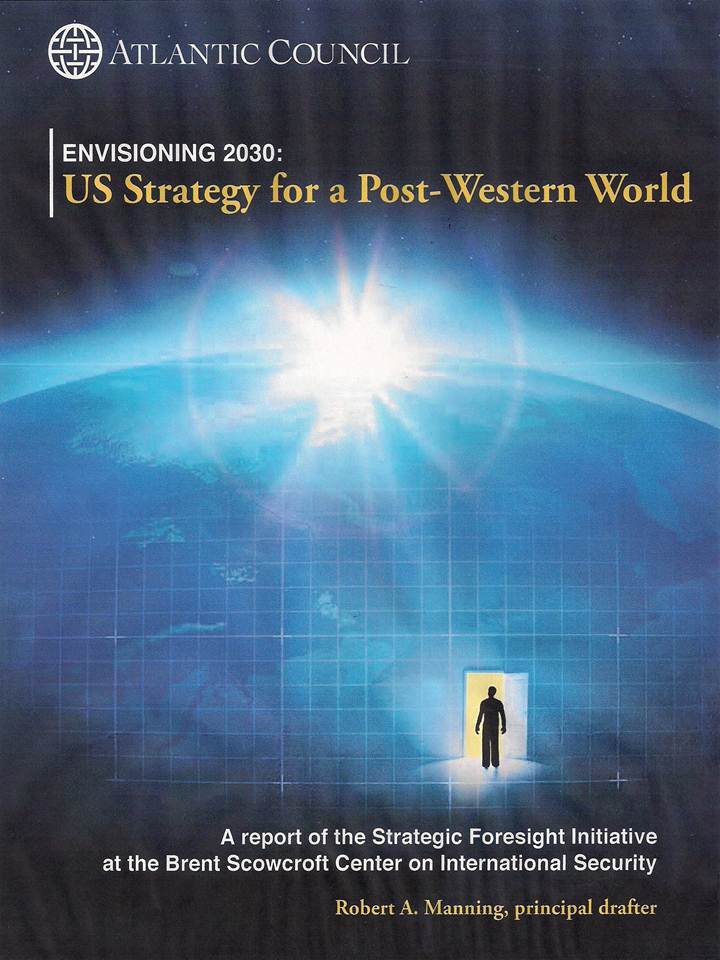
Agree that we are at a potentially historic transition point. However, the Atlantic Council lacks the strategic analytic model to make the most of its otherwise formidable brain trust. Agree on the need for a new mental map, but they chose the wrong map. See the HourGlass Strategy as an alternative (also below the line).
The report misses multiple big possibilities including the eight tribes, M4IS2, and OSE.
1. Frame second-term policies from a more strategic and long-term perspective, recognizing the magnitude of the moment and the likelihood that the United States’ actions now will have generational consequences.
Absolutely. Understanding emergent public governance trends rooted in true cost and whole system analytics, which harness the distributed intelligence of the five billion poor, not in this report.
2. Continue to emphasize what has been called “nation-building at home” as the first foreign policy priority, without neglecting its global context.
Left unsaid is the need to establish a plan, coincident with the creation of a 450-ship Navy, a long-haul Air Force, and an air-liftable Army, to close most of our military bases around the world, and bring all of our troops – and their purchasing power – home.
Phi Beta Iota: This is one of Anthony Judge's shorter and more poignant essays. It is reproduced in full below the line, along with his links, and our on duty editor has added links to the Amazon pages of all the books that he cites. In this essay, complicity is the opposite of integrity, the single word (integrity) most embedded across Phi Beta Iota the Public Intelligence Blog. To read the essay at its source, click on the title above.
Weapon of the Strong analyses the forms of US state terrorism through exclusive, never before published interviews with leading commentators and theorists. The interviews explore the different aspects of state terrorism: its functions, institutional supports and the legal and moral arguments surrounding it, and consider specific case studies in Europe, Latin America and the Middle East.”