Sustainability experts have called on global regulators to ask companies to report on their sustainable policy and performance, disclosing results in a similar way to financial reporting.
“A ‘report or explain’ approach could persuade more companies to report rather than explain why they don’t,” said Teresa Fogelberg, deputy chief executive of the Global Reporting Initiative (GRI).
. . . . . .
About 4,000 global companies report their sustainability performance, using reporting guidelines recently updated by the GRI.
These focus on 79 issues including consulting stakeholders on important topics, human rights, the impact on local communities and gender matters.
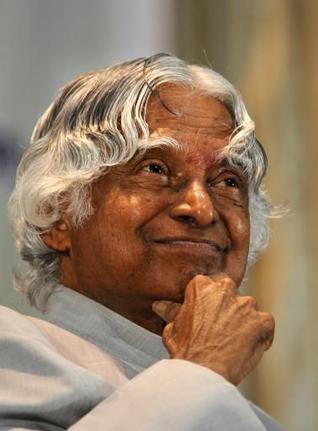
Former President, Mr A P J Abdul Kalam today said that to create a better world, it is necessary to alleviate poverty, safeguard drinking water, use clean energy and ensure quality education and values for all.
Mr Kalam, who was honoured at a public reception by the Indo-American Centre (IAC) here, said: “The world is integrally connected through the environment, economy, people and ideas.”
He said that we need an educational value system, and ideas and innovations should not be politically inclined.
On political unrest in the Middle East, Mr Kalam explained how the Egyptian revolution for a change to democracy has spread to the Arab world.
whether talking about a intelligent knowledge infrastructure, robert's global brain, or suresh's project matching for climate change initiatives, this article seemed useful.
Futurescaper is an online tool for making sense of the drivers, trends and forces that will shape the future. As a user interface system, it is horrible. As a tool for analyzing and understanding complex systems, it works pretty well. Several people asked me about this after my last post, so here is some more detail.
Following the logic of collective intelligence (as part of my my PhD), I broke up the the scenario thinking process into discrete chunks, came up with a system for analyzing and relating them together, and then distilled them into key outputs for helping the scenario development process: 1) Emergent Thematic Maps 2) Revealing Hidden Connections 3) Drilling Down
The first system is called “Futurescaper” and was developed in partnership with the International Futures Forum (IFF), Tony Hodgson and my friend Nathan Koren. This was piloted on a project for the UK Government, exploring secondary and tertiary impacts of climate change.
Using a new “crowdfunding” program called Solar Mosaic, the city is selling solar tiles to locals for $100 a pop and installing them on public buildings
By Maria Gallucci, SolveClimate News
Apr 22, 2011
The city of Oakland, Calif., is getting its residents to help build out a clean energy economy, one solar tile at a time.
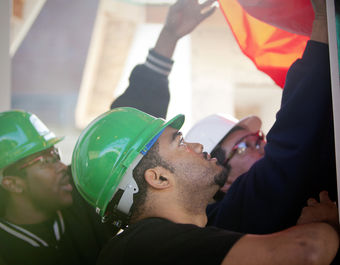
By selling 5,000 tiles at $100 each to locals, the city is aiming to piece together entire rooftop solar arrays at seven budget-strapped schools, youth centers and houses of worship. A team of Oaklanders will be trained and hired to install the panels by as early as July.
The city's efforts are part of a pilot program called Solar Mosaic, a web-based marketplace for community solar initiatives that launched on April 15.
Using the “crowdfunding” model, residents can help generate energy savings and scale back greenhouse gas emissions without having to shell out tens of thousands of dollars for a solar installation at home.
Phi Beta Iota: The existing tax system in the USA is so corrupt it must be abolished. The public is now ready for line-item crowd-sourcing and the fully-transparent Automated Payments/Transaction Tax.
10 April 2011: John Vidal: Bolivia is set to pass the world's first laws granting all nature equal rights to humans. The Law of Mother Earth, now agreed by politicians and grassroots social groups, redefines the country's rich mineral deposits as “blessings” and is expected to lead to radical new conservation and social measures to reduce pollution and control industry
19 Apr 2011: Jonathan Glennie: Bolivia under President Evo Morales is seeking a radical development model based on equality and environmental sustainability – and there are lessons we can all learn.
13 Apr 2011: John Vidal: Development, by the west, creates considerable imbalances and a million problems. Indigenous people can solve these, says David Choquehuanca, Bolivia's foreign minister
Unions representing Central Florida teachers, firefighters, police and other government workers are pulling an estimated $10 million from five banks affiliated with the Florida Chamber of Commerce, blaming them for an attack on public employees.
The unions are also asking their members — an estimated 20,000 people — to withdrawal their personal money from Bank of America, PNC Bank, Regions Bank, SunTrust and Wachovia. And labor leaders across the state could follow in the coming weeks, union officials say.
Archangel73 at 11:59 AM April 22, 2011I have noticed that all of these attacks on Public servants [are] having an opposite effect.
The Fire and Police depts used to be mostly Republican, now all of those folks are leaving the party because they're upset that the burden of everything is being put on THEIR backs.
What was intended to WEAKEN the Unions appears to be having the opposite effect, and employees are becoming more resolute. More importantly, they are becoming angry with the GOP.
Have you ever thought about how completely irrelevant structured learning is? Indeed. “The illiterate of the 21st century will not be those who cannot read or write, but those who cannot unlearn and relearn.” – Alvin Toffler. The video below advocates a change in how we learn – network-centric, personal, based on your context, not based on some institution’s agenda. (Thanks to Judi Clark for sending me the link to this video.)
Burkhard Bilger in The New Yorker profiles David Eagleman, a brilliant researcher who’s studying the brain, consciousness, and the perception of time. At a personal level I’ve spent a lot of time in recent years studying and trying to comprehend my own degrees and levels of consciousness and perception. We think of our “conscious experience” as a constant, and our unconscious as inaccessible… but through attention we learn that there are gradations in the range of conscious to “un-” or “sub-” conscious experience; that perceptions can vary with context; that memory is selective and undependable; that our perception of the world is generally incomplete though we do a good job of filling the gaps. When David Eagleman was a child he fell from a roof and realized that his perception of time had changed as he was falling. Now he’s doing evidence-based research to determine how people experience the world, what are the variations, how does the brain work and how does the mind work? Read about it here. If you know about similar studies and writings, please post in comments.