Professor Brenner gave me permission to distribute and post the attached essay. Without saying so, he describes a way that seems tailor-made to systematically violate just about all the criteria for a sensible grand strategy.
NSA returned to center stage last week thanks to revelations that it has tapped the phones of European leaders. The resulting ruckus raises three questions: why? how far will the targeting governments go in demanding redress? how will Washington respond? In considering them, I look at the political/psychological underpinnings of the Euro-Americans relationship.
Privacy: This week, the European Parliament voted to immediately suspend the sharing of European financial tracking data with the United States in a 280-254 decision, as well as calling for criminal investigations of the NSA. This follows in the footsteps of mass surveillance revelations that the NSA has illegally hacked into the SWIFT financial data. This appears to be yet another public wake-up and backlash against the secretive wiretapping industry.
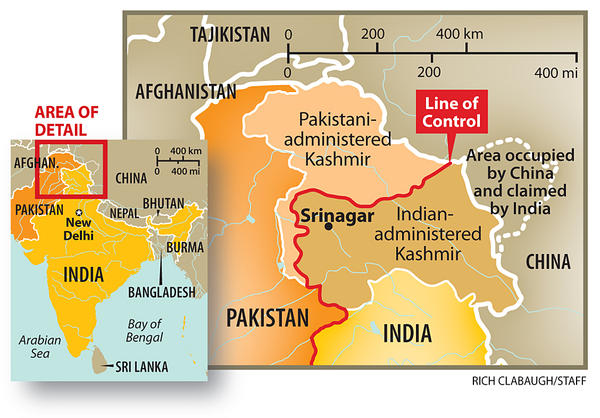
India-Pakistan: Relations are trending downward and tension is up because of a surge in attacks from Pakistan in the past two months along the Line of Control and across the International Border of India's Jammu and Kashmir State.
This week two attacks occurred: on the night of 22 October and the night of 24 October. On the 22nd, mortar fire and small arms fire struck 50 border observation posts on the Indian side of the International Border in the Jammu, or southern, part of the state. The attacks killed one Border Security Force constable and injured six others and a civilian. The harassing fire lasted through the night for more than seven hours. On the 24th, mortar fire and small arms attacks struck 17 border observations posts, injuring eight civilians.
The Union Home Minister, Sushilkumar Shinde, visited one of the target areas on the 24th. He told the media elements, including the Pakistan Rangers and Kashmiri militants, have violated the 2003 ceasefire agreement nearly 150 times. Forty violations occurred in the month of October. He announced reinforcements for the Border Security Forces and increased patrols to prevent infiltration.
Shinde also promised “a fitting response” to attacks by fire from Pakistan. However, Indian retaliatory fire has not reduced the attacks. Locals living along the boundary want the Indian Army to escalate the retaliation.
A diplomatic disaster for the United States is currently unfolding in Berlin. The revelation that the NSA may have monitored cell phone conversations and text messages of Chancellor Angela Merkel has led to popular outrage in Germany, as well as unusually pointed language from the Chancellor and other government officials. The U.S. Ambassador was not merely asked but summoned (“einbestellt”) to the German foreign office—a strong verb used until now (if at all) only for the Syrian and Iranian ambassadors. The Chancellor’s phone conversation with President Obama did nothing to ease the tension. Merkel declared such practices totally unacceptable: Between friends and partners such as the United States and Germany, the monitoring of communications by government leaders is a grave breach of trust, her press secretary emphasized. The Obama administration, other than saying the Chancellor’s phone is not now and will not in the future be monitored, has offered nothing: neither apology, nor explanation of what happened in the past, nor any sort of suggestion for future cooperation or discussion of a collective solution.
An exceedingly important article / blog is copied below. It involves the War on Terror.
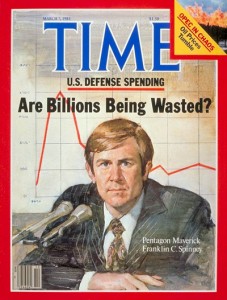
The very important rule rule is “Follow-the-Money.” So, when applied to the War on Terror what do we find? Perhaps, we find a tremendous strengthening of the Military-Industrial-Complex, a substantiation for unconscionable U.S. military budgets (to the determent of other budget areas such as education) and exceedingly huge profits of such corporate giants as Halliburton. According to a 2012 article in the Huffington Post, the U.S. spends more than China, Japan, UK, France, and Russia combined. More than all these added together. Russia spent 52.7 billion while the United States spent 695.7 billion (Not counting off the books stuff such as ‘black ops.”)
Could the War on Terror really be, substantially (and pivotally), about power and money? And until the majority of we, the people, become realistic about the ‘why’ of ‘things’, shine light into the shadows of secrecy, and demand appropriate responsible action from government and corporate leaders, the very few will control the many to the determent of the citizen-public. Consider this; existing corporate-government relationships are insidious in nature and dangerous in fact. President Eisenhower warned us about the this relationship (military-industrial complex) as he left office. Why do you think he waited to do so at the end of his presidency? Think about it. A more balanced relationship can be created. Actually, it must be if our country is to be sustainable and viable in the future. I want a sustainable and viable country. I assume that you do too.
Charts Show that U.S. Policy Has Increased Terror Attacks
The National Consortium for the Study of Terrorism and Responses to Terrorism (START) Global Terrorism Database – part of a joint government-university program on terrorism – is hosted at the University of Maryland.
START is the most comprehensive open source terrorism database, which can be viewed by journalists and civilians lacking national security clearance.
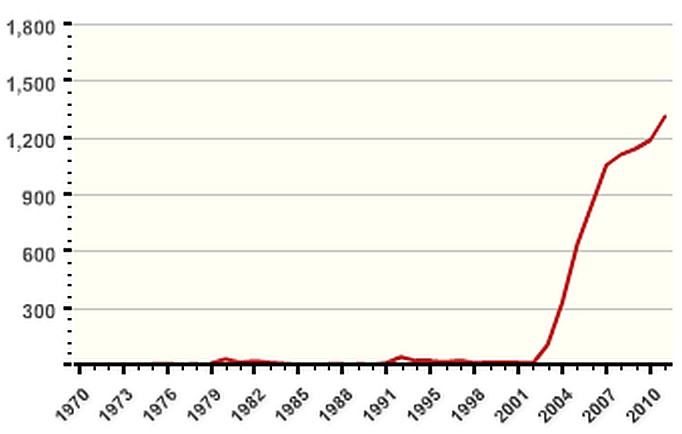
A quick review of charts from the START database show that terrorism has increased in the last 9 years since the U.S. started its “war on terror”.
Click on Image to Enlarge
This chart shows the number of terror attacks conducted in Iraq:
Phi Beta Iota: The article and the charts do not address the financial terrorism of the City of London and Wall Street that have destroyed entire national economies, and particularly those of the USA, Spain, Portugal, Ireland, and Greece. Iceland, alone, had the integrity and intelligence to stuff the bankers into jail.
Gordon Duff first reported in Veterans Today another financial scandal motive for the Repubs wanting to hold up Obama Care. New regulations were going into effect to stop the cross collateralization of insurance company reserves, who are all owned by banks, so they could be market traded. The sums involved were astronomical.
“The Obama Care issue is about ‘funds in management.’ The health insurance industry, through investment banks and hedge funds, accounts for 35% of the entire investment capital of the United States.
This sector has been totally unregulated with, not just individual policyholders but industries and government forced to subsidize a health care Ponzi scheme where in some cases fewer than 3% of policy premiums were paid back in benefits.”
The unprecedented Saudi refusal to take up its Security Council seat is not just about Syria but a response to the Iranian threat
The Muslim world’s historic – and deeply tragic – chasm between Sunni and Shia Islam is having worldwide repercussions. Syria’s civil war, America’s craven alliance with the Sunni Gulf autocracies, and Sunni (as well as Israeli) suspicions of Shia Iran are affecting even the work of the United Nations.
Saudi Arabia’s petulant refusal last week to take its place among non-voting members of the Security Council, an unprecedented step by any UN member, was intended to express the dictatorial monarchy’s displeasure with Washington’s refusal to bomb Syria after the use of chemical weapons in Damascus – but it also represented Saudi fears that Barack Obama might respond to Iranian overtures for better relations with the West.
The Saudi head of intelligence, Prince Bandar bin Sultan – a true buddy of President George W Bush during his 22 years as ambassador in Washington – has now rattled his tin drum to warn the Americans that Saudi Arabia will make a “major shift” in its relations with the US, not just because of its failure to attack Syria but for its inability to produce a fair Israeli-Palestinian peace settlement.
What this “major shift” might be – save for the usual Saudi hot air about its independence from US foreign policy – was a secret that the prince kept to himself.
Israel, of course, never loses an opportunity to publicise – quite accurately – how closely many of its Middle East policies now coincide with those of the wealthy potentates of the Arab Gulf.