Below the Line: Unclassified Impressions & Questions, Three Books on Truth, Past OSINT and IO References with Emphasis on Multinational Sharing and Sense-Making
Alec Ross on subversive technologies, Libya, Wikileaks, and the future of digital diplomacy.”We're willing to make mistakes of commission,” he tells Fast Company, “rather than omission.”
In the turbulent center of the Venn diagram involving President Obama's multilateral foreign policy, open government mandates, and Middle-East unrest is Alec Ross, the Senior Advisor for Innovation to Secretary of State Hillary Clinton. From asking Twitter to delay down-time maintenance during the 2009 student uprising to courting programmers for Africa, Ross's office has been tasked with coordinating the monumental logistics of a new philosophy that embraces global interdependence. Ross spoke with Fast Company about the meaning of the highly controversial “global citizenship” concept, the diplomatic difficulties in supporting subversive technologies, and the future of transparency.
John, a few yrs back you were posting doubts about the official explanations (both Norad and Nist have changed their stories) of 9/11, but not in a long time. I can imagine many reasons to abandon the discussion, like not upsetting some of your readers, but I just wanted to point out that back then the debate was dominated by speculation, but that in recent years the Truth movement has been professionalized by such orgs as Architects and Engineers for 9/11 Truth (some 1500 members risking their careers), Pilots for 9/11 Truth, Firefighters for 9/11 Truth, Scholars for 9/11 Truth, etc., as well as peer-reviewed scientific articles. I'd be interested in your thoughts on the subject nowadays.
We train kids to deal with teachers in a certain way: Find out what they want, and do that, just barely, because there are other things to work on. Figure out how to say back exactly what they want to hear, with the least amount of effort, and you are a ‘good student.'
We train employees to deal with bosses in a certain way: Find out what they want, and do that, just barely, because there are other things to do. Figure out how to do exactly what they want, with the least amount of effort, and the last risk of failure and you are a ‘good worker.'
The attitude of minimize is a matter of self-preservation. Raise the bar, the thinking goes, and the boss will work you harder and harder. Take initiative and you might fail, leading to a reprimand or termination (think about that word for a second… pretty frightening).
The linchpin, of course, can't abide the attitude of minimize. It leaves no room for real growth and certainly doesn't permit an individual to become irreplaceable.
If your boss is seen as a librarian, she becomes a resource, not a limit. If you view the people you work with as coaches, and your job as a platform, it can transform what you do each day, starting right now. “My boss won't let me,” doesn't deserve to be in your vocabulary. Instead, it can become, “I don't want to do that because it's not worth the time/resources.” (Or better, it can become, “go!”)
The opportunity of our age is to get out of this boss as teacher as taskmaster as limiter mindset. We need more from you than that.
I recently had the distinct pleasure of participating in a fascination workshop on “Information and Communication Technology in Areas of Limited Statehood: A New Form of Governance?” The workshop was organized by the Frei Universität’s program on Governance in Areas of Limited Statehood and co-directed by Professors Gregor Walter-Drop and Steven Livingston.
. . . . . .
My colleague Gregory Asmolov made the link explicit during his excellent presentation on “Russian Wildfires and Alternative Modes of Governance: The Role of Crowdsourcing in Areas of Limited Statehood.” Here’s a summary:
“Because of it’s geographical size, high degree of corruption, and reliance on an extraction economy, governance by government in Russia is often weak and ineffective. Russian political expert Liliya Shevtzova goes so far as to claim that the current regime is an imitation of governance. The 2010 wildfires demonstrated the limited capacity of the state to provide effective emergency response. Information technologies, and crowdsourcing platforms in particular, fulfill the gap of the limited statehood. At the same time, however, the Russian government is also trying to use ICT to increase its claims to effective governance.”
Phi Beta Iota: This post is much more than a post. To the best of our (naturally limited) knowledge, this is the first and the best statement that clearly distinguished among “imitation governance,” spontaneous “self-governance,” and the role that information technology plays in making a mockery of the first and a reality of the second.
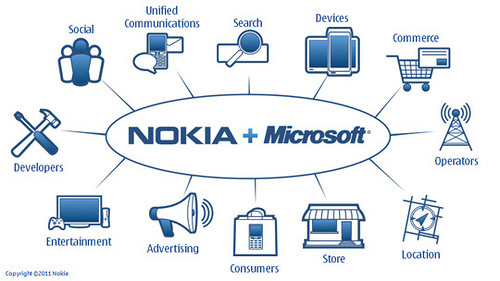
When Nokia announced that it will drop Symbian for Microsoft’s Windows Mobile, many in the industry were taken by surprise. Now, according to industry insiders, the strategy is becoming clear: Nokia will use Microsoft’s patented “white spaces” radio, enabling wireless devices to use television frequencies.
Click on Image to Enlarge
The two firms have apparently been working on a software defined radio platform for several years. Now the companies are preparing a world-wide rollout of a system that may short circuit the world’s largest carriers.
Microsoft and Nokia are expected to utilize small, WiFi-like access points, expected to cost $250-$500 dollars, rather than cell towers that can cost $250,000. Local access points, using unused television frequencies, penetrate indoors better and can have a range similar to PCS cellular radios – approximately 1-3 miles.
Multiple 6 MHz wide channels will be automatically ganged together in this new system, delivering an effective 2-12 Mbps for end users. Using TD-based LTE or WiMAX radios, with a software defined front end, the Nokia/Microsoft access points connect to the internet directly — like WiFi access points. The phones use VoIP software, similar to Skype, jointly developed by Nokia and Microsoft.
According to some industry observers, the impact of white space phones on today’s two trillion dollar telecommunications industry may be significant. White space phones will not need today’s infrastructure and licensed spectrum. They will not be dependent on phone companies.
The initial thrust for the whitespace phone system is expected to be in the developing world. The joint venture is expected to announce several test markets, including the Seattle area this summer and will test a Visa-enabled SIM card, enabling contactless payments.