We care a lot about finding people who are brilliant, who get things done, who make a difference. We care a lot about finding a playwright with talent, a surgeon who can cure us, a programmer who can get the thing to work.
Along the way, many of the linchpins who are able to do work like this develop affectations, quirks and even obnoxious qualities. They might demand an over-equipped dressing room or a private jet or merely be a jerk in meetings (or show up late, which is almost as bad).
We often put up with this, because, after all, they're superstars, right?
Somewhere along the way, we confused the signals with the work. Now there are people who start with the bad behavior and the affectations, hoping that it will be seen as a sign of insight and talent. And they often get away with it. “Who's that?” we wonder… “I don't know, but they must be good at what they do, because why else would we put up with them?” It's a great plan when it works, but I don't think it's a strategy to be counted on.
The key to getting a reputation for being brilliant is actually being brilliant, not just acting like you are.
Phi Beta Iota: The literature on organizational pathologies also refers to this as “rankism,” an affliction suffered by most who rise to the top ranks and allow themselves to be cut off from reality. Daniel Elsberg's quote fromSecrets: A Memoir of Vietnam and the Pentagon Papers, is still the best:
The danger is, you’ll become like a moron. You’ll become incapable of learning from most people in the world, no matter how much experience they have in their particular areas that may be much greater than yours” [because of your blind faith in the value of your narrow and often incorrect secret information].
Tim Wu explains the rise and fall of information monopolies in a conversation with New York Times blogger Nick Bilton. Author of The Master Switch: The Rise and Fall of Information Empires (Borzoi Books), Wu is known for the concept of “net neutrality.” He’s been thinking about this stuff for several years, and has as much clarity as anyone (which is still not much) about the future of the Internet.
I think the natural tendency would be for the system to move toward a monopoly control, but everything that’s natural isn’t necessarily inevitable. For years everyone thought that every republic would eventually turn into a dictatorship. So I think if people want to, we can maintain a greater openness, but it’s unclear if Americans really want that…. The question is whether there is something about the Internet that is fundamentally different, or about these times that is intrinsically more dynamic, that we don’t repeat the past. I know the Internet was designed to resist integration, designed to resist centralized control, and that design defeated firms like AOL and Time Warner. But firms today, like Apple, make it unclear if the Internet is something lasting or just another cycle.
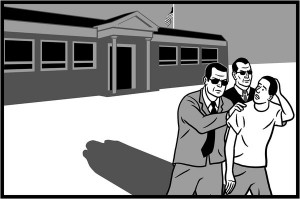
Mid-1990s: Gonzalez, 14, is visited by F.B.I. agents at his high school for hacking into NASA.
Gonzalez, law-enforcement officials would discover, was more than just a casher. He was a moderator and rising star on Shadowcrew.com, an archetypal criminal cyberbazaar that sprang up during the Internet-commerce boom in the early 2000s. Its users trafficked in databases of stolen card accounts and devices like magnetic strip-encoders and card-embossers; they posted tips on vulnerable banks and stores and effective e-mail scams. Created by a part-time student in Arizona and a former mortgage broker in New Jersey, Shadowcrew had hundreds of members across the United States, Europe and Asia. It was, as one federal prosecutor put it to me, “an eBay, Monster.com and MySpace for cybercrime.”
Phi Beta Iota: We opened Hackers on Planet Earth (HOPE) in 1994, making the observation that when the Israeli's captured a hacker they gave him a job, while the US simply kicked them in the teeth and sent them to jail. We tried to keep Phiber Optic out of jail, and we have for decades been on record comparing hackers to astronauts–full of the right stuff and pushing the edge of the envelope. No one, including Marty Harris then in charge of the National Information Infrastructure (NII) wanted to listen. Today the US Government is again ignoring the warnings on the urgency of getting a grip on all information in all languages all the time, and roughly 20 years behind in creating “root” cyber-security. This article by James Verini is a phenomenal update on what we all knew in the mid-1990's that the US Government is still oblivious to–this is not a problem technology or wanton spending can solve–this is a problem that demands discipline, integrity, intelligence, and sharing. It is neither possible nor desireable to secure government or military computers in isolation–this is an “all in” smart safe nation challenge.
Here’s a press release for a performance I’m co-producing with Scoop Sweeney:
AUSTIN – Catherine Braslavsky and Joseph Rowe will bring their musical performance, “From Jerusalem to Cordoba,” from Paris to Austin on December 3, 7pm at St. David’s Episcopal Church, Bethell Hall, 301 E. 8th St., Austin, 78701-3280. The performance is a celebration of the musical and mystical traditions in and around the Mediterranean, from ancient Judaism and Paganism, to medieval Christianity and Islam. It features ancient and original music sung in Hebrew, Aramaic, Latin, Greek, Medieval Spanish, Occitan, and Arabic. Instrumental accompaniment includes Middle Eastern percussion, oud, dulcimer, Tibetan bowls, Indian tampura, and African mbira.
The performance is built on short poetic and narrative texts that include both original material and quotations from Hildegard of Bingen, Meister Eckhart, Ibn ‘Arabi, Yehuda Halevi, etc. The narrative thread woven through the performance evokes a rarely-perceived common ground, and an alternative view of sacred traditions which have so often been in conflict. Braslavsky and Rowe have presented this performance at venues throughout Europe.
The Italian newspaper La Republicca describes the performance as “fascinating… with great spiritual power.” Author Jacques Attali describes it as “A remarkably successful voyage in sound, depicting those rare times when Jews, Christians and Muslims have lived together in peace and dialogue.” Rev. Lauren Artress, Canon at Grace Cathedral in San Francisco, calls it “uplifting and inspiring,” and notes that “Catherine and Joseph are truly gifted musicians. Allow them to enrich your life.” Jon Lebkowsky in Wired Magazine described the music as “…at once new, traditional, and transcendent. … chants and chant-like original compositions powerfully realized as invocations of the human essence — whether it be the soul, spirit, or consciousness — in its ascent.
Phi Beta Iota: This makes the cut for three reasons. First, Jon is selective about what he sends out. Second, holistic analysis and understanding must of necessity include music and art–the Western tradition has destroyed the role of the humanities and in so doing, committed sacrilige with science. Finally, faith is also a part of conscious evolution, and absent its full integration into any intellectual traditional, you end up with fundamentalist idiots doing grave damage within and among communities. Religion is at its most gifted when it is a vibrant part of the cultural tradition and used to transfer the lessons of civilization from one generation to the next–starting with the Golden Rule.
When Nokia announced yesterday that it was reabsorbing the Symbian operating system it had spun out as an open source effort 18 months ago, I thought, “Why bother? I thought MeeGo was your mobile OS future anyhow?” — especially given the lack of attention to the last major release of Symbian (Symbian 3) in September.
Phi Beta Iota: Both Microsoft and Nokia are at a fork in the road. The above review, vastly more critical than the fluff found elsewhere, is bleeding edge truth. Absent new management and a compelling vision–ideally one that united both companies to favor a very simple low cost cellular “key” combined with a vast global grid meshing humans with call centers and back office cloud processing, both companies appear destined for further decline.
LONDON — Months after he was released from Guantánamo Bay, Abdul Rahman was back in the company of terrorist leaders along the Pakistan-Afghanistan border. But he was a double agent, providing Taliban and al Qaeda secrets to Pakistani intelligence, which then shared the tips with Western counterparts.
The ruse cost him his life, according to a former Pakistani military intelligence official, Mahmood Shah. The Taliban began to suspect him, and after multiple interrogations executed him.
The case of Rahman, which Shah recounted to The Associated Press, falls in line with a key aspect of the fight against terror — Western intelligence agencies, with help from Islamic allies, are placing moles and informants inside al Qaeda and the Taliban. The program seems to be bearing fruit, even as many infiltrators like Rahman are discovered and killed.
It was a tip from an al Qaeda militant-turned-informant that led international authorities to find explosives hidden in printer cartridges from Yemen to the United States a week ago, Yemeni security officials say. Officials say the explosives could have caused a blast as deadly as the Lockerbie bombing that killed 270 people.
Phi Beta Iota: Human Intelligence (HUMINT) done right, in the context of Open Source Intelligence (OSINT) done right, is the cheapest, fastest, and most effective means of creating intelligence (decision-support) at all levels from strategic to tactical. After ten years of letting CIA get away with doing both badly, and ten years of the Pentagon's recovering from treating its HUMINT and CI people like shit, it appears that adults are finally back in charge. We continue to under-budget for operational HUMINT and OSINT, and we continue to grossly over-spend on contractor vapor-ware for technical capabilities that simply do not deliver 96% of what what we need, but that is a separate issue. It is good to see HUMINT (not OSINT) making some progress. However, the continued absence of a strategic analytic model and honest governance means that these capabilities are not being focused on transnational crime or on white collar crime, where the most significant gains in the public interest are to be achieved.


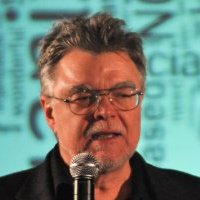
 , Wu is known for the concept of “net neutrality.” He’s been thinking about this stuff for several years, and has as much clarity as anyone (which is still not much) about the future of the Internet.