Journal: The Demise of US Intelligence Qua Brains

Collaboration Zones, Communities of Practice, Ethics, Information Operations (IO), Key Players, Methods & Process, Mobile, Policies, Real Time, Reform, Strategy, Threats
Full Story Online

sensible memo from BTC: Aviation Security After Detroit
INDUSTRY ANALYSIS: Aviation System Security
Business Travel Coalition December 27, 2009
By Kevin Mitchell

The Christmas attempt by a Nigerian man with PETN (one of the most powerful explosives known) affixed to his body to cause harm to an internationally-originated Delta Air Lines flight on approach to Detroit shone a bright light on much that is wrong with the U.S. approach to aviation system security. It is welcome news that President Obama has ordered an airline industry security review so long as it is strategic in nature.

. . . . . . .

The immediate post 9/11 security priority for the U.S. was to prevent a commercial airline from ever again being used as a weapon-of-mass-destruction. Airport screening was strengthened substantially, the Air Marshall program was expanded, cabin and cockpit crews were trained in advanced anti-terrorism techniques, many pilots were armed, F-14s were placed on alert, and most importantly, cockpit doors were reinforced and passengers were forever transformed from passive participants in a time of threat to able defenders. All of this was accomplished within a relatively short period of time after the U.S. was attacked on 9/11.

From that point forward the highest and best use of each incremental security dollar spent should have been on intelligence gathering, risk-management analysis and sharing, and on fundamental police work such that terrorists would never reach an airport, much less board an airplane. What does the immediate investigation into the near-calamity on Christmas reveal?

• The father of the accused terrorist, Umar Farouk Abdulmutallab, informed U.S. officials months ago that he was concerned about his son’s extreme religious views. Not a friend, not a teacher, but his very own father issued the warning!

• The accused Nigerian is in the Terrorist Identities Datamart Environment database (550K names) maintained by the U.S. National Counterterrorism Center. While not on the selectee list (14K names) or no-fly list (4K names), should not some of our scarce security dollars have been used to ensure that he was placed on the selectee list, questioned and subjected to extra searching prior to being allowed to board the Detroit-bound flight from Amsterdam?

U.S. Homeland Security Secretary Janet Napolitano appeared today on ABC’s This Week show and unabashedly steered clear of government accountability arguing that the U.S. did not have enough information to keep the accused man from boarding the flight or to add him to the selectee or no-fly list. However, his very father warned us! Moreover, the UK’s Daily Mail reports that Umar Farouk Abdulmutallab was banned from Britain; his last visa request refused! That the suspect did not but should have received additional questioning and physical screening is where the U.S. government’s focus should be, versus on the in-flight security illusion of restricted passenger movement, if it is intended to be more that temporary.

Continue reading “Journal: The Demise of US Intelligence Qua Brains”
Journal: Selected MILNET Headlines

05 Civil War, 08 Wild Cards, 10 Security, Government, Military

On Point in AF--Full Story

Roadside Bomb Hunting: Learned Skill or Intuition?

With IED casualties since 2001 mounting (2,451 dead, 23,650 wounded, in Iraq and Afghanistan as of Dec. 5), the military is mounting a determined effort to find out whether spotting IEDs is an intuitive, innate skill, like the ability to quickly pick up a new language, or whether it is learned through experience. Because if it's learned through experience, the military can teach other people to be good at it. And save lives.
The same questions arose 40 years ago when the Army and Marines began to wonder if they could clone the guys who were really, really good at walking point and guiding the troops around mines and booby-traps. Two major studies were completed, but the military lost interest as the war wound down and its attention turned back to the Cold War.

Official: Taliban Confident Of Afghan Victory

“They have chosen the IED as the way they are going to fight us,” the intelligence official said, adding the Taliban still engage troops in firefights and use suicide bombers.

“But the IED has had a strategic effect, and it's the weapon of choice. … And I say it's akin to the surface-to-air missile system for the mujahedeen back in the Soviet era.”

AWOL From The Battlefield In war, death of trust invited defeat

With President Obama's announcement the Afghan surge is for 18 months, any possibility trust between U.S. forces and the Afghan people will factor into the stability equation is minimized. Locals will be reluctant to trust U.S. forces just “passing through” the area; reports on militant activity will trickle, not flow, in.

Also missing will be the Afghan people's trust for their own military and police. . . .Trust by NATO troops for Afghan security forces suffers, too, as militants successfully infiltrate such security forces.  . . .  Additionally, many Muslims in Afghanistan and Pakistan distrust U.S. motives in Afghanistan. . . .

Spirit Of America In Afghanistan

In 2003, Sgt. First Class Jay Smith and his Army Special Forces team were based in Orgun-e, Afghanistan and were taking regular rocket fire from al Qaeda fighters. But Sgt. Smith and his men were armed with an effective counterweapon—gifts of school supplies and sports gear for children, and clothing, shoes and blankets for nearby families, all provided by American donors.

After receiving these items, the grateful villagers reciprocated by forming a night-watch patrol to protect our soldiers. Good relations with locals helped save American lives. I've witnessed this success on the front lines, aided by support from home, repeated many times since Sgt. Smith.

Elsewhere:


Continue reading “Journal: Selected MILNET Headlines”

Journal: Evaluating the Gaza Confrontation

04 Inter-State Conflict, 05 Civil War, 06 Genocide, 07 Other Atrocities, 08 Wild Cards, 10 Security, 11 Society, Civil Society, Cultural Intelligence, Ethics, Government, Military, Peace Intelligence
Chuck Spinney

The American strategist and military reformer Colonel John Boyd argued that nations and groups should shape their domestic policies, foreign policies, and military strategies so that they:

  • pump up one's own resolve and increase one's own solidarity,
  • drain away the resolve of one's adversaries and weaken their internal cohesion,
  • reinforce the commitments of allies to one's own cause and make them empathetic to one's success
  • attract the uncommitted to our cause or makes them empathetic to one's success
  • end conflicts on favorable terms that do not sow the seeds for future conflicts

These criteria are the essence of grand strategy and can be thought of as guidelines for evaluating the wisdom of specific policies or actions. And while they make sense logically and intuitively, the difficulty of defining policies that simultaneously conform to and strengthen to all these criteria is equally obvious. The latter challenge is particularly difficult for the unilateral military strategies and the coercive foreign policies like those preferred by Israel or the United States. Military operations and political coercion are often destructive in the short term, and these destructive strategic effects can be in natural tension with the aims of grand strategy, which should be constructive over the long term.

Moreover, the more powerful a country, the harder it becomes to harmonize the often conflicting criteria for a sensible grand strategy. Overwhelming power breeds hubris and arrogance which, in turn, carry a temptation to use that power coercively and excessively. But lording over or dictating one's will to others breeds resentment. Thus, possession of overwhelming power increases the risk of going astray grand strategically.

That risk is particularly dangerous when aggressive external actions, policies, and rhetoric are designed to prop up or increase internal cohesion for domestic political reasons. Very often, the effects or military strategies or coercive foreign policies that are perceived as useful in terms of domestic political cohesion backfire at the grand-strategic level, because they strengthen our adversaries' will to resist, push our allies into a neutral or even an adversarial corner, or drive away the uncommitted … which together, can set the stage for continuing conflict.

With these general thoughts about grand strategy in mind, read the following article by Uri Avnery and ask yourself if Israel's most recent war in Gaza made sense at the tactical level of conflict?, the strategic level of conflict? … and most importantly, at the grand strategic level of conflict?

Chuck Spinney

Full Story Online

Cast Lead 2


Antiwar.com

December 28, 2009

Did we win? Sunday marked the first anniversary of the Gaza War, alias Operation Cast Lead, and this question fills the public space.

Continue reading “Journal: Evaluating the Gaza Confrontation”

Journal: Billions in Aid Mis-Appropriated–Global to Local Needs Table Would Eliminate This Kind of Fraud

Communities of Practice, Ethics, Gift Intelligence, Key Players, Mobile, Policies, Real Time, Threats
Home Page

Sri Lanka tsunami aid misappropriated: watchdog

COLOMBO (AFP) – Nearly half a billion dollars in tsunami aid for Sri Lanka is unaccounted for and over 600 million dollars has been spent on projects unrelated to the disaster, an anti-corruption watchdog said Saturday.

. . . . . . .

The group alleged that out of 2.2 billion dollars received for relief, 603.4 million dollars was spent on projects unrelated to the disaster.

Another half a billion dollars was missing, the group said.

Search: how could cybernetics help obama to govern

Searches

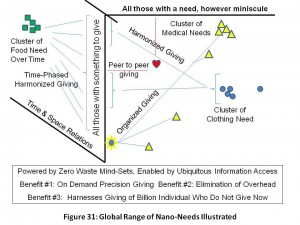
Way cool!  First off, the White House is theater.  We have no strategy, the Office of Management and Budget (OMB) does not know how to manage, and the Central Intelligence Agency (CIA) does not know how to produce intelligence (decision-support) for all who have a “need to know.”  Until President Barack Obama, whom we pray for daily, understands that he does not need to remain a virtual prisoner of Rahm Emanuel and Wall Street, the USA will continue to be Empire as Usual with an incoherent, ineffective government that fails all of us, responsive only to special interests.  Below is a single extraordinary article we found in thinking about your search, followed by a single graphic illustrating how we believe that Cognitive Science (the science side of the World Brain) and Collective Intelligence (the humanities side of the World Brain) can resurrect the deep goodness of America the Beautiful, and create a Prosperous World at Peace.  Obama is exactly one telephone call away from greatness.  Probably not going to happen.

Full Story Online

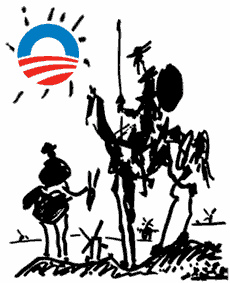
Cracking the Obama Code: Don Quixote vs. the Windmill Owners

Written by “Red Square” of thepeoplescube.com

Uploaded on September 18, 2009

Four hundred years ago, Miguel Cervantes described an archetypal delirious fruitcake who wanted to change the world by turning the clock back to the idealized Utopian times that never really existed. Imagine what Cervantes would write today about the futility of his satirical effort, if he were to learn that four centuries later, a whole movement would arise that emulated his loony character and elected one of their kind as the leader of the free world.
~
Some conservative commentators are demonstratively wishing President Obama well. My heart admires their good intentions, but as I watched Obama's inauguration on TV, my mind couldn't help but ponder the possible consequences thereof.

As someone coming from another country (ex-USSR) I don't participate in racial debates nor do I want to. Being post-racial is fine by me. So let's accept Obama's post-racial premise, leave the issue of melanin content aside, and judge the man solely by the content of his agenda. And the more I look at Obama's agenda the more I realize that wishing him well is like wishing luck to Don Quixote in wrecking the windmill that feeds me and my family.

It's not a matter of taste. The spectacle of a bombastic crackpot in medieval armor poking his lance at random objects is disquieting if you own and operate an industrial facility. It sends thrills up your legs if you share the noble hidalgo's conviction that the perfectly functional, cereal-grinding, income-generating windmills are the embodiment of evil, spreading death and destruction. As far as popular entertainment goes, I've seen worse. But when Don Quixote organizes a community to fight windmills and receives massive support, anyone with a job should be worried. When he becomes president with a popular mandate to wreck windmills at taxpayers' expense, using the government apparatus, hope becomes all but absent.

Being light on details, Obama's inaugural speech briefly remunerated his views – which we already knew from his previous comments, associations, voting record, and cabinet appointments. Here is a partial list of the windmills he pledges to fight:

Windmill #1: Greed is bad for the economy.
Greed is a known “progressive” code word for the freedom to keep what you earn – the sort of freedom that made the United States the economic wonder of the world. To be fair, during the presidential debates McCain also attacked greed in rather quixotic terms, although next to Obama he sounded more like the simple-minded Sancho Panza.

Phi Beta Iota:  Reluctantly, we have copied the entire post because it is utterly brilliant and merits preservation.  Click on the graphic to read the original or below to read the safety copy this sheer work of genius.


Continue reading “Search: how could cybernetics help obama to govern”

noble gold