SchwartzReport: 25% of Americans Struggle to Afford Food; Latin American Inequality Improving While US Most Unequal Country on the Planet

01 Agriculture, 03 Economy, 06 Family, 07 Health, 11 Society

This story, I think, more than almost any other trend I follow on SR makes me furious. Nearly twenty five percent of the people in the richest country on earth struggle to have enough to eat. And the Republicans try over and over again to cut even the little social support that does exist to see that the elderly and the young get at least something to eat. This is immoral at a level I ca! nnot find the words to express.

Report: Nearly a Quarter of All Americans Struggle to Afford Food
KATIE MCDONOUGH, Assistant Editor – Salon

When I read this story I remembered favelas I had seen in Brazil, or the slums in Agentina, and thought to myself is it possible that the disparity between our one per cent and the 99 per cent is so great that it is worse than the difference between rich and poor in Latin America. Apparently it is. What a commentary. This is what we have sunk to.

Latin America’s Inequality Is Improving; The U.S. is The Most Unequal Country In The West
PATRICIA REY MALLÉN – International Business Times


SchwartzReport: Scientists Fighting Corporate Subversion or “The War on Science”

01 Poverty, 02 Infectious Disease, 03 Economy, 03 Environmental Degradation, 05 Energy, 07 Health, 07 Other Atrocities, 09 Justice, 11 Society, Academia, Commerce, Earth Intelligence, Ethics, IO Impotency

schwartz reportThe attack on science by the Theocratic Right and the corporate interests destroying the earth have done great damage, but finally science is pushing back. We'll see.

Corporations Are Manufacturing Uncertainty About Scientific Findings. Now Scientists Are Fighting Back.
BILL MOYERS & COMPANY – The Raw Story

Eagle: Charles Hugh Smith on Degrowth, Anti-Consumerism and Peak Consumption

03 Economy, Civil Society, Commerce, Cultural Intelligence, Earth Intelligence
300 Million Talons...
300 Million Talons…

Degrowth, Anti-Consumerism and Peak Consumption

Degrowth embraces the ongoing devolution of paid work and wealth that cannot be reversed.The anti-consumerism Degrowth movement is gaining visibility and adherents in Europe. Degrowth (French: décroissance, Spanish: decrecimiento, Italian: decrescita) recognizes that the mindless expansion of mindless consumption fueled by credit and financialization is qualitatively and quantitatively different from positive growth.

Degrowth is based on a number of principles:

1. Consumerism is psychological/spiritual junk food (French: malbouffe) that actively reduces well-being (bien-etre) rather than increases it.

2. Better rather than more: well-being is increased by everything that cannot be commoditized by a market economy or financialized by a cartel-state financial machine– friendship, family, community, self-cultivation–rather than by acquiring more. The goal of economic and social growth should be better, not more. On a national scale, the cancerous-growth measured by gross domestic product (GDP) should be replaced with gross domestic happiness/ gross nation happiness (GNH).

3. A recognition that resources are not infinite, despite claims to the contrary. Even if fossil fuels were infinite and low-cost (cheerleaders never mention costs of extraction and refining or the external costs), fisheries, soil and fresh water are not. For one example of many: China Is Plundering the Planet's Seas (The Atlantic). Indeed, all the evidence suggests that access to cheap energy only speeds up the depletion and despoliation of every other resource.

4. The unsustainability of consumerist consumption dependent on resource depletion and financialization (i.e. the endless expansion of credit and phantom collateral).

Read full article with video.

Eagle: China Deepens Control in Argentina

02 China, 03 Economy
300 Million Talons...
300 Million Talons…

I’ll bet that this one didn’t get much air time, if any, on SeeBS, CNoNews, Faux News or any of the other lamestream media, and it’s yet another sign of geopolitical and economic realignment underway:

China to the rescue of Argentina with a 10 billion dollars equivalent swap

This is one that requires a lot of reading between the lines, and I’m probably not any closer to the tea leaves on this one than anyone else, except on one very important thing: Argentina, like the other South American countries, has been persistenly and consistently under the economic and geopolitical thumb of big brother to the north for a long time. Indeed, the USA and its financial oligarchs have been treating South America as a kind of second class collection of “states” or colonies for some time, and particularly since the end of World War Two. The emergence of the BRICSA nations, and Brazil’s central role in it, has begun the decoupling process, a process that will go on for a long time.

So that brings us to the other great South American power, Argentina, and to President Cristina Fernandez, and to this article. I suspect that the tea leaves one needs to read are most prominent in the first and last paragraphs:

SchwartzReport: Army Goes Green (20 Years After It Was Told To…)

03 Economy, 03 Environmental Degradation, 05 Energy, 07 Health, 11 Society, DoD, Earth Intelligence, Ethics, Military, Officers Call

schwartz reportThis is good news. The military, perhaps because it is a centralized command structure, often adopts progressive positions before general society. The military integrated long before the rest of America. It became a gender, race, and religion neutral meritocracy — an evolution in which I played a role — well before this was the norm. So the military's adaptation of noncarbon energy is the latest in a line of accomplishments.

The Army Goes Off the Grid
Jim Hightower – Nation of Change

Continue reading “SchwartzReport: Army Goes Green (20 Years After It Was Told To…)”

David Isenberg: Harvard Paper on Financial Legacy of Iraq and Afghanistan

03 Economy, Military


David Isenberg
David Isenberg

The Financial Legacy of Iraq and Afghanistan: How Wartime Spending Decisions Will Constrain Future National Security Budgets Faculty Research Working Paper Series

Linda J. Bilmes, Harvard Kennedy School

Abstract:
The Iraq and Afghanistan conflicts, taken together, will be the most expensive wars in US history – totaling somewhere between $4 to $6 trillion. This includes long-term medical care and disability compensation for service members, veterans and families, military replenishment and social and economic costs. The largest portion of that bill is yet to be paid. Since 2001, the US has expanded the quality, quantity, availability and eligibility of benefits for military personnel and veterans. This has led to unprecedented growth in the Department of Veterans Affairs and the Department of Defense budgets. These benefits will increase further over the next 40 years. Additional funds are committed to replacing large quantities of basic equipment used in the wars and to support ongoing diplomatic presence and military assistance in the Iraq and Afghanistan region. The large sums borrowed to finance operations in Iraq and Afghanistan will also impose substantial long-term debt servicing costs. As a consequence of these wartime spending choices, the United States will face constraints in funding investments in personnel and diplomacy, research and development and new military initiatives. The legacy of decisions taken during the Iraq and Afghanistan wars will dominate future federal budgets for decades to come.

PDF 22 Pages

Continue reading “David Isenberg: Harvard Paper on Financial Legacy of Iraq and Afghanistan”

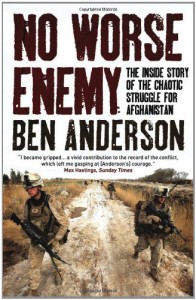
Berto Jongman: Afghanistan For Real: This Is What Winning Looks Like — Article, Full Length Movie Online, and Book

03 Economy, 04 Inter-State Conflict, 05 Civil War, 07 Other Atrocities, 08 Proliferation, 08 Wild Cards, 09 Terrorism, 10 Security, 10 Transnational Crime, 11 Society, Corruption, Cultural Intelligence, Government, Idiocy, IO Deeds of War, Media, Military, Peace Intelligence
Berto Jongman
Berto Jongman

This Is What Winning Looks Like – Full Length

VICE News

NEWS

This Is What Winning Looks Like

My Afghanistan War Diary


Amazon Page
Amazon Page

By Ben Anderson

I didn’t plan on spending six years covering the war in Afghanistan. I went there in 2007 to make a film about the vicious fighting between undermanned, underequipped British forces and the Taliban in Helmand, Afghanistan’s most violent province. But I became obsessed with what I witnessed there—how different it was from the conflict’s portrayal in the media and in official government statements.

. . . . . . .

In February 2013, on his last day at the helm of NATO forces in Afghanistan, General John R. Allen described what he thought the war’s legacy will be: ‘‘Afghan forces defending Afghan people and enabling the government of this country to serve its citizens. This is victory, this is what winning looks like, and we should not shrink from using these words.’’ 


The US and British forces are preparing to leave Afghanistan for good (officially, by the end of 2014), and my time in the country over the last six years has convinced me that our legacy will be the exact opposite of what Allen posits—not a stable Afghanistan, but one at war with itself yet again. Here are a few encapsulated snapshots of what I’ve seen and what we’re leaving behind.

Read full article.

noble gold