Chuck Spinney: Greece in Freefall, Preview of USA in 2013?

03 Economy, 07 Other Atrocities, 11 Society, Budgets & Funding, Commerce, Corruption, Government, Office of Management and Budget
Chuck Spinney

Europe in crisis: Greece in chaos

Personally and collectively, the Greeks don’t understand and can’t cope with what’s happening now, let alone what will happen next. The welfare state is being swiftly and deliberately dismantled without any time to set up replacements

Noëlle Burgi

Le Monde diplomatique, December 2011

EXTRACT:

The Greeks struggle to see a way out of what a social worker described as a return to a “barbaric” way of life. They feel abandoned and unable to cope. Strong family ties are buckling under the pressure of diminished incomes and a collapsing welfare state. Those who can leave, do so. The options for those remaining are limited. Some turn to the Church, which arranges soup kitchens and other social services. In Salonika, Father Stefanos Tolios of the Orthodox church, is swamped by desperate people looking for work. Residents of several cities (Volos, Patras, Heraklion, Athens, Corfu, Salonika) have set up community-based informal economies, based on local exchange systems. Families are bringing their elderly back from retirement homes, to recover the monthly charge of € 300-400.

No country could withstand this. Greece is worse equipped to deal with the social consequences of the austerity measures imposed with a “scientific cruelty” (7) by the national and transnational elites.

Read full article.

Phi Beta Iota:  The level of detail in this article is superb.  The author provides a gripping preview of what could befall the USA in 2012 — Obama will cook the books and spend borrowed money to create a semblance of stability in support of his bid to be President but the bottom line is clear: whoever is elected will deal with a  near-total collapse of the economy and the government in 2013.  If America does not elect a team with a governance philosophy that places We the People first, we are in for four more years of elite loot-fest and the implosion of what is left of the USA.

Marcus Aurelius: The Future of Afghanistan – and US Policy

02 Diplomacy, 03 Economy, 04 Inter-State Conflict, 05 Civil War, 07 Other Atrocities, 08 Wild Cards, 09 Terrorism, 10 Security, 11 Society, Budgets & Funding
Marcus Aurelius

The Future of Afghanistan and U.S. Foreign Policy

Foreign Affairs Snapshot, December 15, 2011

In Afghanistan, even minimally accountable democracy may soon be beyond reach. If so, some form of constrained warlord rule will be the most that's achievable.

The Three Futures for Afghanistan

Snapshot, December 16, 2011

Success in Afghanistan would not be as difficult or expensive as it was for the United States to win wars in Europe or counter the communist threat. Given the risks and the opportunities ahead, an investment in South Asia is worth making.

The Case for Continuing the Counterinsurgency Campaign In Afghanistan

Snapshot, December 16, 2011

The drawdown in Afghanistan may be afoot, but racing for the exits will leave large parts of the country — especially around Kabul in the east — infested with insurgent havens.

A Shift in the Afghanistan Strategy

Letter From, December 1, 2011

The drawdown of U.S. and NATO forces in Afghanistan will proceed rapidly through 2014. As a consequence, the mission will change sooner than many people expect, and that means the fledgling Afghan National Army has to take charge of the fight now.

Afghanistan's Lost Decade

Snapshot, December 15, 2011

Judged by any yardstick, Afghanistan has made little progress since 2001. The United States and its allies have bred an overly centralized and ineffective government in Kabul that is hooked on foreign aid and struggles against a resurgent Taliban. Without serious reforms, the next ten years could be worse.

Washington's Colonial Conundrum in Afghanistan

Snapshot, December 15, 2011

In Afghanistan, the United States faces a choice: either establish a permanent administrative and security presence, or stand back and risk the country becoming a haven for organized criminals and terrorists. Staying forever won’t work, so Washington must accept the risks of withdrawal.

An Absence of Strategic Thinking

Snapshot, December 16, 2011

The U.S. withdrawal from Afghanistan is driven largely by domestic politics. That is a privilege of a country that is both rich and safe. But the United States has security interests in Afghanistan and Pakistan that, despite its best attempts, it will not be able to ignore.

Phi Beta Iota:  Nowhere in this edition of Foreign Affairs is there any reference to an over-arching strategic model that is reality-based and focused on the public interest.  Instead, what we have here are a variety of ideological viewpoints that are totally lacking in any sort of “true cost” accounting analytics.

Chuck Spinney: German Economic Imperialism Killing Europe?

01 Brazil, 02 China, 03 Economy, 03 India, 04 Inter-State Conflict, 05 Civil War, 06 Russia, 07 Other Atrocities, 08 Wild Cards, 10 Transnational Crime, Analysis, Civil Society, Commerce, Corruption, Government, Law Enforcement, Money, Banks & Concentrated Wealth, Policy, Power Behind-the-Scenes/Special Interests, White Papers
Chuck Spinney

Will Germany Kill the Goose that Laid the Golden Egg?

Since the middle of the 19th Century, the central questions in European politics have been been have been the closely connected questions of nationalism and the rise of German power.  As my good friend and eminent historian Gabriel Kolko shows in the brilliant essay attached below, the post war solutions of NATO and the European Union, together with the exigencies of the Cold War, put these questions on hold, but their fundamentals remained, sleeping beneath the surface, and today, the conflicting questions of nationalism and German power are again coming to the fore to create ominous problems for Europe and the world.
There can be no question that, until 2007 or so, the European Union — particularly the opening of borders, the free flow of labour and capital, the disappearance of tariffs, and diminution of non-tariff trade restrictions, etc. combined to make life better for the mass of average Europeans.  Standards of living rose steeply and social services improved in parallel.  This was particularly evident in the poorer EU countries on the southern rim.  I saw and experienced this astounding improvement in the quality of life on a very personal level, living on a sailboat in southern Europe since the summer of 2005.  I will never forget the comment made to me by an Italian psychologist in Calabria in 2006, which is the heart of the provincial south of Italy, “It is a great time to be a European.” To be sure, he was an educated member of the upper middle class, and not representative of the average Calabrian, but it struck me that this Calabrian saw himself as a European.  It was not very long ago, that such a person would only loosely consider himself to be an Italian, not to mention a European.

Josh Kilbourn: 50 Economic Numbers About USA – Frightening!

03 Economy, 11 Society, Commerce, Corruption, Government, Money, Banks & Concentrated Wealth, Power Behind-the-Scenes/Special Interests
Joshua Kilbourn

50 Economic Numbers About The US That Are “Almost Too Crazy To Believe”

Tyler Durden on 12/16/2011

The Economic Collapse Blog does a terrific job of periodically putting together a compilation of the scariest data points about the US economy. Today is one such day, and the list of 50 economic numbers presented is indeed, as the author puts it, “almost too crazy to believe“… Almost. As noted: “At this time of the year, a lot of families get together, and in most homes the conversation usually gets around to politics at some point.  Hopefully many of you will use the list below as a tool to help you share the reality of the U.S. economic crisis with your family and friends.  If we all work together, hopefully we can get millions of people to wake up and realize that “business as usual” will result in a national economic apocalypse.” Or, far more likely, 99% of the population can continue watching Dancing with the Stars, as what little wealth remains is terminally transferred to those who are paying attention right below everyone's eyes.

From the Ecopnomic Collapse Blog:

The following are 50 economic numbers from 2011 that are almost too crazy to believe….

#1 A staggering 48 percent of all Americans are either considered to be “low income” or are living in poverty.

49 remaining items below the line.

Continue reading “Josh Kilbourn: 50 Economic Numbers About USA – Frightening!”

Chuck Spinney: Political Fluff on Iraq vs Real-World Appraisals

03 Economy, 04 Inter-State Conflict, 05 Civil War, 05 Iran, 07 Other Atrocities, 08 Wild Cards, 10 Security, Corruption, Government, Military, Officers Call
Chuck Spinney

After running for President in 2008 on a platform that criticized Iraq as a “dumb war,” Barack Obama just declared America’s misbegotten Iraqi adventure to be an “extraordinary achievement” in a speech to soldiers at Fort Bragg. That declaration of success is not enough for Congressman Duncan Hunter, who took Obama to task, saying, “And even now, as president, he refuses to acknowledge that victory was achieved,”

Such is the self-referencing nonsense produced in contemporary American political discourse shaped by a perpetual election cycle that disconnects debate from the real world and stifles rational governance, but keeps the masses entertained and distracted, much like the circuses did for the Roman masses in the waning days of the Empire. With American politicians are arguing endlessly how great a victory we achieved in Iraq, a natural question remains unasked: What does the rest of the world — particularly the Arab world — thinks of our ‘success'?

Attached, FYI, are two thoughtful alternative points of view on this question.

The first headline is from Rami Khouri's.  He is a columnist for the Lebanese Daily Star and is syndicated by the prestigious Agence-Global. The second headline is from Patrick Cockburn's, writing in the Independent [UK].  He is one of the most well informed western reporters now writing about the Middle East.

Praise Tunisia, not the Iraqi nightmare

By Rami G. Khouri, Daily Star, 14 December 2012

The United States under President George W. Bush drew on a deep well of nonsense, lies and fantasy when it entered Iraq in 2003. President Barack Obama continued this bipartisan American tradition when he said Monday that the departure of American forces from Iraq left behind a country that can be a model for other aspiring democracies. On the other side of the Arab world on the same day, the Tunisian people elected a new president, providing a more credible example of how Arabs can aspire to become democratic without foreign armies destroying their national fabric.  Read more.

Wars without victory equal an America without influence

World View: For all its military might, the US has failed to get its way in Afghanistan and Iraq, severely denting the prestige of the world's only superpower
Patrick Cockburn, Independent, 12 December 2011

Phi Beta Iota:  Mr. Cockburn's article contains one major assumption, to wit that the US  Government will not attack Iran nor condone an Israeli attack on Iran.  We disagree.  Now more than ever, Israel is bent on attacking Iran and drawing the US in–the deployment of US/NATO troops all around Syria, the plans for major NATO air operations ostensibly against Syria (long billed, falsely, as an Iranian puppet state) all point to precisely the opposite: a cresendo joint US-Israel mega-attack on Iran and Syria together.

Mini-Me: Comunidad de Estados Latinoamericanos y Caribeños (CELAC)

01 Brazil, 03 Economy, 08 Wild Cards, 09 Justice, 10 Security, 11 Society, Advanced Cyber/IO, Commerce, Commercial Intelligence, Counter-Oppression/Counter-Dictatorship Practices, Cultural Intelligence, Government
Click on Image to Enlarge

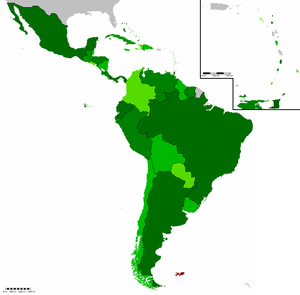
The Community of Latin American and Caribbean States (Spanish: Comunidad de Estados Latinoamericanos y Caribeños, CELAC, Portuguese: Comunidade de Estados Latino-Americanos e Caribenhos, French: Communauté des États Latino-Américains et Caribéens, Dutch: Gemeenschap van de Latijns-Amerikaanse en Caribische landen) is the tentative name[1] of a regional bloc of Latin American and Caribbean nations created on February 23, 2010, at the Rio GroupCaribbean Community Unity Summit held in Playa del Carmen, Quintana Roo, Mexico.[2][3] It consists of all sovereign countries in the Americas, except for Canada, France, the Netherlands and the United States. British and Danish dependencies in the Americas are also not represented in CELAC.

CELAC is an example of a decade-long push for deeper integration within the Americas.[4] CELAC is being created to deepen Latin American integration and to reduce the once overwhelming influence of the United States on the politics and economics of Latin America, and is seen as an alternative to the Organization of American States (OAS), the regional body organized largely by Washington in 1948, ostensibly as a countermeasure to potential Soviet influence in the region.[4][5] [6]

Continue reading “Mini-Me: Comunidad de Estados Latinoamericanos y Caribeños (CELAC)”

DefDog: Washington’s Integrity Part N to the Nth

03 Economy, 07 Other Atrocities, 09 Justice, 11 Society, Commerce, Corruption, Government, Law Enforcement, Money, Banks & Concentrated Wealth, Power Behind-the-Scenes/Special Interests
DefDog

More of the lack of integrity and the bilking of the middle class…..

Mr. Corzine Goes to Washington, With No Pull

William D. Cohan

Bloomberg.com, 11 December 2011

When it comes to shining a light on the cozy relationships between Wall Street and Washington, and how the rich and powerful get access to things the rest of us don’t, there can never be too many juicy examples.

Last month, thanks to Bloomberg Markets magazine, we were treated to the excellent story about how former Treasury Secretary Henry Paulson met with a bunch of bankers and hedge fund managers in New York during the summer of 2008 and shared with them some of his early thinking on the futures of the mortgage behemoths Fannie Mae and Freddie Mac.

Then, last week, Jon Corzine, the former chief executive officer of the defunct MF Global Inc. with a gold-plated resume — he was also a senior partner of Goldman Sachs Group Inc. and a U.S. senator and governor of New Jersey — testified before the House Agriculture Committee about his often-successful campaign to thwart the efforts of Washington regulators to enact rules that he and MF Global didn’t like.

Read full story.

See Also:

2012 Reflexivity = Integrity: Toward Earth/Life 4.0

Journal: Politics & Intelligence–Partners Only When Integrity is Central to Both

Journal: Reflections on Integrity UPDATED + Integrity RECAP

noble gold