In 1912, Woodrow Wilson campaigned for President using many Progressive ideas about strengthening the economy: banking reform, tariff reduction and the elimination of monopolies and trusts. The consolidation of these ideas became known as the New Freedom.
After Wilson's election, Louis Brandeis (who was responsible for many of Wilson's ideas in the first place) wrote a series of articles for Harper's Weekly which outlined why the New Freedom was necessary and how best to implement it. In 1914, the articles were collected in book form and published under the title Other People's Money–and How the Bankers Use It.
Brandeis' central thesis was that the large banking houses were colluding with businessmen to create trusts in America's major industries. Brandeis felt that not only did trusts stifle competition, but also they became so large that they became unable to operate efficiently.
Click on Image to Enlarge
Brandeis backed up his arguments with facts–copious facts gleaned from his battles against J. P. Morgan and Charles Mellen in the New Haven Railroad merger battle and from the Pujo Committee–a House committee report that investigated the abuses of the “Money Trust.”
Wilson was able to push through a number of laws regarding the regulation of business and trusts, but in many ways, due to mergers and stock manipulation, conditions in the business world today remain the same. Many of the details in Other People's Money may be dated, but its central ideas remain relevant–so much so that is still in print almost 90 years after it was first published. The chapters here are free online.
These are discouraging times, but once in a blue moon a bit of hope appears. I am pleased to report on the bit of hope delivered in March of 2011 by Michael Spence, a Nobel prize-winning economist, assisted by Sandile Hlatshwayo, a researcher at New York University. The two economists have taken a careful empirical look at jobs offshoring and concluded that it has ruined the income and employment prospects for most Americans.
To add to the amazement, their research report, “The Evolving Structure of the American Economy and the Employment Challenge,” was published by the very establishment Council on Foreign Relations.
For a decade I have warned that US corporations, pressed by Wall Street and large retailers such as Wal-Mart, to move offshore their production for US consumer markets, were simultaneously moving offshore US GDP, US tax base, US consumer income, and irreplaceable career opportunities for American citizens.
Among the serious consequences of offshoring are
the dismantling of the ladders of upward mobility that made the US an “opportunity society,”
an extraordinary worsening of the income distribution, and
large trade and federal budget deficits that cannot be closed by normal means. These deficits now threaten the US dollar’s role as world reserve currency.
Phi Beta Iota: Everything killing the USA today was properly briefed to the Senate and the White House in the 1970's, 1980's, and 1990's. The missing ingredient was INTEGRITY on the part of the listeners. Intelligence without integrity is irrelevant; integrity without intelligence is dangerously uninformed.
Last year was another good year for millionaires – though their pace of growth is slowing.
According to a new report by Boston Consulting Group out today, the number of millionaire households in the world grew by 12.2% in 2010, to 12.5 million. (BCG defines millionaires as those with $1 million or more in investible assets, excluding homes, luxury goods and ownership in one’s own company).
The U.S. continues to lead the world in millionaires, with 5.2 million millionaire households, followed by Japan with 1.5 million millionaire households, China with 1.1 million and the U.K. with 570,000. Singapore leads the world in “millionaire density,” or the percentage of millionaires, with 15.5% of its population now millionaire households.
The most important trend, however, is the global wealth distribution. According to the report, the world’s millionaires represent 0.9% of the world’s population but control 39% of the world’s wealth, up from 37% in 2009. Their wealth now totals $47.4 trillion in investible wealth, up from $41.8 trillion in 2009.
Phi Beta Iota: The single most consistent precondition for revolution across centuries has been the over-concentration of wealth. We're there. Now all we need is a few precipitants.
(Reuters) – Top Pentagon contractors have been bleeding secrets for years as a result of penetrations of their computer networks, current and former national security officials say.
Phi Beta Iota: This is not new. This is just recycled crap from the White House, desperate as it is to find new enemies as well as new excuses for why our bloated weapons and mobility systems do not work. Just as DoD has known for over a decade that its drone videos were in the clear and could be picked up at will by anyone on the ground, so also DoD has known since at least 1992 that the DoD grid is hopeless, and the contractors don't really have a clue about how to keep a secret. It is all theater–the decision was made in the 1990's to be IRRESPONSIBLE and they are sticking to that. We are quite sure that the Israelis, French, and Germans are far more intrusive than the Russians and Chinese and that Iran is NOT a major player in probing US military-industrial systems–they rely on the CIA to give them nuclear weaponization plans. We are equally certain that most of what the cyber-spies find they use as an example of what NOT to waste money on. China has used its time and energy wisely–they can now incapacitate any US system with electromagnetic neutralization. Sucks for the USG, but probably a good thing for the US public.
Under pressure to reduce the DoD budget, Defense Secretary Robert Gates has – until recently – avoided asking for a reduction in military pay and benefits. However, the Wall Street Journal has reported that increasing pressure on lawmakers to make bigger cuts in the federal deficit has convinced defense budget planners that Congress is willing to look at cutting military compensation.
Since the beginning of his term as Sec Def, Gates has avoided asking for military pay freezes or reductions. He has instead sought to reduce the cost of TRICARE by increasing annual premiums and fees for military retirees and taxing their employers if retirees opt-out of employer provided health care. So far his repeated attempts to make major changes to TRICARE have been thwarted by Congress – mainly due to pressure from groups like the Military Officers Association of America.
However, pressure from the White House to make $400B in cuts may have forced Gates’ hand. In fact, Sec. Gates reently floated the idea that reducing military compensation may not be a bad idea. Gates told a group that reducing military pay wouldn’t negatively impact recruiting; pointing out that even during the worst of the Iraq war the Army was the only service that didn’t exceed their recruiting and retention goals.



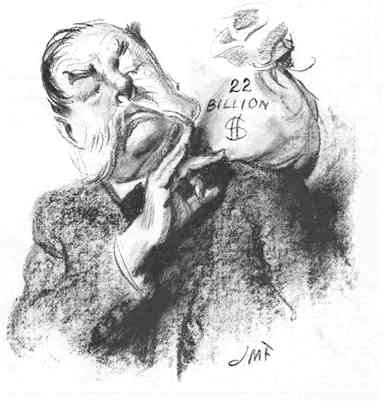
 Chapter I: Our Financial Oligarchy