45 Social Entrepreneurs Showcase at “Unreasonable Finalist Marketplace”

01 Agriculture, 01 Poverty, 02 Infectious Disease, 03 Economy, 03 Environmental Degradation, 04 Education, 05 Energy, 07 Health, 11 Society, 12 Water, Academia, Budgets & Funding, Civil Society, Commerce, Gift Intelligence, microfinancing, Technologies
Explore the projects

http://marketplace.unreasonableinstitute.org

January 20, 2011

The Unreasonable Institute Empowers the Public to Choose the Next Wave of High-Impact Social Entrepreneurs

Global donations will determine which entrepreneurs gain admission to esteemed mentorship program

BOULDER, Colo.–(BUSINESS WIRE)–Starting Jan. 20, 45 social entrepreneurs will showcase their ventures in an online platform called the Unreasonable Finalist Marketplace (http://marketplace.unreasonableinstitute.org/). For 50 days, people from around the world are invited to vote with their wallets on the most viable ventures. The first 25 of the 45 finalists to raise $8,000 in the Marketplace will earn access to the highly acclaimed six-week mentorship program at the Unreasonable Institute. At the Institute, these social entrepreneurs undergo rigorous training sessions, including personal and entrepreneurial skill development, intensive workshops and hands-on guidance from leading thought leaders, innovators, entrepreneurs and investors.

The 45 finalists were selected from more than 300 applicants in 60 countries. Each applicant had to present a financially self-sustaining venture that has the ability to scale to serve the needs of at least 1 million people and demonstrates customer validation through sales or pilots. The finalists this year include a Chinese engineer with a prototype for waterless composting toilets; a 2010 CNN Hero from Kenya who has distributed over 10,000 solar lanterns; and an American inventor with a water purification system that can roll up to the size of a ruler.

Continue reading “45 Social Entrepreneurs Showcase at “Unreasonable Finalist Marketplace””

Transnational Crime: Camorra & New Twin Towers

01 Poverty, 03 Economy, 03 Environmental Degradation, 04 Education, 06 Family, 07 Health, 07 Other Atrocities, 10 Security, 10 Transnational Crime, 11 Society, 9/11 research, Money, Banks & Concentrated Wealth, Power Behind-the-Scenes/Special Interests, Research resources, Videos/Movies/Documentaries
NY Daily News article

There is obviously a lot of news about the recent FBI mafia bust. The NY Daily News has mentioned Massive FBI Mafia bust: Organized crime still has firm grip on unions, even at Ground Zero (1/21/11)

Related: Investigative journalist Roberto Saviano's book Gomorrah: A Personal Journey into the Violent International Empire of Naples' Organized Crime System (about the pervasive crime syndicate Camorra) was made into a movie. NPR reviewed the movie and repeated what was mentioned at the movie's end “Their members have killed more than 4,000 people in 30 years. They are also shareholders in the reconstruction of the Twin Towers.”
||
|
Related:

+ European webzine cafebabel.com interviewed Roberto Saviano (Claims Comorra most associated with Spain; cocaine is Europe's “white oil”)
+ Documentario BBC “The Italian Patient” Parte 1 (Roberto Saviano appears/interview at 3:45 while in hiding)
+ Roberto Saviano interview (his security situation, the need to change economic system, the political system needs the mafia, alliances between legal and criminal entrepreneurs, compromised ‘free press,' and “before the bullets there is slander”)
+ Curse Of The Camorra (YouTube, Journeyman Pictures, 22min video)
+ Roberto Saviano interview on BBC2's The Culture Show (Obituary: “YOU CAN'T IGNORE THIS”)
+ Al Jazeera report on Roberto Saviano and the Camorra
+ Mafia Take Down – USA (at 15:35, mention of NYC construction mob influence; Sammy Gravano confessing to killing 19 people yet getting only 5 years in prison & later witness protection in Arizona)
+ The Victorious Mafia (Journeyman Pictures, 1998, 23min doc, lacks translation)
+ Scampia Camorra Napoli Ground Zero (YouTube clips of arrests, murders, etc with music)
+ Transnational crime category at PhiBetaIota

2011 Food Crisis, Urban Gardening, Social Systems

01 Agriculture, 01 Poverty, 03 Economy, 03 Environmental Degradation, 06 Family, 07 Health, 07 Other Atrocities, 11 Society, 12 Water, Earth Intelligence
Tom Atlee

Dear friends,

Food is basic.

Lester Brown — founder of both the Worldwatch Institute and the Earth Policy Institute, author of over 50 books on environmental issues, recipient of 26 honorary degrees and a MacArthur Fellowship, and (according to the Washington Post) “one of the world's most influential thinkers” — has just published a cogent article on the rapidly emerging global food crisis in Foreign Policy magazine.  He clearly outlines the problem and where attention and resources must be put to ameliorate it.

I knew such a crisis was emerging.  I hadn't realized it was emerging so rapidly.

I offer Brown's article here with no further commentary beyond this:  His essay — like most other insightful, data-filled articles of its type — omits the key fact that the political and economic systems that generate such situations are not built to respond to them in a truly life-affirming way.  “Issues” and “crises” are symptoms of those dysfunctional systems.  If social critics and activists spent half the attention and resources on actually transforming those systems that we expend on “issues” and “crises”, we would soon see those “issues” and “crises” being replaced by “solutions” and “creative initiatives”.  This is a supreme example of the kind of thing that a wiser democracy — if we had one — would start to address immediately, if it hadn't already done so decades ago.

While many of us work to transform our political and economic systems, we need also to consider what to do in the meantime as these issues and crises continue to grow.  So I also offer below two delightful articles on something that we can all do to ameliorate the impact of the food crisis on our own lives and communities.  The articles describe not only the functionality of urban gardening but also its enjoyment — and its spread in the face of rising food prices.  Significantly, such gardening is a key element in one of the more co-intelligent initiatives I've seen in recent years, the Transition Towns movement http://en.wikipedia.org/wiki/Transition_Towns.

Food for thought… and action… and bellies.

Coheartedly,
Tom

=========================

http://www.foreignpolicy.com/articles/2011/01/10/the_great_food_crisis_of_2011

The Great Food Crisis Of 2011
By Lester Brown

Continue reading “2011 Food Crisis, Urban Gardening, Social Systems”

NIGHTWATCH Extract: China Moves In on North Korea

02 China, 02 Diplomacy, 03 Economy, 07 Other Atrocities, 08 Wild Cards, 10 Security, 11 Society, Civil Society, Commerce, Commercial Intelligence, Cultural Intelligence, Government, Strategy

North Korea-China: North Korea will develop the islet of Hwanggumpyong on the Yalu River Delta linking Sinuiju with the Chinese city of Dandong as a special economic zone in cooperation with Chinese businessmen, Chosun Ilbo reported 18 January. North Korean Cabinet already approved a law on the development that will be announced in March or April.

Comment: This is another example of Chinese business tutelage for North Korea. All other special economic zones have either failed for lack of investors or been troubled by North Korean government meddling. In the last category are the Mount Kumgang resort on the east coast and the Kaesong joint industrial park, north of Panmunjom.

One would surmise that a joint venture with the Chinese would be relieved of the unpredictability of North Korean leadership whims, which have undermined the profitability of the joint ventures with the South Koreans. More importantly, every Chinese economic lifeline tossed into the North Korean economic morass is a burden on China and a restraint on North Korea.

The Chinese are moving slowly, but steadily based on their understanding of the magnitude of North Korean economic mismanagement. Thus far, they appear to be helping North Korean enterprises that have prospects of profitability, such as textiles, and Chinese enterprises that benefit from North Korean geography, such as ports and infrastructure on the Sea of Japan.

North Korea never has been self-reliant and its condition of dependency on the global economy has steadily deepened under Kim Chong-il. The Chinese appear determined to salvage what they can and rebuild the rest of North Korea in a different, more sustainable direction, slowly, by converting some North Korean activities into extensions of China's economy.

NIGHTWATCH KGS Home

Phi Beta Iota: The Chinese are out-thinking and out-maneuvering the USA on all fronts, and in a fascinating twist, may be egging the USA on to the same military-industrial death march that led to the end of the Soviet Union.  The above development should be studied in relation to WASHINGTON RULES: US-Korea-China-NK NAFTA.  In both instances, leaders are making strategic moves for reasons they consider valid, but that have nothing to do with the well-being of their respective publics.

WASHINGTON RULES: US-Korea-China-NK NAFTA

01 Agriculture, 02 China, 02 Diplomacy, 03 Economy, 07 Other Atrocities, 08 Wild Cards, 09 Justice, 10 Security, 11 Society, Commercial Intelligence, Corruption, Cultural Intelligence, Methods & Process

A project of Americans for Free and Fair Trade

Dear Citizen:

Barack Obama is pushing a NAFTA-Style Korea Free Trade agreement that would undermine America's sovereignty, laws and economy. This deal would:

  • Allow foreign corporations to drag the U.S. before U.N. and World Bank tribunals to enforce special trade privileges and to demand compensations from the U.S. Treasury.
  • Undermine states rights with hundreds of state laws and regulations subject to review and alteration.
  • Kill almost 160,000 jobs in the U.S.

Six things you can do right now:

1.    Add your organization's name to our coalition letter (attached)
2.    Ask your members to sign our petition
3.    Add this widget to your homepage and e-communications
4.    “Like” on Facebook
5.    Twitter
6.    Learn more. FAQ's

Thank you for your commitment to authentic free trade!

Joseph McCormick
Americans for Free and Fair Trade
Project Site: StopUSKoreaNAFTA.org
Phone: 541.531.0530
Email: jmccormick@freeandfairtrade.org

Frequently Asked Questions (Link)

Below the Line: Top Ten Reasons KORUS is Not Free or Fair Trade

Continue reading “WASHINGTON RULES: US-Korea-China-NK NAFTA”

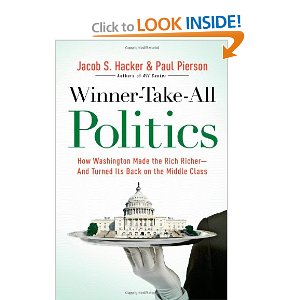
Review (Guest): Winner-Take-All Politics–How Washington Made the Rich Richer – and Turned its Back on the Middle Class

03 Economy, 04 Education, 07 Other Atrocities, 10 Security, 11 Society, Budgets & Funding, Corruption, Cultural Intelligence, Government, Methods & Process, Officers Call, Power Behind-the-Scenes/Special Interests, Waste (materials, food, etc)
Amazon Page

Paul Pierson and Jacob S. Hacker

5.0 out of 5 stars Political Economy

January 17, 2011

Retired Reader (New Mexico) – See all my reviews

This book is an effort by two political scientist to explain how in the last thirty years or so wealth in the U.S. has become concentrated in the hands of a smaller and smaller number of people. The fact that this has occurred is indisputable. So is the fact that the gap between the richest Americans and everybody else has grown exponentially just as the U.S. middle class is gradually disappearing. The explanation of why this has occurred offered by Hacker and Pierson is rather more controversial.

They begin by noting that over the last thirty years not only have the already rich gotten much richer, but that the U.S. National Economy has been transformed into a system that no longer serves the interests of the once broad and thriving American Middle Class that once was the backbone of that economy. In their view the system now serves the interests of a small minority of the rich and very rich (one to five per cent of the population). So their book begins by asking how and why did this occur and why over the last thirty years?

Since Hacker and Pierson are political scientists not economists, they argue that this transformation was due to political, not economic factors. Using what appears to be accurate statistical data they cite three `clues' or factors that point to what happened to the U.S. economy: 1) hyper-concentration of wealth; 2) sustained hyper-concentration; and 3) during the thirty years under study, while wealth concentrated at the very top of the income scale, the economy essentially stopped working for the middle and working classes who continually lost ground during this period.

This economic transformation in favor of the rich they argue is not the result of impersonal economic forces but of deliberate government actions or at times inaction (drift). Their central thesis is that mostly incremental government policies over the last thirty years have had the cumulative effect of changing the U.S. economic system into a `winner take all' system heavily biased in favor of the rich and very rich. At the same time federal government policies undermined the traditionally strong labor unions that served as a counter weight to corporations' power and systematically deregulated financial markets and executive compensation.
Continue reading “Review (Guest): Winner-Take-All Politics–How Washington Made the Rich Richer – and Turned its Back on the Middle Class”

noble gold