Dutch Thinking: Roads to Be Solar Panels

05 Energy, Cultural Intelligence
Click on Image to Enlarge

Dutch To Build Solar Panels Into Their Roads, Starting With Bike Lanes

by Alex Davies, Paris, France on 04.22.11

Science & Technology, treehugger.com

The Dutch are well known for their ubiquitous bike lanes, to the point where Amsterdam is neck and neck with Copenhagen for the title of most bike-loving capital in Europe. Now, Denmark will have to come up with something big to match the latest plan from the Netherlands – the installation of solar panels in roads, starting with bike lanes.
Click on Image to Enlarge

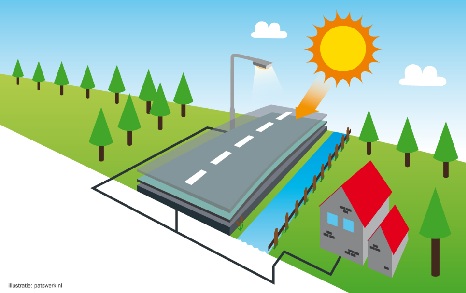
Talk about the efficient use of space: if you're going to have roads (and hopefully you'll have bike lanes), why not put that space to work producing energy? Called the Solaroad, the project is the brainchild of Dutch research firm TNO. The idea is pretty straightforward: a layer of concrete forms the road itself. A centimeter thick layer of crystalline silicon solar cells is laid on top, and covered by a layer of toughened glass. The energy potential: 50kWh per square meter per year, which can then be used to power street lighting, traffic systems and households.

Read rest of article….

See Also:

Arno Reuser

Historical Backgrounder on Libya

05 Energy, 08 Wild Cards, 10 Security, Civil Society, Cultural Intelligence, Government, IO Sense-Making, Military, Peace Intelligence
Chuck Spinney Recommends...

The author of this long but very useful historical analysis on the history of Libya is also the author of Violent Politics: A History of Insurgency, Terrorism, and Guerrilla War, from the American Revolution to Iraq, one of the very best books I have ever read on the subject of guerrilla warfare.

Whence Libya?  Why Libya?  Whither Libya?

William R. Polk, March 31, 2011

Since the Libyan regime was established by a coup d’état in 1969,  Americans and Europeans — with a three-year intermission from 1986 to 1988 — found it acceptable enough to recognize it, sell it arms and buy its petroleum.  In that one interval, on April 15, 1986, the American government under President Ronald Reagan attempted to kill Colonel Muammar Qaddafi by bombing his residence and did wound his wife and kill about 75 Libyans including his adopted daughter.  Two years later, Qaddafi retaliated by bombing an American airliner.  That attack killed 270 people including 190 Americans among whom were at least four intelligence officers.  These were just the major events; there were many others.  Of course, Americans and Libyans took very different views of them.  But both sides eventually smoothed over their angers, and relations again became profitable and “correct” on both sides, as they remained until early this year.

So, what is the basis of those attitudes and the causes of those actions?  Who are the Libyans anyway?  And what is the position of Qaddafi among them?  What motivates the Libyans?  What governs their action?  And what is likely to be the outcome of the revolt, the regime’s resistance to it and the Western intervention?

With the prejudice of a historian, I find that seeking answers to these questions requires at least a glance at the past.  That is the aim of this essay.

Read the essay….

Graphic: Holistic Analytics for Nuclear-Climate

03 Environmental Degradation, 05 Energy, 07 Other Atrocities, 08 Proliferation, 11 Society, 12 Water, Advanced Cyber/IO, Analysis, Balance, Budgets & Funding, Citizen-Centered, Communities of Practice, Earth Intelligence, Earth Orientation, Ethics, History, Leadership-Integrity, Multinational Plus, Peace Intelligence, Policies-Harmonization, Processing, Reform, Strategy-Holistic Coherence, Threats, Tribes, True Cost
Click on Image to Enlarge

Public Intelligence Forensics: Atomic Untruths

03 Environmental Degradation, 05 Energy, 07 Other Atrocities, 08 Proliferation, 10 Security, 11 Society, Advanced Cyber/IO, Commerce, Corruption, Earth Intelligence, Government, Media, Military, Misinformation & Propaganda, Peace Intelligence, Politics of Science & Science of Politics, Secrecy & Politics of Secrecy

Amazon Page

The Atomic Cafe: Lampooning America’s Nuclear Obsession

What vintage bomb survival suits have to do with Dr. Stragelove and Richard Nixon.

The recent tragedy in Japan has triggered a tsunami of terror, founded and unfounded, about the potential risks of nuclear reactors.

While there are people better equipped than us to explain the precise implications of the situation, we thought we’d put things in perspective by examining the flipside of these dystopian fears: The exuberant optimism about nuclear power in mid-century America.

Continue reading “Public Intelligence Forensics: Atomic Untruths”

Japan Lost Its Integrity over Nuclear Safety

03 Economy, 05 Energy, 07 Other Atrocities, 08 Proliferation, 08 Wild Cards, 10 Security, 11 Society, Commerce, Corruption, Earth Intelligence, Government, IO Sense-Making
Chuck Spinney Recommends...

The below report in the Guardian makes three general points regarding the Tokyo Electric's management operations at the Fukushima Daiichi reactor site:

1. Cost-cutting degraded safety procedures.

2. Collusion between industry and regulators.

3. Deferring decisions on how to permanently store nuclear waste.

Thank god these problems do not occur in Amerika (sic).

Chuck Spinney

Japan Nuclear Firm Admits Missing Safety Checks at Disaster-Hit Plant

Documents show operator failed to carry out mandatory checks at Fukushima Daiichi and allowed fuel rods to pile up

by Justin McCurry in Osaka, The Guardian/UK, March 22, 2011

Read full article….

Phi Beta Iota: Integrity, or the lack of integrity, is the defining factor in the rise or fall of complex civilizations.  The harm coming from the lack of integrity by the members of the UN Security Council with respect to nuclear proliferation and safeguards for nuclear waste; the arms market (they are the largest traders), and the general disregard for poverty, infectious disease, and environmental degradation, makes it clear that “governance” today is totally corrupt.  The good news is that informed hybrid networks can overcome Industrial Era irresponsibilities.  Multinational information-sharing and multinational intelligence (decision-support) offers a non-violent way forward.

Blocking the French, Too Little Too Late No Strategy

02 Diplomacy, 05 Energy, 08 Wild Cards, 10 Security, Government, IO Sense-Making, Military, Peace Intelligence
Who, Me?

Libya, appears to me to be a US-UK venture, having little to do with Gaddafy. Rather, in significant part it is driven by the goal of squelching potential and logical French influence in the in the Middle East and its leadership in accommodating (establishing the terms of integration) Islam in Europe and the West.

Mr Malloch-Brown is one of the few legitimate contenders to Anglo statesmanship in this era. But I find the following to be misleading in trying to make the case that this was a worthy mission, but too hard to bring off diplomatically. I believe these to be talking points.

Mark Malloch-Brown: Diplomatic ‘triumph' at the UN is unravelling already

The Council might have begun by contemplating two clear political alternatives and then developing a military strategy that flowed from that choice

Independent UK, Tuesday 22 March 2011  Read article…

Phi Beta Iota: The sweeping public movements across North Africa and the Middle East are if anything an indictment of what one author calls the “fifty-year wound” and a validation of what another author calls the “unconquerable world.”  Vastly more benevolent strategic imperatives, such as Ambassador Mark Palmer's vision for providing all 44 dictators with an exit strategy (42 of them “best pals” of the USA at this time), have been ignored. 

Climate Change, HAARP, Process, Politics, Power

01 Agriculture, 03 Economy, 03 Environmental Degradation, 04 Education, 05 Energy, 07 Health, 07 Other Atrocities, 08 Proliferation, 11 Society, 12 Water, Advanced Cyber/IO, Cultural Intelligence, Key Players

“Remember than one one's conspiracy is another man's business plan.”

“Climate change (both sides) is all about politics.”

Phi Beta Iota: We are at the intersection of ideology, social conditioning, weak education, and the culmination of decades of power politics that have produced a severely retarded i.e. damaged collective psyche.  The collective intelligence movement can be regarded as a healing counter-cancer within this larger cancerous world non-brain.  The nuclear-tsunami in Japan is an opportunity for delving deeply into everything that can be known.  It is an opportunity to re-evaluate the known risks of nuclear power; to re-examine climate change from a holistic perspective including a rigorous look at all human processes that could be contributing to the environmental degradation of the Earth; and to establish an analytic model as well as a road-map for addressing both climate change and nuclear proliferation with the non-violent dissemination of knowledge.

Continue reading “Climate Change, HAARP, Process, Politics, Power”

noble gold