NIGHTWATCH Extract: China Expands to the Seas

02 China, 03 India, 10 Security, 11 Society, Analysis, Geospatial, Strategy

Click to Enlarge

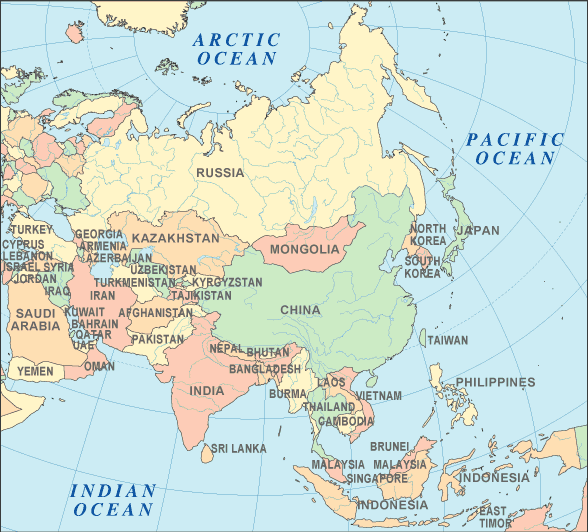
China-Burma: Construction of a high-speed rail link between China's southwestern province of Yunnan and Myanmar will begin in two months. The line will link Kunming, Yunnan's capital to Yangon (Rangoon), on the Indian Ocean, according to Wang Mengshu, an academic from the Chinese Academy of Engineering.

Wang said a China-to-Cambodia high-speed rail connection is under discussion as well as a link between Yunnan and Vientiane, the capital of Laos. He said that all three rail connections are likely to be completed with 10 years. Wang said the project aims to boost cooperation between China and its Southeast Asian neighbors and foster the economic development of China's western regions.

China-Bangladesh: China is interested in increasing cooperation with Bangladesh in different sectors including agriculture technology, trade, commerce and communication, according to a report about the 21 November meeting between Lu Hao, leader of a visiting Chinese delegation and a member of the Communist Party of China and Bangladesh President Zillur Rahman, The Daily Star reported. Rahman called for more Chinese cooperation on socioeconomic development, adding that China is a great friend to Bangladesh. Lu said he hopes the new cooperation will strengthen bilateral relations.

NIGHTWATCH Comment: China is creating a sphere of influence that stretches from North Korea to Pakistan, and surrounds India. This is a threat to US interests as well as to the political independence of the states accepting Chinese aid. A rail line to the Burmese port of Rangoon would give China access to two Indian Ocean ports with direct rail links to China. The other will be Gwadar in western Pakistan which was built with Chinese investments and aid.

Rail links from China through the Karakoram Range to Pakistan Rail and then a spur to Gwadar are undergoing feasibility studies. The link to Rangoon is much more advanced.

NIGHTWATCH KGS Home

Phi Beta Iota: We must disagree with our learned colleague whose analytic skills we greatly admire.  China's building of infrastructure to the seas is not a threat to American the Beautiful as envisioned by our Founding Fathers–it is only a threat to a predatory imperialist out of control government stupid enough to spend $750 million dollars EACH on three fortresses in Baghdad, Kabul, and Islamabad, at the same time that US infrastructure and US economic competitiveness has been DESTROYED by a two-party tyranny that has sold the American public out–in a word, treason against the public interest.  ENOUGH.  It is time to shut down the Empire before the Empire shuts down America the Beautiful.  Tomorrow we will post a review of Buckminster Fuller's Ideas and Integrities written in 1928.  He nailed it.  The US Government at the political level is NOT in “friendly” hands….certainly not friendly to the 90% that actually pay their taxes unmindful of how those taxes are funding fraud, waste, and abuse on a global scale.  America desperately needs an honest President willing to sponsor Electoral Reform in February in time for the 4th of July recall of anyone who votes against it, and a Director of National Intelligence (DNI) who actually wants to create a Smart Nation and stop going along with $90 billion a year in fraud, waste, and abuse….[less the 4% that General Tony Zinni says is useful].


Journal: Master Key to the Internet?

02 China, 03 Economy, 10 Security, Commercial Intelligence, Communities of Practice, Computer/online security, Mobile, Real Time

Jon Lebkowsky Home

Are there “master keys” to the Internet?

Interesting article in the New York Times“How China meddled with the Internet,” based on a report to Congress by the United States-China Economic and Security Review Commission. The Times article talks about an incident where IDC China Telecommunication broadcast inaccurate Web traffic routes for about 18 minutes back in April. According to the Times, Chinese engineering managers said the incident was accidental, but didn’t really explain what happened, and “the commission said it had no evidence that the misdirection was intentional.” So there was a technical screwup, happens all the time, no big deal? Or should we be paranoid?

No doubt there’s a lot to worry about in the world of cyber-security, but what makes the Times article interesting is this contention (not really attributed to any expert):

While sensitive data such as e-mails and commercial transactions are generally encrypted before being transmitted, the Chinese government holds a copy of an encryption master key, and there was speculation that China might have used it to break the encryption on some of the misdirected Internet traffic.

That does sound scary right? China has an “encryption master key” for Internet traffic?

Except it doesn’t seem to be true. Experts tell me that there are no “master keys” associated with Internet traffic. In fact, conscientious engineers have avoided creating that sort of thing. They use public key encryption.

So why would the times suggest that there’s a “master key”?

Phi Beta Iota: We have three thoughts:

1)  There's been a movie on the idea, and a low-rent mind might have been led to use the idea for spin.

2)  Much more seriously, we have been told that many routers strip security as a routine means of increasing speed.  We do not know the truth of the matter, since encrypted emails do arrive with encryption, but as a general proposition, security does seem to have been sacrificed to speed, and it may be there is no need for an Internet key in general.

3)  Finally, we would observe that 80% of signals intelligence is pattern analysis, and being able to pull a massive amount of Internet into a place where pattern analysis of who is talking to who can take place, might, conceivably be worth doing.

See Also:

Reference: Saving Defense from Itself

10 Security, Commissions, DoD, Hill Letters & Testimony

Weekend Edition

November 19 – 21, 2010

Open Letter to Erskine Bowles

How to Cut the Defense Budget

By THOMAS CHRISTIE, PIERRE SPREY, FRANKLIN SPINNEY et al.

Counterpunchhttp://www.counterpunch.org/christie11192010.html

The Honorable Erskine Bowles
National Commission on Fiscal Responsibility and Reform
1650 Pennsylvania Avenue, N.W.
Washington, DC 20504

Dear Mr. Bowles:

We are writing to you and other members of the President's National Commission on Fiscal Responsibility and Reform as individuals who have worked in national security affairs for decades for the Department of Defense, in the Armed Forces and for Democrats and Republicans in Congress. Our concern is the defense budget.

Similar to what your “Co-Chairs' Proposal” said last week regarding Social Security and other issues, we do not believe that defense spending should be reduced to a bargaining chip in budget negotiations at the Deficit Commission. On the other hand, we do believe that the defense budget is dangerously bloated, giving rise to serious decay in our armed forces.

Weaker forces at higher costs (discussed below) are the result of many years of exploitation of defense spending for political purposes, dereliction of oversight duties, and gross mismanagement by the Pentagon, the White House and the Congress. There has been a fundamental absence of accountability, both that required by the Constitution and that which accompanies sound management.

Read entire very detailed letter of testimony…

Phi Beta Iota: What our distinguished colleagues have not included in this letter is the fact that the US does not have a coherent reality-based strategy within which to evaluate ALL threats and provide a force structure suitable to ALL threats, nor does the US have an intelligence community able to provide any more than 4% (“at best” according to General Tony Zinni) of what we need in the way of intelligence support to policy, acquisition, and operations.  At the same time, the Pentagon is committing a major crime against its own humanity by spending less than 1% of its budget on the 4% of the force that takes 80% of the casualties: the infanty, this from General Robert Scales.  With all due respect, both Gates and Clapper have presided over the maintenance of the status quo; they have not changed the game for the better; and they have failed to do what needed to be done.

Journal: Pentagon Acquisition

03 Economy, 10 Security, Corruption, Military
DefDog Recommends...

Pentagon’s Favorite Jet Delayed as Costs Rise Yet Again

Add another several billion dollars and years in delays to the military’s most important new jet. Nearly a year after Defense Secretary Robert Gates fired the head of the F-35 Joint Strike Fighter program for failing to keep costs and performance under control, a new internal Pentagon review finds the $382 billion stealth plane might get pushed back as much as three years, with an added $5 billion price tag.

. . . . . . .

The delay is due to a host of problems central to the aircraft, including “software, engineering and flight difficulties,” according to Bloomberg. Fixing them will require jacking program costs up an estimated $5 billion. Worse, Venlet’s review is supposed to find that the Joint Strike Fighter will be “as much as 1 1/2 times more expensive to maintain” as the F-16, the F/A-18, the A-10 and the AV-8B — the planes the Joint Strike Fighter is supposed to replace.

Read rest of article….

Phi Beta Iota: The literature on complexity & catastrophe is quite clear–one cannot micro-manage complexity, and the Pentagon keeps trying to do precisely that: build more and more complex systems that fail in unanticipated cummulative ways.  The mind-set is broken, and no amount of money can fix that mind-set.  It is going to take a kick-ass Secretary of Defense willing to actually do a clean-sheet redesign of Whole of Government and M4IS2 operations, using information and intelligence to reconnect PPBS to reality, and to harmonize other people's money.  What we have now is flat out nuts, unaffordable, and ineffective.

See Also:

Continue reading “Journal: Pentagon Acquisition”

Journal: Taliban’s grip is far stronger than the West will admit

04 Inter-State Conflict, 05 Civil War, 08 Wild Cards, 10 Security, Analysis, History, InfoOps (IO), Intelligence (government), Military, Misinformation & Propaganda, Officers Call, Power Behind-the-Scenes/Special Interests, Strategy
Chuck Spinney Recommends...

Afghanistan – behind enemy lines

James Fergusson returns after three years to Chak, just 40 miles from Kabul, to find the Taliban's grip is far stronger than the West will admit

Independent, 14 November 2010

The sound of a propeller engine is audible the moment my fixer and I climb out of the car, causing us new arrivals from Kabul to glance sharply upwards. I have never heard a military drone in action before, and it is entirely invisible in the cold night sky, yet there is no doubt what it is. My first visit to the Taliban since 2007 has only just begun and I am already regretting it. What if the drone is the Hellfire-missile-carrying kind?

Three years ago, the Taliban's control over this district, Chak, and the 112,000 Pashtun farmers who live here, was restricted to the hours of darkness – although the local commander, Abdullah, vowed to me that he would soon be in full control. As I am quickly to discover, this was no idle boast. In Chak, the Karzai government has in effect given up and handed over to the Taliban. Abdullah, still in charge, even collects taxes. His men issue receipts using stolen government stationery that is headed “Islamic Republic of Afghanistan”; with commendable parsimony they simply cross out the word “Republic” and insert “Emirate”, the emir in question being the Taliban's spiritual leader, Mullah Omar.

The most astonishing thing about this rebel district – and for Nato leaders meeting in Lisbon this week, a deeply troubling one – is that Chak is not in war-torn Helmand or Kandahar but in Wardak province, a scant 40 miles south-west of Kabul.

Read rest of this direct look at ground truth….

Phi Beta Iota: We are reminded by this piece of how the best CIA desk officers knew instantly, the day we announced going to war in Viet-Nam, that we had gotten it wrong, that Ho Chi Minh was a nationalist, and that we would lose.  By the time Afghanistan rolled around, intelligence had become both jejeune and unethical (silent in the face of treason), and politics had become even more ideologically psychopathic and corrupt than ever before.  James Fegusson has given us a very fine contribution–this is ground truth at its best.

See Also:

Worth a Look: Book Review Lists (Negative)

and most especially:

Review: War Without Windows

Review: None So Blind–A Personal Account of the Intelligence Failure in Vietnam

Review: Who the Hell Are We Fighting?–The Story of Sam Adams and the Vietnam Intelligence Wars

Journal: Cyber-Heist 2nd Generation

03 Economy, 04 Education, 10 Security, Civil Society, Collective Intelligence, Computer/online security, Cultural Intelligence, Cyberscams, malware, spam, InfoOps (IO), IO Mapping, Law Enforcement, Mobile, Standards
Marcus Aurelius Recommends

The Great Cyber-Heist

New York Times

By JAMES VERINI

November 10, 2010

Full Story Online

Mid-1990s: Gonzalez, 14, is visited by F.B.I. agents at his high school for hacking into NASA.

Gonzalez,  law-enforcement officials would discover, was more than just a casher. He was a moderator and rising star on Shadowcrew.com, an archetypal criminal cyberbazaar that sprang up during the Internet-commerce boom in the early 2000s. Its users trafficked in databases of stolen card accounts and devices like magnetic strip-encoders and card-embossers; they posted tips on vulnerable banks and stores and effective e-mail scams. Created by a part-time student in Arizona and a former mortgage broker in New Jersey, Shadowcrew had hundreds of members across the United States, Europe and Asia. It was, as one federal prosecutor put it to me, “an eBay, Monster.com and MySpace for cybercrime.”

Read rest of article….

Phi Beta Iota: We opened Hackers on Planet Earth (HOPE) in 1994, making the observation that when the Israeli's captured a hacker they gave him a job, while the US simply kicked them in the teeth and sent them to jail.  We tried to keep Phiber Optic out of jail, and we have for decades been on record comparing hackers to astronauts–full of the right stuff and pushing the edge of the envelope.  No one, including Marty Harris then in charge of the National Information Infrastructure (NII) wanted to listen.  Today the US Government is again ignoring the warnings on the urgency of getting a grip on all information in all languages all the time, and roughly 20 years behind in creating “root” cyber-security.  This article by James Verini is a phenomenal update on what we all knew in the mid-1990's that the US Government is still oblivious to–this is not a problem technology or wanton spending can solve–this is a problem that demands discipline, integrity, intelligence, and sharing.  It is neither possible nor desireable to secure government or military computers in isolation–this is an “all in” smart safe nation challenge.

See Also:

1994 Sounding the Alarm on Cyber-Security

Search: smart nation intelligence reform electoral reform national security reform

Continue reading “Journal: Cyber-Heist 2nd Generation”

noble gold