Journal: Afghanistan Views–USAF Flag & SOF Major

Collaboration Zones, Communities of Practice, Ethics, Key Players, Policies, Threats
Chuck Spinney
Chuck Spinney
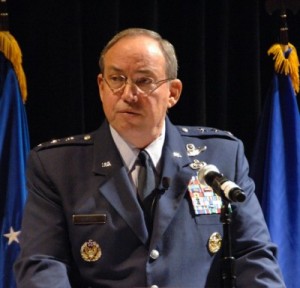
USAF Flag Strategy for AF

Chuck Spinney Sends….

Here are two opposing views on how to win in Afghanistan:

1. An Air Force general's view from the Top Down

2. Army Special Forces major's view from the bottom up
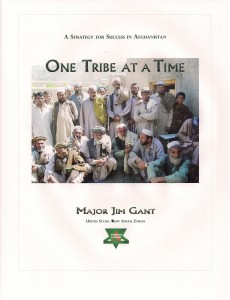
SOF Major AF Strategy
SOF Major Strategy for AF

My comment: While I think the major is far closer to reality than the general, I would argue that the Pentagon, which is run by generals, does not have a clue how to go about executing the major's strategy, if they chose to do so  — and they won't.  But that might not matter, because, paradoxically, I think the major's excellent appreciation of the Afghan conundrum illustrates indirectly why we need to get out of Afghanistan asap.

There are at least two reasons why this is so:

First, the military has no clue how to execute the kind of strategy advocated by the major. That is why General McChrystal asked for a large increase in conventional troops.  The surge just approved by the President shows (a) that the military is completely wedded to an approach that uses a large US footprint, centralized command and control, and a reliance on heavy firepower, like the AF general's predilection for bombing; and (b) the politicians are wedded to the concept that strengthening an already corrupt centralized Afghan gov't and Afghan national army and national police forces will “win the hearts and minds” of the rural population.

Note that the weakest parts of the major's excellent analysis occur when he tries to reconcile support of the Afghan central government and Afghan national army with his decentralized tribal strategy — they can not be reconciled except through tribal mediation processes that start a village level jirgas and slowly work upwards to “national” level loya jirga.  But that traditional approach would result in a repudiation of the central gov't as it is now constituted.

Second. I am not sure there will ever be enough time to make his strategy work on a war-winning scale. As the major makes clear, we are struggling to deal with a culture that is based on profoundly important concepts of honor and revenge.  Planners in Washington and Kabul are trying to shape the cultural DNA of a rural tribal society that is the product of a 3000 years of cultural evolution.  This culture may seem primitive to strategists in Washington trying to export the our way of life (not the major, who clearly understands that strategy must be shaped by the mores of the Afghan culture), but this tribal culture is in fact a highly evolved in a complex relationship to its environment.  The problem as I see it is that  too much water has gone over the dam since we foolishly began trying to cynically manipulate the value systems of this tribal culture by inflating the Islamic crazies in late 1970s (with goal of making it more likely that Sov's would invade and enmesh the Sovs in their Vietnam-like quagmire).

Continue reading “Journal: Afghanistan Views–USAF Flag & SOF Major”
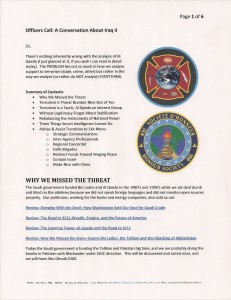
Officers Call: A Conversation About Iraq II

02 China, 04 Inter-State Conflict, 05 Civil War, 05 Iran, 10 Security, Analysis, Ethics, IO Sense-Making, Military, Officers Call, Peace Intelligence
Officers Call on Iraq II

Sir,

There's nothing inherently wrong with the analysis of Al Qaeda (I just glanced at it, if you wish I can read in detail today).  The PROBLEM lies not so much in how we analyze support to terrorism (state, crime, other) but rather in the way we analyze (or rather do NOT analyze) EVERYTHING.

Here's what I have thrown together for you, in six pages with links.

Summary of Contents (OC Iraq II)

  • Why We Missed the Threat
  • Terrorism is Threat Number Nine Out of Ten
  • Terrorism is a Tactic, Al Qaeda an Interest Group
  • Without Legitimacy Forget About Stabilization
  • Rebalancing the Instruments of National Power
  • Three Things Secret Intelligence Cannot Do
  • Advise & Assist Transition to Exit Menu
    • Strategic Communications
    • Inter-Agency Professionals
    • Regional Concordat
    • Faith Brigades
    • Redirect Funds Toward Waging Peace
    • Contain Israel
    • Make Nice with China

Officers Call on Iraq I

Semper Fidelis,  Robert

Journal: College Musings on Ron Paul and Economy

03 Economy, 11 Society, Communities of Practice, Ethics

Full Story Online
Full Story Online

The Ron Paul Revolution Continues

Lauren Kawam Issue date: 12/10/09 Section: News

He calls himself the “The ‘Real' hope for America – not hype,” according to his MySpace page, and if the number of friends he has on there is any indication – nearly 200,000 – Ron Paul isn't fading into the dust, at least not with the technologically savvy generations.

. . . . . . .

“The very good thing that has happened here in the last two years is that government's credibility is crashing,” Paul said. “There's been way too much trust in the government. That has been our moral hazard over many, many centuries. Trust in the government that it's here to help you, it's here to protect you … they're going to scare everybody to death to try to argue the reason why you have to have big government, and you really don't. What we need is more faith, more confidence and a better understanding of what individual liberty is all about.”

Continue reading “Journal: College Musings on Ron Paul and Economy”

Journal: US Begins Regional War on Pashtun

05 Civil War, 08 Wild Cards, 10 Security, Government, Military, Peace Intelligence
Chuck Spinney
Chuck Spinney

Chuck Spinney sends:
In my opinion, this is an extremely important piece of writing and needs to be read very carefully.  The author of this article built an international reputation for excellence during his reporting on the Iraq War, and now he is positioning himself to do the same on Afghanistan.  Conflating al Qaeda with the Taliban will mutate the so-called war on terror into an Anti-Pashtun (AF-Pak) War, with unknowable ramifications that could very well make the lunacy of Mad King George's aggression in Iraq look miniscule in comparison.

Full Story Online
Full Story Online

A Wider and Unnecessary War: The March of Folly

By PATRICK COCKBURN  December 7, 2009

By treating Pashtun villagers as if they were all Taliban, and Taliban as being the equivalent of al-Qa’ida, Mr Obama is increasing, not reducing, the threat of terrorist attack on the US or Britain. He is providing the battleground bin Laden hoped for and, like President Bush before him, has jumped willingly into the al-Qa’ida trap.

. . . . . .

One of the most foolish and misleading claims by US and British generals is that fighting a guerrilla war can be successfully combined with dispensing aid and building bridges and roads. But, as one commentator puts it, such a mixture of Wyatt Earp and Mother Theresa is not feasible. Soldiers are trained to get what they want by force and that is generally what they do. Afghans whose families have just been killed by a bomb will not be conciliated by a fine new drainage system.

Other minefields face incoming American and British forces. The Afghan government is in many respects a criminal racket.

Journal: Dumb Crowd Sourcing–Good Start

Collaboration Zones, Communities of Practice, Key Players, Methods & Process, Mobile, Policies, Real Time, Threats
Full Story and Video Online

Pyramid scheme lets audience vote for climate solutions

A worldwide audience will decide the planet's fate in game-show format during the Copenhagen climate summit by suggesting and voting on climate solutions and how they will be funded.

Phi Beta Iota: This is exactly the right idea in the wrong venue with the wrong frame of reference.   We love it, it is a good start.  What they should be doing is creating a Global Range of Need Table that spans all ten high level threats to humanity, across all twelve core policy areas, with preference given to the eight major humanities.  See  Strategic Analytic Model and also Earth Intelligence Network.  Below is the two-pager circulating in United Nations and BRIC circles.

UN World Brain Institute and Global Game Talking Points (2 pages)

Journal: Google to Planet–You Don’t Need Privacy

09 Justice, 10 Security, Commerce, Government, Law Enforcement

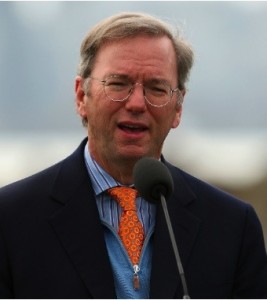
Eric Schmidt CEO Google

Google CEO: Secrets Are for Filthy People

Eric Schmidt suggests you alter your scandalous behavior before you complain about his company invading your privacy. That's what the Google CEO told Maria Bartiromo during CNBC's big Google special last night, an extraordinary pronouncement for such a secretive guy.

Google chief: Only miscreants worry about net privacy

“If you have something that you don't want anyone to know, maybe you shouldn't be doing it in the first place,” Schmidt tells CNBC, sparking howls of incredulity from the likes of Gawker.

Sue Google for Cheating You on AdSense

Everything went according to plan until 11:00 A.M. on December 9, 2008. With a single click, a faceless Google employee decided that Think Computer Corporation's membership in the AdSense program “posed a significant risk to our AdWords advertisers,” and the account was disabled with no warning.

Journal: Questions on AF & PK, The Larger Question

03 Economy, 04 Inter-State Conflict, 05 Civil War, 08 Wild Cards, 10 Security, Civil Society, Ethics, Government, Media, Military, Peace Intelligence

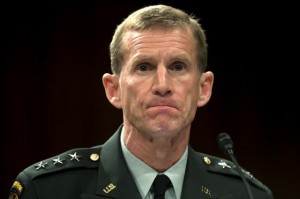
General Stanley McChrystal

What Congress Should Ask McChrystal

Phi Beta Iota: WIRED Magazine has put together a number of questions that ably illustrate the confusion in the public mind over why we are in Afghanistan and what that has to do with Pakistan.  Based on the history of the Cold War, which appears to have been a Fity Year Wound, In Search of Enemies, or as General Smedley Butler, USMC (Ret) put it, War is a Racket, we have to wonder.  When one combines the scandals associated with health care (50% waste according to PriceWaterhouseCoopers), the economy (a fraudulent Federal Reserve and phantom wealth leveraged by Wall Street to the detriment of the commonwealth), and all of the other pressing problems facing America, the larger question is not really about Afghanistan or Pakistan but rather about process.  Is America a democracy?  Is our policy process reasoned and informed?  Is the public interest being served? Does the White House really understand  The True Cost of Conflict/Seven Recent Wars and Their Effects on Society?

noble gold