

The truth at any cost lowers all other costs — curated by former US spy Robert David Steele.

SOURCE: P2P Foundation Category:P2P Infrastructure
This is a specialization of our general Technology section, focusing more explicitely on the ‘true internet' or distributed P2P infrastructures. It is being updated over the next week or so.
On the overall perspective of the P2P Foundation: What Digital Commoners Need To Do, a meditation on the strategic phases in the construction of a peer to peer world
Help us improve our definition of what a true P2P Infrastructure should be: Defining True P2P Infrastructures
Programmatic Statement for the creation of a world-wide user-controlled network based on a distributed architecture, by Raffael Kéménczy
Projects we find worthty of support:
Projects to decentralize/distribute the internet:
Continue reading “Internet Freedom–The Public Dialog Continues”

Decentralizing the Internet So Big Brother Can’t Find You
Jim Dwyer
The New York Times, February 15, 2011
On Tuesday afternoon, as Secretary of State Hillary Rodham Clinton spoke in Washington about the Internet and human liberty, a Columbia law professor in Manhattan, Eben Moglen, was putting together a shopping list to rebuild the Internet — this time, without governments and big companies able to watch every twitch of our fingers.
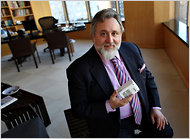
The list begins with “cheap, small, low-power plug servers,” Mr. Moglen said. “A small device the size of a cellphone charger, running on a low-power chip. You plug it into the wall and forget about it.”
. . . . . . .
Put free software into the little plug server in the wall, and you would have a Freedom Box that would decentralize information and power, Mr. Moglen said. This month, he created the Freedom Box Foundation to organize the software.
. . . . . . .
Social networking has changed the balance of political power, he said, “but everything we know about technology tells us that the current forms of social network communication, despite their enormous current value for politics, are also intensely dangerous to use. They are too centralized; they are too vulnerable to state retaliation and control.”
Continue reading “Decentralizing the Internet So Big Brother Can’t …”
An Idea Worth Spreading: The Future is Networks
Venessa Miemis. March 16 2010
This weekend I experienced a snowcrash; a moment where the seemingly disparate pieces of information floating in my head came together. A synapse fired, a new connection was made, and I was brought to a new level of consciousness, a new way of seeing the world. In reading this over, it almost sounds obvious, but it took me a while to get here. I hope that by sharing with you, it’ll help you “get it” too. So let me take you on my thinking trail.
See Also:
How to Communicate if the US Government Shuts down the Internet
16+ Projects & Initiatives Building Ad-Hoc Wireless Mesh Networks
A Metathinking Manifesto [Who's the Architect?]
Continue reading “CONNECT First, the Collective Intelligence Will Happen Naturally”
How We Use Social Media During Emergencies [INFOGRAPHIC]
Mashable
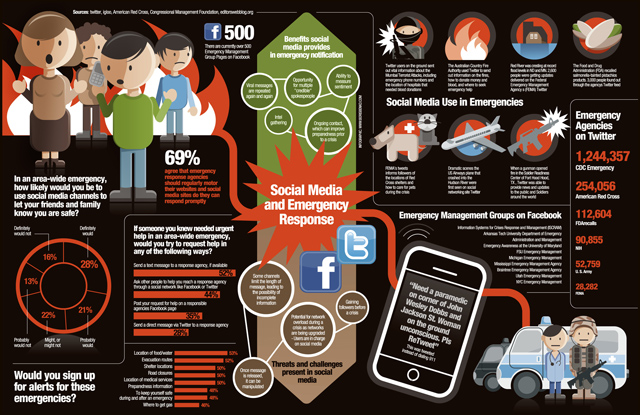
The use of social media during national and international crises, both natural and political, is something that Mashable has followed with great interest over the past few years.
As a culture, we started becoming more aware of the power of social media during times of crisis, like when the Iran election in 2009 caused a furor, both on the ground and on Twitter. More recently, the Internet and social media played an important role in spreading news about the earthquake in Haiti and political revolution in Egypt.
But what about other kinds of natural disasters or crime? Can social media be used to good effect then?
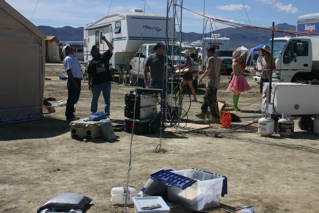
OpenBTS is an open-source Unix application that uses the Universal Software Radio Peripheral (USRP) to present a GSM air interface (“Um”) to standard GSM handset and uses the Asterisk® software PBX to connect calls. The combination of the ubiquitous GSM air interface with VoIP backhaul could form the basis of a new type of cellular network that could be deployed and operated at substantially lower cost than existing technologies in greenfields in the developing world.
In plain language, we are working on a new kind of cellular network that can be installed and operated at about 1/10 the cost of current technologies, but that will still be compatible with most of the handsets that are already in the market. This technology can also be used in private network applications (wireless PBX, rapid deployment, etc.) at much lower cost and complexity than conventional cellular.
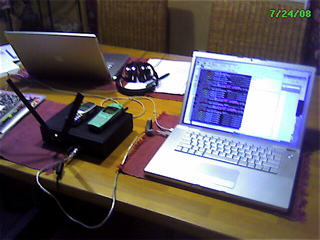
Project News (Last Updated 17 January 2011)
Kestrel Signal Processing OpenBTS Page with Links
OpenBTS YouTube Short Videos (Just Over 30)
Phi Beta Iota: This is as close to “world-changing” as it gets. Neither Microsoft nor the cellular providers–nor the governments whose people stand to gain the most (but whose corrupt politicians prefer the status quo)–want to surf this wave, they would rather fight it. If there were ONE social networking initiative that is guaranteed to change the world for the better, this is the one. In our always humble opinion.
Burning Man's open source cell phone system could help save the world
Solar-powered OpenBTS systems costs pennies a day and operates in the farthest outreaches of Earth.
By Julie Bort, Network World
August 30, 2010 02:47 PM ET
Today I bring you a story that has it all: a solar-powered, low-cost, open source cellular network that's revolutionizing coverage in underprivileged and off-grid spots. It uses VoIP yet works with existing cell phones. It has pedigreed founders. Best of all, it is part of the sex, drugs and art collectively known as Burning Man. Where do you want me to begin?
The Open Source Subnet
Cell towers that blend vs. those that offend
“We make GSM look like a wireless access point. We make it that simple,” describes one of the project's three founders, Glenn Edens.
The technology starts with the “they-said-it-couldn't-be-done” open source software, OpenBTS. OpenBTS is built on Linux and distributed via the AGPLv3 license. When used with a software-defined radio such as the Universal Software Radio Peripheral (USRP), it presents a GSM air interface (“Um”) to any standard GSM cell phone, with no modification whatsoever required of the phone. It uses open source Asterisk VoIP software as the PBX to connect calls, though it can be used with other soft switches, too. (More stats in a minute that I promise will blow away your inner network engineer.)
Direct to Source (If Still Up); Full Story Back-Up Copy Below This Line
