What’s the difference between Barry Bonds and Goldman Sachs executives? The later was fortunate enough to be questioned by incompetent lawmakers while Bonds ended up in a courthouse with an actual jury and prosecutors.
. . . . . .
“The Goldman guys may have worse batting average than Barry Bonds but they were better educated by their lawyers about they should shouldn’t say. They also had the benefit of being questioned by incompetent people who had no idea about the financial nomenclature at the heart of their allegations,” Singer says.
It was worth a smile at breakfast that morning in February 2006, a scrap of social currency to take out into the world. Michael Porter, the Harvard Business School management guru, had grown famous offering competitive strategies to firms, regions, whole nations. Earlier he had taken on the problems of inner cities, health care and climate change. Now he was about to tackle perhaps the hardest problem of all (that is, after the United States’ wars in Afghanistan and Iraq).
He had become adviser to Moammar Gadhafi’s Libya.
Phi Beta Iota: Harvard is now the poster child for all that is wrong with education–no intelligence, no ethics, and grotesquely expensive. Yale can now claim the mantle in the East.
Note: Truthdig server overwhelmed. This is the Common Dreams reprint.
A nation that destroys its systems of education, degrades its public information, guts its public libraries and turns its airwaves into vehicles for cheap, mindless amusement becomes deaf, dumb and blind. It prizes test scores above critical thinking and literacy. It celebrates rote vocational training and the singular, amoral skill of making money. It churns out stunted human products, lacking the capacity and vocabulary to challenge the assumptions and structures of the corporate state. It funnels them into a caste system of drones and systems managers. It transforms a democratic state into a feudal system of corporate masters and serfs.
WASHINGTON — When Eric Smith, 26, returned home after his second tour in Iraq serving as a Navy medic, he didn't expect to have a difficult time finding work.
While on tour, Smith had worked as a physician's assistant in the intensive care unit (ICU), caring for patients undergoing everything from cancer to recent brain surgery. At times, he served on the front lines treating infections. He never thought the expertise he had developed in the field wouldn’t amount to a job back home — but when he returned he found that he couldn't get a job in medicine without the right certifications.
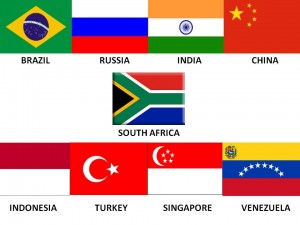
SANYA, Hainan, April 14 (Xinhua) — Leaders of five BRICS countries, Brazil, Russia, India, China and South Africa, released on Thursday a joint document, Sanya Declaration, at the BRICS Leaders Meeting in south China's resort city of Sanya.
The following is the full text of the document.
Sanya Declaration
(BRICS Leaders Meeting, Sanya, Hainan, China, 14 April 2011)
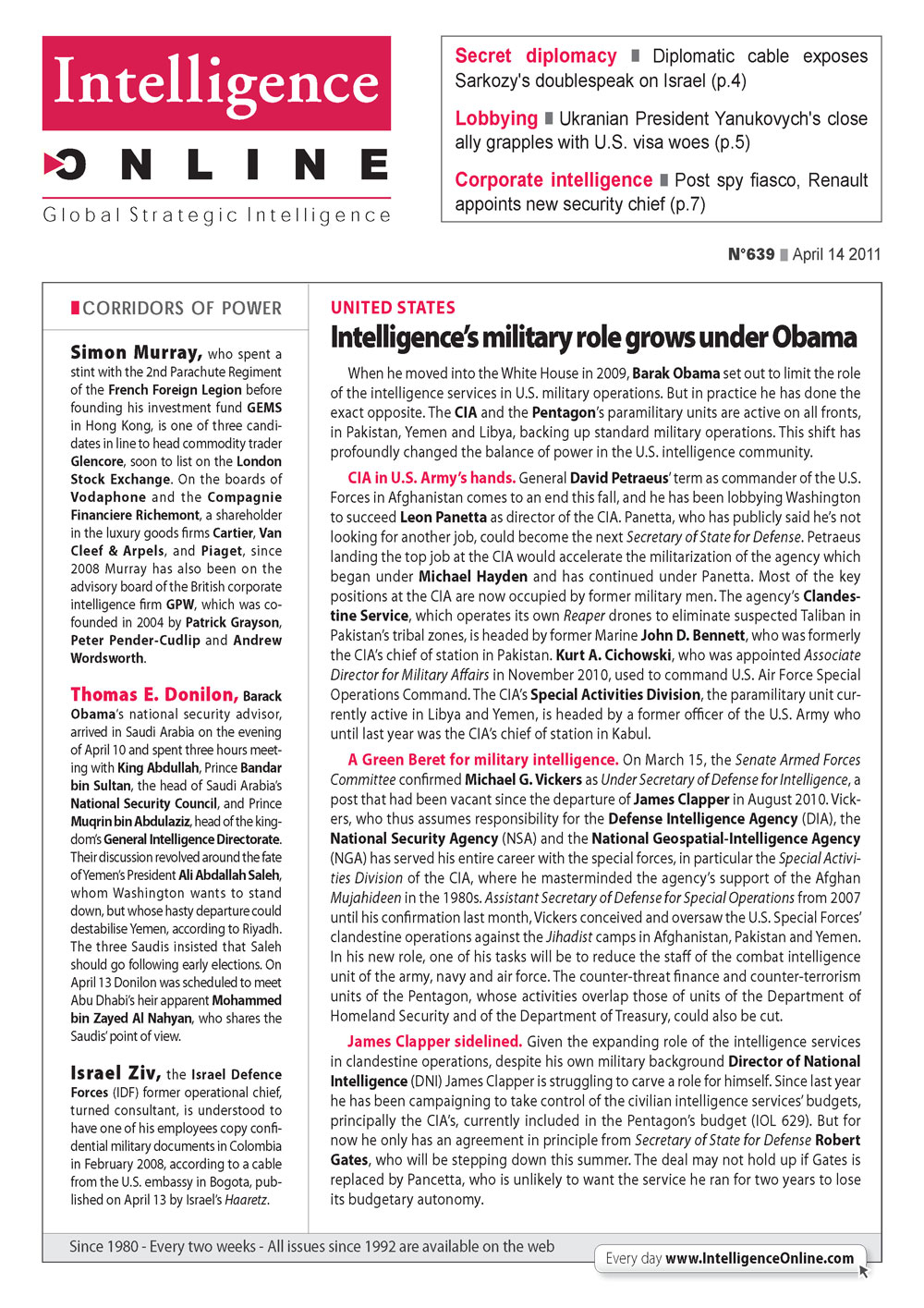
Phi Beta Iota: Posted with permission. We strongly recommend the Intelligence Online offerings. We have received a number of commentaries around this topic, and they boil down to the situation being much, much worse than depicted here:
2. Nose-dive to the lowest common denominator, completely destroying regional and country expertise and having no linguistic capabilities or grasp of history and culture (CIA, DIA)
3. Completely out of control procurement, rotten requirements definition, no full life-cycle planning (e.g. buy collection, do not buy processing), and generally disconnected from reality (NSA/Cyber-Command)
4. We are reminded that there are 1,200 distinct “organizations” wasting money and going through the motions on counter-terrorism–meanwhile, the Department of Homeland Security gropes little girls, confiscates aftershave, and is generally on the underside of institutionalized tyrannical idiocy.
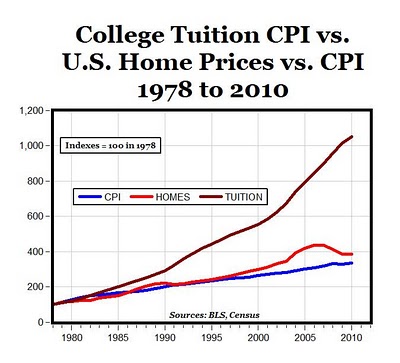
Peter Thiel (Paypal and other ventures) has been making some waves for his position that higher education in the US is the next bubble. In short, he's right. Given what we now have available in terms of tools, it should be possible to get an Ivy league education for $20 a month.
Instead we are getting a stagnant product that is so out of date that it doesn't deliver much social and economic value. Even worse: it's undergoing hyper-inflationary price increases.
. . . . . . .
The solution to this problem is to help create employment opportunities (like what we are doing with our open venture start-up) that don't use a degree as a gating mechanism. A solution that creates its own educational modules if needed (from scratch using modern tools and techniques). A solution that delivers something better than an Ivy league eduction and then backs it up with economic and social opportunities that exceed what you get in the global econonomic and social sprawl.
Fair warning: This article will piss off a lot of you.
I can say that with confidence because it’s about Peter Thiel. And Thiel – the PayPal co-founder, hedge fund manager and venture capitalist – not only has a special talent for making money, he has a special talent for making people furious.
. . . . . . .
Like the housing bubble, the education bubble is about security and insurance against the future. Both whisper a seductive promise into the ears of worried Americans: Do this and you will be safe. The excesses of both were always excused by a core national belief that no matter what happens in the world, these were the best investments you could make. Housing prices would always go up, and you will always make more money if you are college educated.
Like any good bubble, this belief– while rooted in truth– gets pushed to unhealthy levels.
. . . . . . .
But Thiel’s issues with education run even deeper. He thinks it’s fundamentally wrong for a society to pin people’s best hope for a better life on something that is by definition exclusionary.
. . . . . . .
Thiel’s solution to opening the minds of those who can’t easily go to Harvard? Poke a small but solid hole in this Ivy League bubble by convincing some of the most talented kids to stop out of school and try another path. The idea of the successful drop out has been well documented in technology entrepreneurship circles. But Thiel and Founders Fund managing partner Luke Nosek wanted to fund something less one-off, so they came up with the idea of the “20 Under 20″ program last September, announcing it just days later at San Francisco Disrupt. The idea was simple: Pick the best twenty kids he could find under 20 years of age and pay them $100,000 over two years to leave school and start a company instead.
Phi Beta Iota: Read the chapter “Paradigms of Failure” in ELECTION 2008: Lipstick on the Pig (EIN, 2008) to understand that the depth and breadth of the integrity failure in the USA. “Credentialling” is a form of top-down sub-prime scam, selling a credential instead of an education. As Thiel suggests, time for change at the top is long over-due.



 Full text of Sanya Declaration of the BRICS Leaders Meeting