I have decided to focus today's SR on GMOs and the transgenic sector because it represents such a clear example of the geopolitical shift we are living through: the Ascendence of the Non-geographical corporate states.
NGCSs are not just corporations, in a business sense, that we mean when we say, corporatocracy. These transnational entities are so big and so powerful that they are essentially states, literally countries without geography. They have their own foreign policies; their own goals that may have little to do with the policies of the country where they happen to be based. They control the political structure and write the laws that govern them, and judge them. They are the emerging world powers.
This transfer, is not a continuation of the chain of family, to tribe, to village, to duchies and the like, to nations. The NGCS springs from the business world. Its priority is profit. In its most extreme manifestation nothing else really is a factor.
Nowhere is the transfer of national power over to the NGCSs clearer than in what is happening in food and water. Parts of this trend are known, but the overarching strategy the NGCSs are following, and the tactics they are using are rarely seen as the coherent whole they are.
Monsanto, BASF, Bayer, Dow, DuPont and Syngenta. They are usually described as chemical pesticide companies but, I think, a better way to see them is as a corporate cohort making an aggressive attempt to gain domination over the world's food and water supplies.
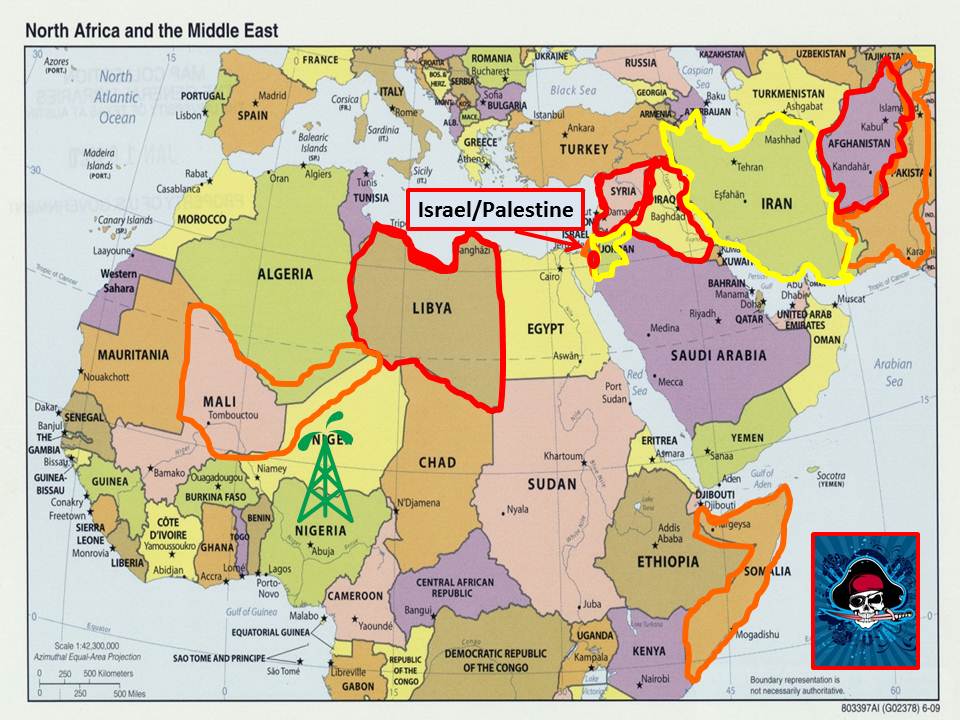
China-Mali:For the record. China has offered to send more than 500 soldiers to the UN force seeking to contain Islamist militants in Mali . This would be China's largest UN peacekeeping contingent.
Iraq: An attack at a military checkpoint at Taji, north of Baghdad, on Thursday killed 11 people, including four soldiers, and wounded five.
Comment: The pause appears ended. The fighting has killed 420 people this month.
Lebanon: Fighting in Tripoli continued for a fifth day. Overnight clashes killed six people and wounded 40. .The Middle East is now destabilized from the border of Iran to the Mediterranean.
Niger: Islamic militants executed coordinated attacks at two locations in Niger, the country east of Mali. In one attack, a suicide bomber detonated a car bomb at a French-Niger owned uranium mine in the town of Arlit. Simultaneously and 125 miles south, another bomber detonated a car bomb inside a military camp in the city of Agadez. Other jihadists in vehicles attempted to overrun the base, but were stopped by a firefight with Nigerian soldiers. The bombs killed 5 bombers, 25 people and injured 29, according to the Ministry of Defense. No expatriates were killed.
During this Watch, a surviving bomber is holding several Nigerien soldiers hostage
These were the first terrorist attacks of this kind in Niger. The two towns are in central Niger. Some of the facilities for processing uranium ore were damaged at Arlit.
An affiliate of al-Qaida in the Islamic Maghreb, known as the Movement for Unity and Jihad in West Africa (MUJAO) claimed responsibility. They were also involved in the Mali fighting. Nigerien officials judge the fighters came from Libya. One said that Libyan instability is destabilizing the entire region.
Early this year one military analyst judged that Niger was even less prepared than Mali to cope with Islamic militants and terrorists. Nevertheless, a Nigerien unit participated in clearing operations in Gao, Mali.
The key points are that the jihadists have not given up their plans to establish a base in Sahelian Africa and all the countries are vulnerable. Their territory is enormous with poor infrastructure. They are poor and have small, poorly supported security forces.
The attacks might compel France to deploy some of the troops withdrawing from Mali to Niger. Niger is France's single most important supplier of uranium for its extensive nuclear and electric power industries.
France might need to re-evaluate its strategy for providing security assistance to its former colonies. The threat calls for an integrated regional approach to security. The Sahelian nations and France will certainly need outside help.
The popular perception of Hezbollah as simply an Islamic terrorist organization has been colored by American-Israeli propaganda (particularly wrt to relations with Iran and Syria), sloppy reporting, and a growing sense of Islamophobia in American culture.
Rami Khouri is a prolific Lebanese intellectual who writes widely on the Middle East. His austere, direct form of writing lays out arguments clearly and concisely. Like all writers of Middle Eastern affairs, his predictions are often wrong, but unlike most, his fault lines, when they occur, are easily traced. In short, Khouri is always a good read and well worth following, because even if his arguments turn out to be erroneous, they are a fount of useful information.
Attached below is his fascinating take on Hezbollah. I reformatted it to highlight his points but have not changed a word or the order of his words. Some readers find my highlighting distracting, others like it; if you are one of the former, the link below will take you to the original.
BEIRUT — The most fascinating aspect of the war in Syria this month — and perhaps also the most significant in terms of long-term regional geo-politics — is the direct involvement of Hezbollah, the powerful Lebanese Shiite party and resistance group that is closely allied to Iran and Syria. The significance of Hezbollah’s participation in the battle for the Syrian town of Qusayr comprises several distinct elements:
I didn’t plan on spending six years covering the war in Afghanistan. I went there in 2007 to make a film about the vicious fighting between undermanned, underequipped British forces and the Taliban in Helmand, Afghanistan’s most violent province. But I became obsessed with what I witnessed there—how different it was from the conflict’s portrayal in the media and in official government statements.
. . . . . . .
In February 2013, on his last day at the helm of NATO forces in Afghanistan, General John R. Allen described what he thought the war’s legacy will be: ‘‘Afghan forces defending Afghan people and enabling the government of this country to serve its citizens. This is victory, this is what winning looks like, and we should not shrink from using these words.’’
The US and British forces are preparing to leave Afghanistan for good (officially, by the end of 2014), and my time in the country over the last six years has convinced me that our legacy will be the exact opposite of what Allen posits—not a stable Afghanistan, but one at war with itself yet again. Here are a few encapsulated snapshots of what I’ve seen and what we’re leaving behind.
Why Snake Oil is the Drug of Choice for Ayn Rand Wannabees
Attached are two important papers, one by Stephanie Kelton and the other by Paul Krugman, arguing that it is time to consign austerity economics to the dustbin of history. Both are variations on a theme and are spot on, IMO.
The fundamental problem tamping down the American recovery is excessive debt in the private sector, NOT the government sector. Yet austerity economics ignores this reality and argues speciously for reductions in government spending. The sequester has taken this nonsense to the level of policy lunacy by legislating an abdication of government's primary responsibility –i.e., to make policy decisions, in to law. As Krugman points out there is method to the austerity madness, however.
But madness it is. The attached chart, which I have distributed before, uses Federal Reserve Data to place the real debt problem into a long term perspective. Note the vertical scales are IDENTICAL! Bear in mind, the chart is about 1.5 years out of date and it does not reflect the recent, pre-sequester reductions in Federal Debt discussed below.
It is a brutal fact that no country benefited more from war during in the 2oth Century than the United States. World War I enriched and invigorated the US economy, and the self destruction of the 19th Century European state system left the US as the world's mightiest industrial power. World War II ended the Great Depression, put the US on a pathway to unparalleled world military power, and set the stage a long economic boom that created a rich middle class that, not withstanding its recent hardening of the arteries, remains unprecedented in world history. Pearl Harbour excepted, neither war visited any significant destruction on the American homeland.
While we think of war in terms of our sacrifices, it may surprise readers to learn that the United States suffered fewer military deaths in WWII than Yugoslavia, an allied country not usually thought of in the NASCAR mentality of the United States as being a major player that war. In fact, hundreds of millions of people — mostly civilians — died in the wars (and their aftermath) of the 20th Century, while the United States in comparison paid a relatively minor price in lives lost and a vanishingly small price in terms of material destruction wrought at home.
Indeed the most traumatic material destruction and highest number of civilian deaths suffered on the US mainland since the dawn of the unprecedented state violence of the 20th Century were caused by the attacks on the World Trade Center and the Pentagon in September of 2001 (the nearby NYSE was closed for only a week and the Pentagon never shut down). While horrific and psychologically devastating in themselves, these attacks were a horrendous crime, not an act of war.
Moreover, when viewed in the grand sweep of the preceding 100 years, the material and human destruction of 9-11 was pinprick compared to that visited on the trenches in Flanders, the Somme, and Verdun, the cities of Nanking and Warsaw, London and Coventry, Hamburg and Berlin and Dresden, Leningrad and Stalingrad and Minsk, or in the fire bombing raids on Tokyo, the atomic bombing of Hiroshima and Nagasaki, or the now forgotten destruction of every city in North Korea, of millions of civilians killed by bombing (and sanctions) in North Vietnam, Iraq, or Afghanistan. Even casual readers of history know this summary just scratches the surface of carnage wrought by 20 Century warfare — carnage which, by the grace of good fortune, pretty much bypassed the people and land of the United States. Perhaps some American even think this good fortune is a kind of entitlement. Is it not surprising that President Bush's call on the American people to keep consuming and living the good life when he asked Congress to authorize a global war of terror in our national response to the crime of 9-11 was so well received?
None of these facts denigrates the bravery and sacrifice of the American soldiers, sailors, marines, and airmen who fought and died in the wars of the last 100 years, but they are facts nevertheless, and they provide a backdrop against which the strength our national character is measured by others.
Nor should we be surprised, given this history of good fortune, that many leaders and opinion makers in America, especially strategic wannabees like Senator Lindsey Graham of South Carolina or the armchair strategists in the Heritage Foundation (which receives a lot of grant money from arms merchants who benefit from war), treat war as a cavalier endeavor. Nothing typifies this cavalier attitude so much today as the loose talk about bombing Iran's nuclear reactors (unless it be an intervention in Syria). The attached essay puts this kind of warmongering talk into a perspective appropriate to those who, unlike most Americans during the 20th Century, would be on the receiving end of such an attack.
Watergate eventually became the story of two young rookie reporters who exposed and took down a president.
Try to think of another major story in your lifetime where the reporters themselves took center stage, and in the process nearly eclipsed their own work. Odd.
One of them, Bob Woodward, expanded his fame. The powers-that-be permitted him to go on and, with extraordinary access, write books criticizing future presidents. Woodward became the in-house attack dog. Mr. Limited Hangout.
The other reporter, Carl Bernstein, faded into relative obscurity. Well, he began connecting journalists to the CIA. That wasn't a smart career move. That was, perhaps, a case of biting the hand that had fed him.
To learn why Richard Nixon was really blown out of the White House, you could begin with the infamous Nazi chemical/pharmaceutical cartel, IG Farben. The cartel that pushed Hitler over the top into power in Germany.
Phi Beta Iota: For the convenience of our professionals reluctant to click through, the entire post is reproduced below. We believe that the assassination of JFK, the cover up by LBJ, and the fact that the Bush and Rockefeller families got away with it, was the beginning of the decline of responsible politics (the art of satisficing the needs of all) in the USA. There is serious matter for reflection in this post.