Extract from Conclusion in the Above: I have observed the World Game as a student-participant, and wish it well. I have also observed Bob Pickus's work, as a student-participant in Turn Toward Peace, and wish him well. There are still other alternatives, but whichever road leads us faster into a world without war, what I gain most from Pickus and Fuller is their sense of the Big Picture. No one else can match their indefatigable and comprehensive efforts to see the problem whole, and to steer the world's energy into a grand design of peace.
I’ve found myself giving cautionary talks on the future of the Internet, or possible futures, plural – the real danger that the Internet and the World Wide Web that operates on it will become less open, perhaps become fragmented, balkanized into closed networks that no longer cooperate, filled with walled gardens with various filters and constraints, and no longer be a platform with low barriers to entry and assurance that if you connect something, anyone anywhere in the world will have access to it. The Internet would no longer be the powerful engine for innovation and communication it has been.
Tim Berners-Lee, who created the World Wide Web, writes about this in Scientific American, saying that some of the web’s “successful inhabitants have begun to chip away at its principles. Large social-networking sites are walling off information posted by their users from the rest of the Web. Wireless Internet providers are being tempted to slow traffic to sites with which they have not made deals. Governments—totalitarian and democratic alike—are monitoring people’s online habits, endangering important human rights.”
If we, the Web’s users, allow these and other trends to proceed unchecked, the Web could be broken into fragmented islands. We could lose the freedom to connect with whichever Web sites we want. The ill effects could extend to smartphones and pads, which are also portals to the extensive information that the Web provides.
My next scheduled talk about the future of the Internet is January 5 at noon, at Link Coworking [Austin, TX].
Phi Beta Iota: The paradigm is power is “rule by secrecy” and fragmentation. The web and all that suggests for human connectivity is its anti-thesis. 2012 appears to be the year of convergence, confrontation, and emergence.
Tim Wu explains the rise and fall of information monopolies in a conversation with New York Times blogger Nick Bilton. Author of The Master Switch: The Rise and Fall of Information Empires (Borzoi Books), Wu is known for the concept of “net neutrality.” He’s been thinking about this stuff for several years, and has as much clarity as anyone (which is still not much) about the future of the Internet.
I think the natural tendency would be for the system to move toward a monopoly control, but everything that’s natural isn’t necessarily inevitable. For years everyone thought that every republic would eventually turn into a dictatorship. So I think if people want to, we can maintain a greater openness, but it’s unclear if Americans really want that…. The question is whether there is something about the Internet that is fundamentally different, or about these times that is intrinsically more dynamic, that we don’t repeat the past. I know the Internet was designed to resist integration, designed to resist centralized control, and that design defeated firms like AOL and Time Warner. But firms today, like Apple, make it unclear if the Internet is something lasting or just another cycle.
Some people say Gandhi was about nonviolence. And he was.
But he is significant for something else that I believe is far more important:
He changed the game.
With no one's permission, he reconfigured the playing field of colonialism to a higher Game in which everything the British did in their smaller, narrower game backfired on them. Prisons, guns, threats and bureaucracies of control not only ceased to work like they used to, but actually generated more power for Gandhi's world-changing Game.
Gandhi's Game involved, in his words, “experiments in Truth” — a search for Truth, a bigger Truth, a common inclusive Truth, a win-win Truth in every situation. The British — and even many of Gandhi's compatriots — were not aligned to that Truth. They wanted victory, control, and righteousness. These things trapped them in their smaller game until, one by one, and sometimes wholesale, Gandhi's commitment to Truth won their hearts and minds — and Shift happened.
The Pentagon's intelligence directorate is killing off one of its most strategically important mission areas: monitoring efforts by foreign governments to buy U.S. firms and technology, such as the multiple efforts by China's military-linked equipment company Huawei Technologies to buy into the U.S. high-technology sector.
Defense officials tell Inside the Ring that Thomas A. Ferguson, acting undersecretary of defense for intelligence (USDI) and a former Defense Intelligence Agency (DIA) space analyst, initiated the dismantling of the financial-threat intelligence monitoring.
Phi Beta Iota: US Intelligence is out of control–as good as some of the leaders are in terms of diversity of experience within the OLD system, they simply do not have the mind-set nor the authorities to restructure intelligence to the point that it can meet all appropriate needs. The person ostensibly responsible for strategy, a CIA body, has just been made deputy director of DIA, and we have no doubt that a “strategy” exists that might ultimately turn DIA into the analysis center and CIA into a collection management center (while NSA becomes the all-source processing center, all as outlined in Chapter 13 of ON INTELLIGENCE: Spies and Secrecy in an Open World) as well as all subsequent books such as INFORMATION OPERATIONS: All Information, All Languages, All the Time, this is all too little, too slow, too incoherent, and too expensive. An Open Source Agency (OSA) under diplomatic auspices, and a voluntary shift of $200 billion from Program 50 to Program 150 as a lure for Newt Gingrinch coming into the 2012 coalition cabinet under Obama running as an Independent (miracles do happen), are both essential.
Phi Beta Iota: This is one of the most balanced sensible white papers from a vendor it has been our pleasure to encounter. Taken in context of Microsoft thinking about buying Adobe after failing to see the value of Sun's Open Office, this white paper merits broad appreciation against the possibility that Adobe could become the Context & Content Division that Microsoft does not have and will not have under Steve Ballmer now that Ray Ozzie has given up on Microsoft and moved on.
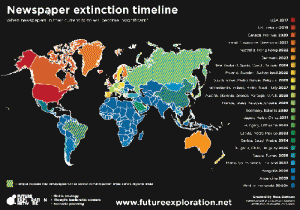
Part of the point I wanted to make was that this date is different for every country. As such I have created a Newspaper Extinction Timeline that maps out the wide diversity in how quickly we can expect newspapers to remain significant around the world. First out is USA in 2017, followed by UK and Iceland in 2019 and Canada and Norway in 2020. In many countries newspapers will survive the year 2040.
Phi Beta Iota: Certainly worth reflecting on, this misses two big realities. First, newspapers could still convert themselves into honest citizen intelligence networks and focus on sense-making. Second, five billion poor people are not yet digital and while the dumb cell phone has a bright future, the smart phones and pads do not, in part because of raw earth shortfalls, in part because of embedded toxicity of materials, and in part because even with call centers, there is a very big space that “smart analog” newspapers could fill. The latter is particularly true if one factors in the fact that five billion poor people need alternatives to rote education including primers that can be passed around and do not need power sources.


 , Wu is known for the concept of “net neutrality.” He’s been thinking about this stuff for several years, and has as much clarity as anyone (which is still not much) about the future of the Internet.