
Louis D. Brandeis on Banks Against the People

03 Economy, 07 Other Atrocities, 09 Justice, 10 Transnational Crime, 11 Society, Commerce, Commercial Intelligence, Corruption, Counter-Oppression/Counter-Dictatorship Practices, IO Sense-Making, Money, Banks & Concentrated Wealth, Power Behind-the-Scenes/Special Interests
Who, Me?

In 1912, Woodrow Wilson campaigned for President using many Progressive ideas about strengthening the economy: banking reform, tariff reduction and the elimination of monopolies and trusts. The consolidation of these ideas became known as the New Freedom.

After Wilson's election, Louis Brandeis (who was responsible for many of Wilson's ideas in the first place) wrote a series of articles for Harper's Weekly which outlined why the New Freedom was necessary and how best to implement it. In 1914, the articles were collected in book form and published under the title Other People's Money–and How the Bankers Use It.

Brandeis' central thesis was that the large banking houses were colluding with businessmen to create trusts in America's major industries. Brandeis felt that not only did trusts stifle competition, but also they became so large that they became unable to operate efficiently.
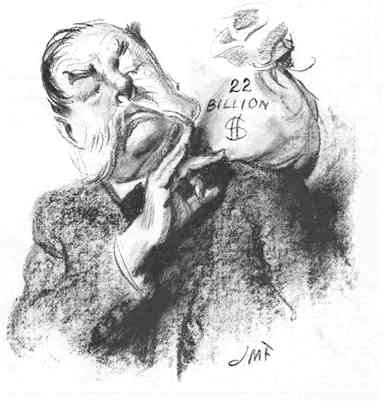
Click on Image to Enlarge

Brandeis backed up his arguments with facts–copious facts gleaned from his battles against J. P. Morgan and Charles Mellen in the New Haven Railroad merger battle and from the Pujo Committee–a House committee report that investigated the abuses of the “Money Trust.”

Wilson was able to push through a number of laws regarding the regulation of business and trusts, but in many ways, due to mergers and stock manipulation, conditions in the business world today remain the same. Many of the details in Other People's Money may be dated, but its central ideas remain relevant–so much so that is still in print almost 90 years after it was first published.  The chapters here are free online.

Chapter I: Our Financial Oligarchy

Chapter II: How The Combiners Combine

Chapter III: Interlocking Directorates

Chapter IV: Serve One Master Only!

Chapter V: What Publicity Can Do

Chapter VI: Where The Banker Is Superfluous

Chapter VII: Big Men And Little Business

Chapter VIII: A Curse Of Bigness

Chapter IX: The Failure Of Banker-Management

Chapter X: The Inefficiency Of The Oligarchy

Tip of the Hat to the University of Louisville Louis D. Brandeis School of Law.

How IGNORING Warnings on Off-Shoring Killed USA

03 Economy, 07 Other Atrocities, Civil Society, Commerce, Corruption, Cultural Intelligence, Government, IO Sense-Making, Secrecy & Politics of Secrecy
Chuck Spinney Recommends...

Nobel Laureate: Globalism Has Been Ruinous for Americans

How Offshoring Has Destroyed the Economy

By PAUL CRAIG ROBERTS, Counterpunch, 31 May 2011

These are discouraging times, but once in a blue moon a bit of hope appears. I am pleased to report on the bit of hope delivered in March of 2011 by Michael Spence, a Nobel prize-winning  economist, assisted by Sandile Hlatshwayo, a researcher at New York University. The two economists have taken a careful empirical look at jobs offshoring and concluded that it has ruined the income and employment prospects for most Americans.

To add to the amazement, their research report, “The Evolving Structure of the American Economy and the Employment Challenge,” was published by the very establishment Council on Foreign Relations.

For a decade I have warned that US corporations, pressed by Wall Street and large retailers such as Wal-Mart, to move offshore their production for US consumer markets, were simultaneously moving offshore US GDP, US tax base, US consumer income, and irreplaceable career opportunities for American citizens.

Among the serious consequences of offshoring are

  • the dismantling of the ladders of upward mobility that made the US an “opportunity society,”
  • an extraordinary worsening of the income distribution, and
  • large trade and federal budget deficits that cannot be closed by normal means. These deficits now threaten the US dollar’s role as world reserve currency.

Read full article….

Phi Beta Iota: Everything killing the USA today was properly briefed to the  Senate and the White House in the 1970's, 1980's, and 1990's.  The missing ingredient was INTEGRITY on the part of the listeners.  Intelligence without integrity is irrelevant; integrity without intelligence is dangerously uninformed.

Pentagon Creates New Excuse for Waging War

07 Other Atrocities, 10 Security, 11 Society, Computer/online security, Corruption, Cultural Intelligence, Government, InfoOps (IO), IO Impotency, Military, Misinformation & Propaganda, Power Behind-the-Scenes/Special Interests, Technologies
DefDog Recommends....

Pogo reigns supreme…..

Pentagon Will Consider Cyberattacks Acts of War

By and

New York Times, May 31, 2011

WASHINGTON — The Pentagon, trying to create a formal strategy to deter cyberattacks on the United States, plans to issue a new strategy soon declaring that a computer attack from a foreign nation can be considered an act of war that may result in a military response.

Read rest of article…

Phi Beta Iota: These people literally have no clue and are simply striving for budget share before Pentagon right-sizing gets underway.  We absolutely guarantee that what the Pentagon and the US Intelligence Community do to their own employees every day (including forbidding thumb drives now) qualifies as a crime against humanity as well as an act of war.  The USG is its own worst enemy in every possible sense.

See Also:

2011 Cyber-Command or IO 21 + IO Roots

Bob Gates, Chief Maintenance Clerk, Talks Crap — and the Wall Street Journal Goes Along…

Defense and the Deficit–Busting the Defense Bubble, Ending Defense Entitlement

Reference: The Pentagon Labyrinth

Review (Guest): The Pentagon Labyrinth

Review: Grand Theft Pentagon–Tales of Corruption and Profiteering in the War on Terror

Search: cost of corruption + Corruption RECAP

<1% of World Population Controls 39% of All Wealth

03 Economy, 07 Other Atrocities, 11 Society, Budgets & Funding, Civil Society, Corruption, Counter-Oppression/Counter-Dictatorship Practices, Cultural Intelligence, Money, Banks & Concentrated Wealth, Peace Intelligence
Click on Image to Enlarge

Millionaires Control 39% of the World’s Wealth

By Robert Frank

Wall Street Journal, May 31, 2011

Last year was another good year for millionaires – though their pace of growth is slowing.

According to a new report by Boston Consulting Group out today, the number of millionaire households in the world grew by 12.2% in 2010, to 12.5 million. (BCG defines millionaires as those with $1 million or more in investible assets, excluding homes, luxury goods and ownership in one’s own company).

The U.S. continues to lead the world in millionaires, with 5.2 million millionaire households, followed by Japan with 1.5 million millionaire households, China with 1.1 million and the U.K. with 570,000. Singapore leads the world in “millionaire density,” or the percentage of millionaires, with 15.5% of its population now millionaire households.

The most important trend, however, is the global wealth distribution. According to the report, the world’s millionaires represent 0.9% of the world’s population but control 39% of the world’s wealth, up from 37% in 2009. Their wealth now totals $47.4 trillion in investible wealth, up from $41.8 trillion in 2009.

Read rest of article….

Phi Beta Iota: The single most consistent precondition for revolution across centuries has been the over-concentration of wealth.  We're there.  Now all we need is a few precipitants.

See Also:

Continue reading “<1% of World Population Controls 39% of All Wealth”

USA: Thirteen Big Lies — Needed Counter-Narrative

07 Other Atrocities, Advanced Cyber/IO, Analysis, Budgets & Funding, Civil Society, Collective Intelligence, Corporations, Corruption, Counter-Oppression/Counter-Dictatorship Practices, Cultural Intelligence, Ethics, History, info-graphics/data-visualization, InfoOps (IO), Intelligence (government), IO Impotency, Journalism/Free-Press/Censorship, Methods & Process, Misinformation & Propaganda, Money, Banks & Concentrated Wealth, Officers Call, Policies, Politics of Science & Science of Politics, Power Behind-the-Scenes/Special Interests, Reform, Secrecy & Politics of Secrecy, Standards, Strategy, Technologies, Waste (materials, food, etc)
Jock Gill

Here are a few of the BIG lies used to support the status quo.  What we need, rather urgently, is a counter-narrative

LIE 1. The earth is an open system with infinite supplies and sinks;

POSSIBLE TRUTH:  Earth is a closed system, changes that used to take 10,000 years now take three, humanity is “peaking” the entire system.

LIE 2. Everything must be monetized;

POSSIBLE TRUTH:  Money is an exchange unit and an information unit; in the absence of holistic analytics and “true cost” transparency, mony is actually a toxic means of concentrating wealth and depriving communities of their own resources (e.g. land).

LIE 3. The extreme unregulated free market is the only option for a modern economy;

POSSIBLE TRUTH:  Information asymmetries and “rule by secrecy” have been clearly documented–the free market is neither free nor fair.  A modern economy needs to be transparent, resilient, and hence rooted in the local.

Continue reading “USA: Thirteen Big Lies — Needed Counter-Narrative”

Weak Signals: USG Debt

03 Economy, 07 Other Atrocities, 11 Society, Budgets & Funding, Civil Society, Commerce, Commercial Intelligence, Corruption, Cultural Intelligence, Government

FACT:  USG  poised to borrow $1.6 TRILLION in 20

FACT:  No one is talking about stopping borrowing as a pre-condition for addessing the problem.

FACT:  No one is talking about strategic analytics across the entire budget

FACT:  Democrats are demanding tax increases without any reference to reduced borrowing.

FACT:  Some, not all, Republicans beginning to associate “truth” with “debt.”

Wikipedia Overview

News on US Debt

Gates Puts Military Pay Cuts on the Table

03 Economy, Budgets & Funding, Cultural Intelligence, Military
Marcus Aurelius Recommends

Why are we not surprised?

Gates Puts Pay Cuts on the Table

Military.com, May 26, 2011

Terry Howell

Under pres­sure to reduce the DoD bud­get, Defense Sec­re­tary Robert Gates has – until recently – avoided ask­ing for a reduc­tion in mil­i­tary pay and ben­e­fits. How­ever, the Wall Street Jour­nal has reported that increas­ing pres­sure on law­mak­ers to make big­ger cuts in the fed­eral deficit has con­vinced defense bud­get plan­ners that Con­gress is will­ing to look at cut­ting mil­i­tary com­pen­sa­tion.

Since the begin­ning of his term as Sec Def, Gates has avoided ask­ing for mil­i­tary pay freezes or reduc­tions. He has instead sought to reduce the cost of TRICARE by increas­ing annual pre­mi­ums and fees for mil­i­tary retirees and tax­ing their employ­ers if retirees opt-out of employer pro­vided health care. So far his repeated attempts to make major changes to TRICARE have been thwarted by Con­gress – mainly due to pres­sure from groups like the Mil­i­tary Offi­cers Asso­ci­a­tion of Amer­ica.

How­ever, pres­sure from the White House to make $400B in cuts may have forced Gates’ hand. In fact, Sec. Gates reently floated the idea that reduc­ing mil­i­tary com­pen­sa­tion may not be a bad idea. Gates told a group that reduc­ing mil­i­tary pay wouldn’t neg­a­tively impact recruit­ing; point­ing out that even dur­ing the worst of the Iraq war the Army was the only ser­vice that didn’t exceed their recruit­ing and reten­tion goals.

Read full article….

noble gold