Last month, Director of National Intelligence James Clapper and Secretary of Defense Leon Panetta announced the creation of a new U.S. espionage agency: the Defense Clandestine Service, or DCS. DCS is expected to expand the Pentagon's espionage personnel by several hundred over the next few years, while reportedly leaving budgets largely unchanged. The news nonetheless surprised some observers in Washington because the move appeared, at least initially, to be a direct challenge to the Central Intelligence Agency, whose National Clandestine Service leads the country's spy work overseas. Then came a second surprise: former CIA officers and other intelligence experts started applauding. The question is why.
Veterans for Peace works for the abolition of war, and while that process will take many steps, one that should be taken immediately is the dissolution of the North Atlantic Treaty Organization.
NATO has always been a war-making institution lacking in accountability to the peoples of the nations it claims to represent. But NATO at least once claimed a defensive purpose that it neither claims nor represents any longer.
NATO has militarized the nations of Europe against the will of their people, now maintains hundreds of nuclear weapons in non-nuclear European nations in blatant violation of the Nuclear Nonproliferation Treaty, and is threatening Russia with missile base construction on its borders.
Having fought aggressive wars in Yugoslavia, Iraq, Afghanistan, and Libya, NATO remains in Afghanistan, illegally, immorally, and to no coherent purpose. The people of the United States, other NATO nations, and Afghanistan itself, overwhelmingly favor an end to NATO's presence, while Presidents Obama and Karzai, against the will of their people, work to commit U.S. forces to at least 12.5 more years in Afghanistan.
WASHINGTON, April 10, 2012 – The World Bank today announced that it will implement a new Open Access policy for its research outputs and knowledge products, effective July 1, 2012. The new policy builds on recent efforts to increase access to information at the World Bank and to make its research as widely available as possible. As the first phase of this policy, the Bank launched today a new Open Knowledge Repository and adopted a set of Creative Commons copyright licenses.
The new Open Access policy, which will be rolled out in phases in the coming year, formalizes the Bank’s practice of making research and knowledge freely available online. Now anybody is free to use, re-use and redistribute most of the Bank's knowledge products and research outputs for commercial or non-commercial purposes.
“Knowledge is power,”World Bank Group President Robert B. Zoellick said. “Making our knowledge widely and readily available will empower others to come up with solutions to the world’s toughest problems. Our new Open Access policy is the natural evolution for a World Bank that is opening up more and more.”
The policy will also apply to Bank research published with third party publishers including the institution’s two journals—World Bank Research Observer (WBRO) and World Bank Economic Review (WBER)—which are published by Oxford University Press, but in accordance with the terms of third party publisher agreements. The Bank will respect publishing embargoes, but expects the amount of time it takes for externally published Bank content to be included in its institutional repository to diminish over time.
The World Bank will be adopting an Open Access Policy as of July 1. In addition, the Bank recently launched the World Bank Open Knowledge Repository (OKR) and became the first major international organization to adopt a set of copyright licenses from Creative Commons. As a result, a wealth of Bank research and knowledge products are now freely available to anyone in the world for use, re-use, and sharing.
Why is this so significant?
How can open access contribute to the goal of eliminating poverty?
How does the new policy impact the Bank's researchers and authors?
How will the OKR benefit users of Bank knowledge, in particular those in developing countries?
Join us in person at the World Bank or online for a lively conversation about these and other aspects of open access to research, and its potential for development progress.
FEATURED GUESTS:
Peter Suber Director of the Harvard Open Access Project and a leading voice in the open access movement
Cyril Muller Vice President for External Affairs at the World Bank
Michael Carroll American University law professor and founding board member of Creative Commons
Adam Wagstaff Research Manager of the World Bank's Development Research Group
(WASHINGTON DC) – As news about Israeli political parties merging dominates headlines, this one is being overlooked. The US House of Representatives Defense Appropriations Subcommittee yesterday approved almost $1 billion for Israel’s anti-missile defense programs.
The expensive systems are called Arrow 3. The American politicians propose spending this exorbitant amount in order to upgrade the current Arrow system, David’s Sling, and Iron Dome.
The names are fancy, unlike the missiles they say they are defending themselves from. The munitions fired from Gaza are al Qassam rockets and they are little more than unguided fireworks.
Israeli and American media portray the ‘rocket attacks from Gaza’ as a serious danger and they claim that the large U.S. tax payer contributions are necessary in order to ‘defend’ Israel. The Gaza rockets have in all time, killed a total of 28 Israeli citizens. Some place the number at 29.
The total appropriation is the highest ever approved for the four programs; it reflects the willingness of the United States to back yet another racist, apartheid government that uses American investments to send Israeli youth to college, and to kill Palestinians; Muslims and Christians, who have few rights under a system that Israel created, offering one set of laws and punishments to Jews, and a different set for all other human beings.
Living in America is becoming very difficult for anyone with a moral conscience, a sense of justice, or a lick of intelligence. Consider:
We have had a second fake underwear bomb plot, a much more fantastic one than the first hoax. The second underwear bomber was a CIA operative or informant allegedly recruited by al-Qaeda, an organization that US authorities have recently claimed to be defeated, in disarray, and no longer significant.
This defeated and insignificant organization, which lacks any science and technology labs, has invented an “invisible bomb” that is not detected by the porno-scanners. A “senior law enforcement source” told the New York Times that “the scary part” is that “if they buil[t] one, they probably built more.”
The more followers you have, the stronger is their belief in you. The more believers you have, the greater your chances of getting elected. With both you can rule the nation. The difference between the two is that believers will fight for their cause. This forms the basis for real power (From author).
The influence of religion is such that power, order and government perceive their effects as a stabilizer on society as well as the legitimation of their rule. Depending on the history, the state depends on a society that is moral, consistent and trusting in their institutions. As decision makers, real power ensures that their decisions will be both supported and followed by society. From the very beginning of society, religious institutions fought for “believers-parishioners.” As a result, politics borrows from religion in that it is a secularization of bureaucratic competencies formally entrusted to an absolute ruler ‘personally’ chosen by a supreme being and counseled by his representative on earth – embodied as the senior religious leader. Sometimes this symbiotic relationship is equal, sometimes dependent upon the other but always it is both visual and implied. What both understand is that power is expressed in numbers which is something they both need.
This analysis is a series of articles consisting of historical and contemporary facts in order to examine this relationship in more detail. By minimizing editorial comment and without bias to any particular religion, the intent to explore a dimension that remains largely underexplored in modern scholarship. In other words if intelligence professionals are dedicated patriots above the norm then what effect does religion play in the composition of their national identity and their duties in serving the state?
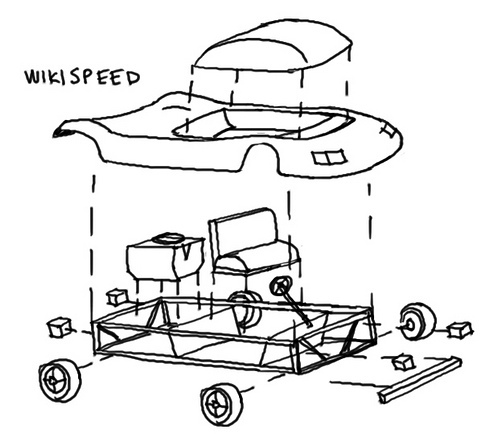
Joe Justice is the ideator of Team Wikspeed: a team of volunteers distributed around the world who recently created a prototype car that is open source, modular and ultra-efficient in just three mo… …YES, in just three months compared with the years it takes traditional car manufacturers to bring out a new model.
See Also:
This is an extremely interesting interview with Joe Justice … it gives the gist of where the manufacturing revolution is going.
Phi Beta Iota: Achieving an Open Source Everything world is a three part process:
1. Creation of Open Source Alternatives.
2. Creation of Integrated infrastructure–pieces need to intersect.
3. Abolishment of political parties and governments that try to micro-impose safety standards (e.g. air bags) and other onorous measures whose sole real purpose is to make competition unaffordable for the Open Source Everything movement, while blackmailing commerce into contributing to Political Action Campaigns.