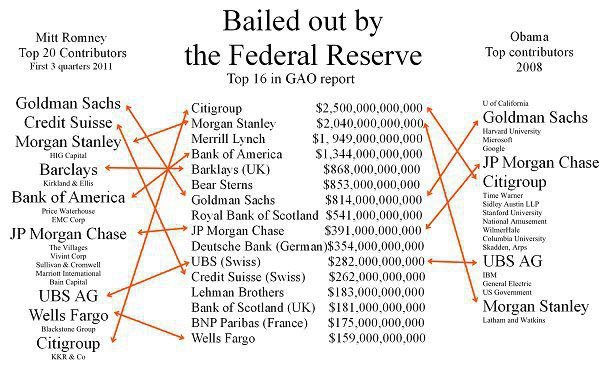
Source and More Data
Continue reading “Graphic: GAO Audit In One Graphic – Banks Buying Politicians”

The truth at any cost lowers all other costs — curated by former US spy Robert David Steele.
Source and More Data
Continue reading “Graphic: GAO Audit In One Graphic – Banks Buying Politicians”

The New Rules Of Innovation: Bottom-Up Solutions To Top-Down Problems
In his new book, Vijay Vaitheeswaran argues that we’re thinking about worldchanging innovation all wrong: It’s not going to come from where we expect it.
Arnie Cooper
www.fastcoexist.com, 19 March 2012
The world is currently standing “on the cusp of a post-industrial revolution.” So writes Vijay Vaitheeswaran in his new book, Need, Speed and Greed: How the New Rules of Innovation Can Transform Businesses, Propel Nations to Greatness and Tame the World’s Most Wicked Problems, out March 13. Vaitheeswaran, a 20-year veteran correspondent for The Economist and adviser to the World Economic Forum, wrote the book, he says, as a way to inspire bottom-up solutions to top-down problems like resource depletion, climate change, and growing income inequality. We spoke with Vaitheeswaran about the importance of disruptive technologies, social entrepreneurship, and embracing China’s rise.
Co.Exist: As you point out in your book, modern humanity has arrived at the first phase of an unprecedented “innovation revolution,” yet many are being left behind. Why is that and what are we gonna do about it?
Vijay Vaitheeswaran: First, I think it’s a wonderful time to be alive. Shockingly, this might be the best time to be in the bottom billion because of transformations like mobile telephony and micro-credit. But it’s getting much harder to be in the middle class in places like America. The principal reason for this, I think, is that educational systems are increasingly out of touch with the needs of the ideas economy. The current education system that our and other countries developed was suited to the industrial revolution, a one-size-fits-all model for education that treats people as commodities. But we’re in an innovation age where creativity, individual initiative, willingness to think out of the box and disrupt established business or even lifestyle patterns is much more important than simple manual tasks that produce the next widget. So I think the great challenge for developed economies like the U.S. is to reinvent education. The challenge for each one of us is to keep relearning how to learn.

Huh?
Bush’s Terror War and the Fixing of Intelligence
On September 11, 2001, within hours of the murderous 9/11 attacks, Bush, Rumsfeld, and Cheney had committed America to what they later called the “War on Terror.” It should more properly, I believe, be called the “Terror War,” one in which terror has been directed repeatedly against civilians by all participants, both states and non-state actors. It should also be seen as part of a larger, indeed global, process in which terror has been used against civilians in interrelated campaigns by all major powers, including China in Xinjiang and Russia in Chechnya, as well as the United States.2 Terror war in its global context should perhaps be seen as the latest stage of the age-long secular spread of transurban civilization into areas of mostly rural resistance — areas where conventional forms of warfare, for either geographic or cultural reasons, prove inconclusive.
. . . . . .
In 2011 an important book by Kevin Fenton, Disconnecting the Dots, demonstrated conclusively that the withholding was purposive, and sustained over a period of eighteen months.8 This interference and manipulation became particularly blatant and controversial in the days before 9/11; it led one FBI agent, Steve Bongardt, to predict accurately on August 29, less than two weeks before 9/11, that “someday someone will die.”9
Continue reading “Mini-Me: From JFK to 9/11 Spotlight Shines on the CIA”

New report released by the Institute for Economics & Peace analyses the macroeconomic effects of US government spending on wars and the military since World War II.
The IEP’s latest report, Economic Consequences of War on the US Economy, analyses the macroeconomic effects of US government spending on wars and the military.
The report studies five periods – World War II, the Korean War, the Vietnam War, the Cold War, and the Afghanistan/Iraq wars – exposing the effect of war financing on debt, consumption, investment, jobs, taxes, government deficits, and inflation.
The findings of the report show devastating trends for US tax, debt and deficit debates.
Download the report here
Key findings
The U.S. has paid for its wars either through debt [World War II, Cold War, Afghanistan/Iraq], taxation [Korean War] or inflation [Vietnam]. In each case, taxpayers have been burdened, and private sector consumption and investment have been constrained as a result.
Report highlights
The report shows the following economic indicators experiencing negative effects either during or after the conflicts:
The higher levels of government spending associated with war tends to generate some positive economic benefits in the short-term, specifically through increases in economic growth occurring during conflict spending booms. However, negative unintended consequences occur either concurrently with the war or develop as residual effects afterwards thereby harming the economy over the longer term.
Phi Beta Iota: There appears to be a continued reluctance to address the real causes of our terrible situation: corruption across the board. No amount of intellectual posturing, whether in a book or in a conference, is a substitute for full transparency and the truth — the whole truth. The lack of integrity across all eight tribes — academia, civil society, commerce, government, law enforcement, media, military, and non-government/non-profit — is the ROOT CAUSE of our collapse.
See Also:
Journal: Politics & Intelligence–Partners Only When Integrity is Central to Both
2012 THE OPEN SOURCE EVERYTHING MANIFESTO: Transparency, Truth & Trust

Crisis Mapping Climate Change, Conflict and Aid in Africa
I recently gave a guest lecture at the University of Texas, Austin, and finally had the opportunity to catch up with my colleague Josh Busby who has been working on a promising crisis mapping project as part of the university’s Climate Change and African Political Stability Program (CCAPS).
Josh and team just released the pilot version of its dynamic mapping tool, which aims to provide the most comprehensive view yet of climate change and security in Africa. The platform, developed in partnership with AidData, enables users to “visualize data on climate change vulnerability, conflict, and aid, and to analyze how these issues intersect in Africa.” The tool is powered by ESRI technology and allows researchers as well as policymakers to “select and layer any combination of CCAPS data onto one map to assess how myriad climate change impacts and responses intersect. For example, mapping conflict data over climate vulnera-bility data can assess how local conflict patterns could exacerbate climate-induced insecurity in a region. It also shows how conflict dynamics are changing over time and space.”
 The platform provides hyper-local data on climate change and aid-funded interventions, which can provide important insights on how development assistance might (or might not) be reducing vulnerability. For example, aid projects funded by 27 donors in Malawi (i.e., aid flows) can be layered on top of the climate change vulnerability data to “discern whether adaptation aid is effectively targeting the regions where climate change poses the most significant risk to the sustainable development and political stability of a country.”

If this weren’t impressive enough, I was positively amazed when I learned from Josh and team that the conflict data they’re using, the Armed Conflict Location Event Data (ACLED), will be updated on a weekly basis as part of this project, which is absolutely stunning. Back in the day, ACLED was specifically coding historical data. A few years ago they closed the gap by updating some conflict data on a yearly basis. Now the temporal lag will just be one week. Note that the mapping tool already draws on the Social Conflict in Africa Database (SCAD).
This project is an important contribution to the field of crisis mapping and I look forward to following CCAPS’s progress closely over the next few months. I’m hoping that Josh will present this project at the 2012 International Crisis Mappers Conference (ICCM 2012) later this year.
Phi Beta Iota: Now imagine a global database on corruption that is updated daily and then hourly, anonymously sourced as needed, calling out corrupt officials by name, date, time, and place.
Huh?
My friends and colleagues,
Forgive the interruption. I reach out to you on a matter of some urgency, about my dear friend, a former CIA officer, dedicated, stoic, talented … and now in deep and terrifying trouble. What's happening to him is so stunningly crappy, and so unjustifiable, that his defense and support has become a personal priority. Though triggered — I believe — by a personal and political agenda, I see his cause as strikingly apolitical: this is about a man falsely persecuted, and the survival of his family.
Please, please take a minute to look at the below. Any questions, reach out to me, and/or check out the sites at the bottom of this email.
Thanks so much,
Peter Landesman
Dear Friends and Colleagues:
We write to ask you to join us in supporting, protecting and materially helping our friend and colleague, John Kiriakou, a long-time former C.I.A. official and case officer. Incredibly, John has been accused by the Department of Justice of crimes under the 1917 Espionage Act, a charge historically reserved for persons who betrayed their country to foreign governments for money.
Why? The prosecutors have not claimed that John talked to any foreign government, passed any government documents or accepted funds from anyone hostile to the United States. Instead, according to the facts asserted in the indictment, he committed the “crime” of responding honestly to a query from the New York Times related to the agency's interrogation program under the Bush Administration, which included waterboarding.
Continue reading “Mini-Me: US Government Witch Hunting Continues…”
Some important connections drawn between aid, corruption, and positive change; and also important omissions — conflicts out of the news where paying attention could make a difference.
Singling Out Forgotten Conflicts
The ISN Blog, 15 March 2012
A popular method for identifying which conflicts necessitate more attention from the international community is to estimate the difference between supply and demand of humanitarian assistance in these conflicts. Supply and demand, however, are very hard to measure in emergencies. This has led to the development of several indicators used to measure ‘forgotten conflicts’.
These indicators are often applied on an annual basis and are intended to generate media attention (to increase donations) and/or support donor operations (to comply with impartiality). Have these efforts been successful? Have they effectively singled out and buttressed forgotten conflicts? Looking back on the past decade, in this blog post I’ll assess which conflicts received the least (and most) attention from international actors.
Continue reading “Berto Jongman: Humanitarian Aid & Forgotten Conflicts”
