Review: Hannibal Rising

5 Star, Atrocities & Genocide, Philosophy

Amazon Page
Amazon Page

More than Satisfies, Ignore the Nit-Pickers,

January 23, 2007
Thomas Harris
Having read “Silence of the Lambs” first, and then the other two books by this author, I was skeptical but interested when I saw this book at an airport. It is excellent. Having fully engaged me with his earlier books, I was absolutely delighted to have this book fully occupy my flight from Denver to Dulles. It is carefully crafted and completely credible.

Future readers will benefit from being able to read the Hannibal series from start to finish. I am quite eager to see the author craft a book in which Hannibal takes on Wall Street and selectively culls the herd of greedy lying cheats that manage the Enron clones so proud of “exploding the client” (see my review of Michael Lewis' “Liar's Poker” and also “Confessions of an Economic Hit Man,” as well as “Cheating Culture” and “The Manufacture of Evil.”

Although I normally do not read or review fiction, this author has joined John Le Carre (the George Smiley series) and is one of handful of “must read” authors of fiction that is to my personal taste as a former spy and infantry officer.

This author has found his niche. Hannibal must live and love and kill with elegance. Bring on the next one!!!

Vote on Review
Vote on Review

Click Here to Vote on Review at Amazon,

on Cover Above to Buy or Read Other Reviews,

I Respond to Comments Here or There

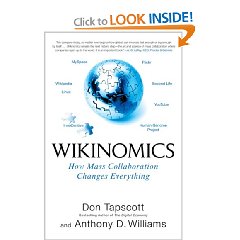
Review: Wikinomics–How Mass Collaboration Changes Everything

5 Star, Economics, Information Society, Intelligence (Collective & Quantum), Intelligence (Public)

Amazon Page
Amazon Page

Solid FOUR, Some Preening, Double-Spaced Overview,

January 16, 2007
Don Tapscott
Out of respect for Laura K. Turner's deeper knowledge of this author, I am integrating some of her observations and correcting myself where appropriate. The edit below raising the book to a four was done immediately after publishing the original review.

EDIT: After reading Cass Sunstein's book, which earned a four, I feel compelled to raise this to a four but Amazon does not allow me to change star ratings. This is a solid four, the preening not-withstanding.

There are a *lot* of platitudes in this double-spaced book, to the point that I felt I was reading a very simplified version of more complex ideas (which is of course a plus when dealing with ill-informed corporate chiefs and policy-makers (see Ben Gilad, “Blindspots” from Infonortics UK, not available via Amazon).

I've read stuff by this primary author (Tapscott) before and he has certainly made sustained contributions to our understanding, am just wondering if this book was a bit too quickly done–it struck me as more simplistic and shallower than I expected. Although Ms. Turner refers to seven distinct business models, neither “model” nor “business model” appear in the book's index, and my original impression, after a second look at the book and my notes, stands: the subtitle says it all: this is about mass collaboration.

There are a few flaws with this book that would normally take it down to three stars, but given the importance of the topic, the quick read, and the known serious past of the author, I have brought it back up to four after comparing it with “Infotopia.” It is double-spaced with a heavy dose of jargon, with a very over-simplified and uncritical view of the unfettered joys of globalization. This author has evidently never heard of “true cost” or “natural capitalism.”

In light of Ms. Turner's comments, I freely admit to lacking the deeper understanding of past books by the primary author, and I suspect that her spirited defense of this book rests more on substance from the past that a reader of this book cannot fathom.

As one who was first educated in the 1970's, I found it a real irritant to have the author appear to invent and be the catalyst for ideas like prosumer (Alvin Toffler, first used in his keynote speech to my annual conference in 1993), importance of external knowledge (Peter Drucker), and the paradigm shift (Thomas Kuhn in “The Structure of Scientific Revolution”). The author says that he “Don” wrote the book on paradigm shifts. Although the author footnotes the first two, not the third, this is in the end-notes and the sense of preening and exaggeration is distinctly annoying, especially when combined with the almost total lack of recognition of any of the 300 or so books by others about wealth of knowledge, infinite wealth, forbidden knowledge, Voltaire's bastards, etc. This struck me as a very self-centered book in more ways than one.

Now, Ms. Turner says a book should be judged on its rigor, coherence, creativity, and readability. B for the first two, A for the second two.

Although the author mentions GoogleEarth on more than one occasion, there is not real development in this book of the importance of the geospatial foundation for sharing all information in historical and cultural context.

A few minor thoughts worth noting:

–Well-done Wikis (the author makes no mention of trolls or all the other problems associated with Wikipedia) cut email by 75% and meetings by 50%. Would that this were so, and properly documented, but it's a start.

–90% of most R&D is internal and therefore lacking in the diversity that might come from the larger open network. This is *very* important. We need to build the World Brain and machine-speed translation and integration. Singapore, the Nordic nations, and even Estonia are ahead of the USA in this area.

–top billion people are believed by some to have 2-6 spare hours a day during which they could be contributing knowledge and mentoring to the larger group. [Bottom five billion desperately need to be connected to the Net for free, and if we did that–for what we have spent on Iraq we could have given out 5 billion free cell phones–they would create infinite wealthy.]

–Bill Gates thinks that Free/Open Source Software is communist. I guess that's the equivalent of me thinking Microsoft is fascist.

–Four things I had *not* heard of: CollabNet, Scorecard, InnoCentive, and TakingITGlobal.

I am posting two customer images here to try to make the point that the world of mass collaboration is a great deal more complicated and also a great deal more exciting, than the author communicates.

Bottom line: if you are not immersed in this topic, and want one book to partly understand your kids and the emerging, this one will do nicely. It was not deep enough to fully occupy me during a five hour trip from coast to coast–take a second book as back-up.

In addition to acknowledging Ms. Turner's helpful and professionally presented observations, I am using the new feature to add links to other books I recommend. You can see my many lists (especially the one on creating infinite wealth and the other on cheating the 90% that do the real work) for many other recommendations, and if you want to see my reviews easily when books have tens or hundreds of reviews, use the selection box in the upper right of your Amazon profile page. I do not list the author's books because of the limit to 10, but certainly Paradigm Shift and The Digital Economy as well as Digital Capital can be considered.

I conclude that I read broadly and Ms. Turner reads deeply, and I hope this review is a useful intersection of our combined paths.

The Structure of Scientific Revolutions
Introduction to Paradigms: Overview, Definitions, Categories, Basics, Optimizing Paradigms & Paradigm Engines
Out of Control: The New Biology of Machines, Social Systems and the Economic World
Powershift: Knowledge, Wealth, and Power at the Edge of the 21st Century
Smart Mobs: The Next Social Revolution
The Wealth of Networks: How Social Production Transforms Markets and Freedom
Infotopia: How Many Minds Produce Knowledge

Three new references (10 May 2008):
Society's Breakthrough!: Releasing Essential Wisdom and Virtue in All the People
Group Genius: The Creative Power of Collaboration
Collective Intelligence: Creating a Prosperous World at Peace


Vote on Review
Vote on Review

Review: Palestine–Peace Not Apartheid

5 Star, Atrocities & Genocide, Empire, Sorrows, Hubris, Blowback, Peace, Poverty, & Middle Class, Politics, Power (Pathologies & Utilization), Religion & Politics of Religion, Truth & Reconciliation

Amazon Page
Amazon Page

Truth is the only thing that will save us,

January 13, 2007
Jimmy Carter
President Jimmy Carter does not have a malicious bone in his body, and is one of the most intelligent Presidents we have ever had. His scholarship is NOT off the mark. What is off the mark is the dogmatic refusal of Zionist Jews to listen to reason.

See my reviews of Fog Facts : Searching for Truth in the Land of Spin (Nation Books) and Lost History: Contras, Cocaine, the Press & ‘Project Truth' for a sense of just how crazy all these people are that are claiming anti-semitism. I have nothing but disdain for the Jews that resigned, for they are disgracing themselves and America by showing so vividly their monstrous disrespect for the truth, for dialog, and for one of the finest Presidents this Nation has ever had (I say this as an estranged moderate Republican).

Reality is not easy. Reality is constantly obscured by corporate media owned by the corporations whose mis-deeds they dare not report, and whose relations with the 45 dictators of the world are beyond cozy–they are self-serving partnerships to loot the commonwealth of nations and leave all publics, not just the Palestinians, in the dirt. See Breaking the Real Axis of Evil: How to Oust the World's Last Dictators by 2025

Reality is also obscured by a US Congress that now has 43 Jews and only 1 Muslim, a Congress that until very recently abdicated its role as the FIRST branch of government and failed to balance the powers of an imperial presidency run amok (see my reviews of The Broken Branch: How Congress Is Failing America and How to Get It Back on Track (Institutions of American Democracy) and Breach of Trust: How Washington Turns Outsiders Into Insiders. America must be very alert to the dual hijacking of its government by corporations and by Zionist Jews who forget that they used terrorism to win their freedom from England, just as our American founders used terrorism to win the War of Independence.

Terrorism is a tactic. Anyone that does not understand that is either stupid (less likely) or maliciously deceptive (more likely).

It is my rare privilege to be the #1 Amazon reviewer for non-fiction (#48 over-all), and it is on that foundation that I stand today in praise of Jimmy Carter, and in demand of the immediate resignation of Dick Cheney, or his impeachment (see my list on books relevant to evaluating Dick Cheney, and on impeachment for those who cannot wait).

Reality is tough. Lying to ourselves is as good as bullet in our heads. See my varied lists for the reality that is the context for this good book by a good man.

Note: the Arabs are just as despicable as the Jews, for they have treated the Palestinians the way India and Japan treat their untouchables. Nothing in this book, or in my review, should be contrued as forgiving of the Arabs. It is my personal view that the US should disengage from the Middle East and also withhold our support to Israel until such time as it will listen to Jimmy Carter's sound advice, and agree to a shared state without walls–partition, as with India and Pakistan, breeds on-going violence. It is only tolerance and a common commitment to creating shared wealth that works. The Saudi ruling royalty are EVIL. See See No Evil: The True Story of a Ground Soldier in the CIA's War on Terrorism and Sleeping with the Devil: How Washington Sold Our Soul for Saudi Crude. For a more elegant view, see Leap of Faith: Memoirs of an Unexpected Life

Gandhi (Widescreen Two-Disc Special Edition) had it right: Palestine is to the Palestinians as France is to the French. Contrary to the dogma and lies that the rabid Jews (as opposed to rational Jews taking the long view) spread, the land *was* occupied by the Palestinians, and the Jews are genociding them the way the early American settlers genocides the Native Americans. No one has clean hands here, but it helps no one at all to demean an honest author and good man, and to falsely claim that this book is anti-semitic. This book is anti-stupid, and I am anti-stupid.

Vote on Review
Vote on Review

Click Here to Vote on Review at Amazon,

on Cover Above to Buy or Read Other Reviews,

I Respond to Comments Here or There

Review: Tragedy & Hope–A History of the World in Our Time

5 Star, Banks, Fed, Money, & Concentrated Wealth, Budget Process & Politics, Complexity & Catastrophe, Corruption, Crime (Corporate), Crime (Government), Democracy, Economics, History, Power (Pathologies & Utilization)

Amazon Page
Amazon Page

First Stone in the Digital Study of Abusive Wealth,

January 4, 2007
Carroll Quigley
This is a very long book, longer than Laurie Garrett's Betrayal of Trust: The Collapse of Global Public Health and it has taken me over two months, between other easier to read books, to examine. I strongly recommend that W. Cleon Skousen's book The Naked Capitalist be purchased at the same time, as it offers a very helpful “Cliff's Notes” and summary of the larger work.

I give this book 5 stars for substance, 4 stars for personal bias, and 4 stars for being both too late, and too soon–to late to have saved us from what Derek Leebaert calls The Fifty-Year Wound: How America's Cold War Victory Has Shaped Our World, too soon to be centerpiece, as I would have it be, of a massive public intelligence digital project to nail down all the relationships and follow all the money.

Carroll Quigley's book is excruciatingly dull and filled with thousands of facts in very small print. I never-the-less recommend it for purchase because it may well be one of the more fundamental references of our time. Two other books that complement this one are Mike Rupert's Crossing the Rubicon: The Decline of the American Empire at the End of the Age of Oil and Jim Marrs' Rule by Secrecy: The Hidden History That Connects the Trilateral Commission, the Freemasons, and the Great Pyramids. See also Moises Naim, Illicit: How Smugglers, Traffickers, and Copycats are Hijacking the Global Economy.

Now to my final point: others get nervouos when I begin to engage the “conspiracy literature,” and I have to reiterate that the conspiracy literature is no more nor any less rife with bias and error than the conventional literature. See my reviews of John Perry's Lost History: Contras, Cocaine, the Press & ‘Project Truth' and Larry Beinhart's Fog Facts: Searching for Truth in the Land of Spin. And if your really want to worry, read John Lewis Gaddis The Landscape of History: How Historians Map the Past on how inept and ignorant most of our scholars are, or the more conventional Information Anxiety 2 by Richard Saul Wurman.

Quigley is the cornerstone for a public intelligence digital map that will emerge over the next few years. I anticipate that thousands of books and articles, including Sterling and Peggy Seagrave's “Gold Warriors” (which has strangely disappeared from Amazon but is being read by millions of Chinese in both Mandarin and common Chinese) will all “make sense,” and I believe they will make enough sense to warrant a massive restriction on illicit wealth such as has never before occured under non-violent circumstances. I am NOT saying repossession, but rather an end to banks lending money they do not have, governments borrowing from banks, and intermediaries charging excessively while ignoring “true cost” of their goods to the planet. This book is revolutionary, but it is also before its time.

The books below provide critical insights into how we can empower the five billion at the bottom of the pyramid to create infinite wealth. I and 23 other co-founders have created the Earth Intelligence Network to do precisely that.

They also afford me an opportunity to make clear that understanding abusive wealth does not mean we much confiscate ill-gotten gains. Doing so would serve no useful purpose and it would spread so thinly among the five billion poor. We must let sleeping dogs lie, and create infinite wealth that stabilizing localities and enables peace everywhre.

Please do at least read my review of each of the below gifts from others:
The Fortune at the Bottom of the Pyramid: Eradicating Poverty Through Profits (Wharton School Publishing Paperbacks)
Blessed Unrest: How the Largest Movement in the World Came into Being and Why No One Saw It Coming
The Wealth of Networks: How Social Production Transforms Markets and Freedom
Revolutionary Wealth: How it will be created and how it will change our lives
Infinite Wealth: A New World of Collaboration and Abundance in the Knowledge Era
The Wealth of Knowledge: Intellectual Capital and the Twenty-first Century Organization
The New Craft of Intelligence: Personal, Public, & Political–Citizen's Action Handbook for Fighting Terrorism, Genocide, Disease, Toxic Bombs, & Corruption
Collective Intelligence: Mankind's Emerging World in Cyberspace
The Tao of Democracy: Using Co-Intelligence to Create a World That Works for All

Vote on Review
Vote on Review

Click Here to Vote on Review at Amazon,

on Cover Above to Buy or Read Other Reviews,

I Respond to Comments Here or There

Review: The Naked Capitalist

5 Star, Banks, Fed, Money, & Concentrated Wealth, Capitalism (Good & Bad), Economics

Amazon Page
Amazon Page

Essential Pre-Cursor to Quigley's “Tragedy & Hope”,

January 4, 2007
Cleon Skousen
Despite the considerable reading that I do, it was most helpful to have this book as both a capstone to reading Quigley's Tragedy & Hope: A History of the World in Our Time, and as a form of Cliff's Notes. While I am an estranged moderate Republican and shy away from those that have been too close to the extremes of either left or right, this is a sensible book, and it earns five stars on its merits.

The single most important contribution this book makes, at least for me, is in its discussion of the manner in which tax-exempt foundations are used to conceal and protect wealth from taxes, and to reward corrupt politicians who “went along.”

Lest the more conventional readers dismiss the reviewer comment below about wars being about profit, about lending money to both sides and arbitraging the instability, I would point quickly to Smedley Butler's War Is a Racket: The Anti-War Classic by America's Most Decorated General, Two Other Anti=Interventionist Tracts, and Photographs from the Horror of It. General Butler was one of the most decorated Marines in history, and in his book he publicly denounces the role of the Marine Corps as an enforcer for the US banks. Then of course you have Confessions of an Economic Hit Man which I judge to be 15% fluff and 85% raw gold substance.

So there you have it–books like this are now entering the consciousness of the middle class, and with Lou Dobbs leading the pack, the middle class is beginning to rouse from its passive acceptance of elitist screw jobs on Congress, the White House, the economy, the military, and the poor. We *are* farm animals from whom profit is being harvested, and we will remain farm animals for so long as we fail to read and think and discuss and demand.

I end by urging one and all to join Reuniting America, and demand Electoral Reform as the one non-negotiable expecation from the current Congress and before November 2008.

Vote on Review
Vote on Review

Click Here to Vote on Review at Amazon,

on Cover Above to Buy or Read Other Reviews,

I Respond to Comments Here or There

Review: The True Cost of Low Prices–The Violence of Globalization

5 Star, Banks, Fed, Money, & Concentrated Wealth, Capitalism (Good & Bad), Congress (Failure, Reform), Corruption, Crime (Corporate), Crime (Government), Economics, Environment (Problems), Executive (Partisan Failure, Reform), Peace, Poverty, & Middle Class

Amazon Page
Amazon Page

Superb Overview of True Cost of False Profits (Pun Intended),

January 4, 2007

Vincent A. Gallagher

“True Cost” has become a meme that is rapidly spreading and revealing to the public how insane and unfair many of our so-called “free trade” policies are. This book is a superb piece of informed scholarship with a strong foundation on real-world practice, and the auther is both objective and empathetic. True costs and real slaves of the global economy (who join the US prison population in slavery).

Soon Paul Hawken (see Natural Capitalism: Creating the Next Industrial Revolution) will open the World Index of Social and Environmental Responsibility (WISER) and WikiCalc will be available. I anticipate a huge outpouring of information that allows anyone with a cell phone to scan the barcode, send it to WISER or Amazon, and get back both the “true cost” of any good in terms of carbon, water, slavery, and tax avoidance, and pointers to the nearest green and local alternative products.

SUPER BOOK.

See also:
The Wealth of Networks: How Social Production Transforms Markets and Freedom
Powershift: Knowledge, Wealth, and Power at the Edge of the 21st Century
Revolutionary Wealth: How it will be created and how it will change our lives
Infinite Wealth: A New World of Collaboration and Abundance in the Knowledge Era
The Fortune at the Bottom of the Pyramid: Eradicating Poverty Through Profits (Wharton School Publishing Paperbacks)

Vote on Review
Vote on Review

Click Here to Vote on Review at Amazon,

on Cover Above to Buy or Read Other Reviews,

I Respond to Comments Here or There

Review: The True Cost of Conflict/Seven Recent Wars and Their Effects on Society

5 Star, Asymmetric, Cyber, Hacking, Odd War, Atrocities & Genocide, Congress (Failure, Reform), Corruption, Crime (Government), Misinformation & Propaganda, True Cost & Toxicity, War & Face of Battle

Amazon Page
Amazon Page

Ten Years Ahead of Its Time, Now Part of “True Cost” Meme,

January 4, 2007
Michael Cranna
This book was ten years ahead of its time in relation to the emergent “true cost” meme that is exploding as the public acquires access to more information and the tools to make sense of that information.

The author has done a first-rate job of looking at seven conflicts and their costs or (rarely) benefits. This is precisely the kind of analysis that is needed if Congresses and Parliaments are to be educated and weaned away from the bankers fondness for war and credit for war as a profit harvesting opportunity.

I recommend that in addition to this book, the reader consider General Smedley Butler's book, “War is a Racket,” and the superb book by Cees Wiebes, “Intelligence and the War in Bosnia” (see my review for lessons learned).

Vote on Review
Vote on Review

Click Here to Vote on Review at Amazon,

on Cover Above to Buy or Read Other Reviews,

I Respond to Comments Here or There

noble gold