Review: New World New Mind–Moving Toward Conscious Evolution (Paperback)

5 Star, Consciousness & Social IQ, Intelligence (Collective & Quantum), Values, Ethics, Sustainable Evolution

Amazon Page
Amazon Page

5.0 out of 5 stars From 1989, Not Updated, Superb Never-the-Less,

April 28, 2005
Robert E. Ornstein
EDIT 20 Dec 07 to add links.

This superb book was published in 1989 and is being reissued, and I am very glad it has come out again. I bought it because it was recommended by Tom Atlee, seer of the Co-Intelligence Institute, and I found it very worthwhile.

As I reflect on the book, I appreciate two key points from the book:

1) The evolution of our brains and our ability to sense cataclysmic change that takes place over long periods of time is simply not going fast enough–the only thing that can make a difference is accelerated cultural evolution, which I find quite fascinating, because cultural evolution as the authors describe it harkens to noosphere, World Brain, co-intelligence, and what the Swedes are calling M4 IS: multinational, multiagency, multidisciplinary, multidomain information sharing–what I think of as Open Source Intelligence–personal, public, & political.

2) One of the more compelling points the authors make is that not only are politicians being elected and rewarded on the basis of short-term decisions that are by many measures intellectually, morally, and financially corrupt, but the so-called knowledge workers–the scientists, engineers, and others who should be “blowing the whistle,” are so specialized that there is a real lack of integrative knowledge. I realized toward the end of the book, page 248 exactly, that Knowledge Integration & Information Sharing must become the new norm.

This is a tremendous book that is loaded with gems of insight. I have it heavily marked up. Although it integrates and reminds me of ideas ably explored in other books, such as Health of Nations, Cultural Creatives, Clock of the Long Now, ATTENTION, Limits to Growth, and Forbidden Knowledge, these two authors have integrated their “brief” in a very readable way–as one person says on the book jacket, they effectively weave together many strands of knowledge.

The annotated bibliography is quite good, and causes me to be disappointed that the publishers did not provide for the updating of the bibliography–the ideas being blended are timeless and need no update.

Two notes toward the end were quite interesting. They speculate that Japan may be the first modern nation to collapse, if it is subject to disruption of the global trade and transportation system. They also have high praise for Global 2000, an integrative work whose predictions for the 2000 period (written in the 1970's, I believe) are turning out to be quite accurate.

Finally, woven throughout the book, is the simple fact that we are now burning up our savings–consuming the Earth at a much faster rate than it can replenish itself. We are very much out of harmony with our sustaining environment, and at grave risk of self-destruction. Interestingly, they remind of the Durants last word in “The Lessons of History:” that the only revolution, the only sustainable revolution, is that which takes place in the human mind. As these authors would have it, if we do not develop a new collective mind capable of integrating, understanding, and acting sensible, for the long term, on what we can know as a collective mind, then our grandchildren will become prey for the cockroaches of the future.

At a time when the new Director of National Intelligence (DNI), Ambassador Negroponte, is seriously contemplating the establishment of a national Open Source (Information) Agency as recommended by the 9-11 Commission, to get a grip on all the historical and current knowledge, both scientific and social, that we have lost touch with, I can think of just three books I would recommend to the DNI as a foundation for his reflections: this one, Buckman's “Creating a Knowledge Driven Organization,” and Wheatley's “Leadership and the New Science.” I would end his tutorial, or perhaps inspire it, by screening Tom Atlee's video, “From Group Magic to a Wise Democracy.”

Strangely, for I tend to be very gloomy about our prospects these days, I find that this book has cheered me somewhat. I sense the possibility of a break-out through a combination of wise information acquisition and sharing policies, and the application of the new technologies that L-3, CISCO, and IBM, among others, are bringing out, technologies that put intelligence on the edge of the network, and permit the creation of infinitely scalable and shareable synthetic information exactly suited to any need at any level.

There *is* an answer to all that ails us, and these two authors discuss it in a very capable manner.

See also, with reviews:
Integral Consciousness and the Future of Evolution
The Tao of Democracy: Using Co-Intelligence to Create a World That Works for All
The Cultural Creatives: How 50 Million People Are Changing the World
Group Genius: The Creative Power of Collaboration
The Wealth of Networks: How Social Production Transforms Markets and Freedom
Global Brain: The Evolution of Mass Mind from the Big Bang to the 21st Century
World brain
Leadership and the New Science: Discovering Order in a Chaotic World
The World Cafe: Shaping Our Futures Through Conversations That Matter
THE SMART NATION ACT: Public Intelligence in the Public Interest

Vote on Review
Vote on Review

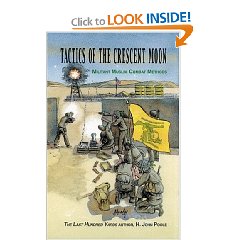
Review: Tactics of the Crescent Moon–Militant Muslim Combat Methods (Paperback)

5 Star, Terrorism & Jihad, War & Face of Battle

Amazon Page
Amazon Page

5.0 out of 5 stars Extraordinary–Breaks the Code and Outs China and Iran,

April 24, 2005
H. John Poole
This book is quite extraordinary, and all of the reviews are helpful in appreciating its content. The author has done a brilliant meticulous job of culling through open source references to create a thoughtful, well-structured, and superbly foot-noted document that is nothing less than “Ref A” for what must become the new “American Way of War.”

Big ideas:

1) One third of the world is Muslim, and if we do not restore morality to our form of democratic capitalism, and they adopt asymmetric warfare techniques, we are toast.

2) Iran certainly, and China probably, are fostering global terror as part of their grand strategy–each with different objectives–to end Anerica's status as a super-power.

3) Pakistan, Syria, Egypt, and Saudi Arabia continue to train and support terrorists, with North Korea, Yemen, Sudan and various other countries (e.g. Bangladesh) having diverse roles to play.

4) Hezbollah out of Iran, rather than Al Qaeda out of Saudi Arabia, is the major player in the Iraqi insurgency, and its methods (hostages, suicide bombings, disguised IEDs) are clearly visible across the Iraqi theater of operations and now beginning to appear elsewhere in the world.

5) We cannot win 4th generation asymmetric wars with firepower alone. The heart of the book is a dissection of the Muslim insurgent's inspired excellence at close and asymmetric combat, and a carefully articulated case for getting back into the business of field light infantry that has the skill to infiltrate, surprise, and defeat enemies “mano a mano”–as some of us have been saying for some time (my own phrase has been “one man, one bullet”), but this author does a fantastic job of nailing it in war-fighting terms, modern way must be won by bottom up squad-level observation and skill, not top down command and control wielding firepower that kills 10-100 non-combatants for every US life that it might save (and ultimately–the author is compelling on this point–the deaths of those non-combatants inspire more suicidal terrorists who kill more US fighting men and women than might have died if we had done it right in the first place.

6) The author outlines in detail, with absolutely first-class documentation of his many sources (this is the first book I can remember reading where a single short sentence might contain as many as six different footnotes) the tactical techniques that Muslim radicals have learned to use, to including tunnels and disguises for both themselves and their Improvised Explosive Devices (IED). I agree with General Zinni–this book is required reading for every member of our Armed Forces, from Private to General. If you have a loved one in the Armed Forces, buy them this book and send it to them immediately.

7) Light infantry, acting as a gendarme with superior human intelligence, can nail the terrorists, but unless we want to occupy the world–something impossible to do (see point one)–then we must mobilize all of the instruments of national power and dedicate ourselves to nurturing legitimate effective *indigenous* governments everywhere. That means we must stop supporting 44 dictators, and we must stop imposing immoral capitalism (carpetbagging) on South America, Asia, and Africa.

This book is nothing short of ispirational. Sadly, it will probably be ignored by the Pentagon because, as the author himself points out, the old outdated and ineffective American Way of War is based predominantly on massive firepower and a heavy contractor presence that is most profitable for our arms merchants (see General Smedley Butler, “War is a Raquet”) and our beltway bandits. Consequently, I pray that this book will be bought, read, and acted upon by anyone who has every served in the U.S. military, is serving now, or knows someone now serving or likely to serve (I have three boys, the oldest will be of draft age in two years). What we are paying for now is not working and time is running out. We need a fundamental change in direction, and that will not happen absent a national uprising, or at Tom Atlee would say, “from group magic to a wise democracy.”

The author gets special high marks from me for relating morality and our acknowledgement of God to being able to win at war. He is absolutely right to castigate the Supreme Court for removing God from our national fabric, and points out that the same Supreme Court once declared slaves to be non-humans. He understands, as Clausewitz did, that the moral is to the material by at least one order of magnitude–in today's information-rich era, I would double it. Morality matters, and we have lost that high ground by allowing special interests to dictate America's profiteering foreign policy, rather than letting the common sense of the American people enrich America's foreign policy for the common good of all–as the Golden Rule suggests: do unto others as you would have them do unto you.

If the public demands that its politicians attend to this author's views, and if our military leaders–both suited and uniformed–attend to this book, it will save hundreds of thousands of lives, tens of billions of dollars, and perhaps the American way of life.

See the links at Phantom Soldier: The Enemy's Answer to U.S. Firepower

Vote on Review
Vote on Review

Review: You’re in Charge–Now What? The 8 Point Plan

5 Star, Best Practices in Management

Amazon Page
Amazon Page

5.0 out of 5 stars May not be the newest, but I found it the most useful,

April 9, 2005
Thomas J. Neff
I bought two books on the first 100 days–this one and “The First 90 Days” by Michael Watkins. I found this book the most useful, and it quickly and immediately inspired me to prepare a succinct 100 day plan broken down into 10 day blocks, for a new $2 billion a year agency. Hence, I completely disagree with those that trash this book and recommend “The First 90 Days” instead of this book. I do find both books useful–read this one first, then cherry pick from Watkins.

Sure, anyone can cook a meal with the same ingredients, and sure, there are a number of books on this topic. For me, this book has exactly the right combination of white space, font size, lay-out, progressive structure, and inspiring snippets (including the all-important advocacy for having an in-house revolutionary).

I recommend this book be read in conjunction with Robert Buckman's “Creating a Knowledge-Driven Organization,” Margaret Wheatley's “Leadership and the New Science” (which Buckman told me inspired his own work), and Clayton Christensen's “The Innovator's Solution” (or you can just read my short summative reviews of those three books).

Vote on Review
Vote on Review

Review: Confessions of an Economic Hit Man

5 Star, Capitalism (Good & Bad)

Amazon Page
Amazon Page

5.0 out of 5 stars Immoral Capitalism Is Costing Us the Republic….,

February 27, 2005
John Perkins
Edit of 20 Dec 07 to reduce links to ten.

This book should be read simultaneously with two others books: David Callahan's The Cheating Culture: Why More Americans Are Doing Wrong to Get Ahead and also William Greider's, The Soul of Capitalism: Opening Paths to a Moral Economy.

The alter ego of this book, in this case from Latin America, is Alvaro Vargas Llosa's “Liberty for Latin America: How to Undo Five Hundred Years of State Oppression (Independent Studies in Political Economy) As populism sweeps across Latin America, and Western corporations are expelled, as Hugo Chavez in Venezuela works to extend European concepts of Social Democracy and egalitarian distribution of wealth, this book (“Confessions”) can be said to be the equivalent of Martin Luther's posting to the cathedral door–it outlines all the reasons why Americans–US citizens–must heal themselves and retake control over their own economy, ceasing the transfer of its plagues to others.

At root, this book is about what we teach in our schools and practice in our daily lives: values, or a lack there-of. Together with other related books, such as Clyde Prestowitz' Rogue Nation: American Unilateralism and the Failure of Good Intentions this book makes crystal clear the fact that we have abandoned our original morality and focus on a Republic offering hope to all mankind, and instead created an Empire, by, of, and for the 1% of the American population that is now in super-sized wealthy elite status.

Most upper middle class and wealthy elite Americans will be made uncomfortable by this book. Having been educated by largely marginal educational systems where cheating is tolerated and rote learning pays lip service to the concept of developing independent intellects, most will find this book shocking to the point of wondering if it is false. Instead, I would join the author in suggesting that it is we who are living the lie, we who have lost faith with our Founding Fathers.

According to the author, there is a clear and present danger to all Americans, and to the rest of the world, of continuing a system of “off the books” national security practices which revolve around “independent” corporate activities that seek to subvert and impoverish Third World nations for the enrichment of a narrow elite in America, and a narrower elite within each of the countries being targeted.

One cannot help but be impressed by the commonality of themes between this author, and the fatwa's of Bin Laden and the charismatic populism of Hugo Chavez. Indeed, the author goes so far as to suggest, obliquely but clearly, that Bin Laden and others who oppose US multinational imperialism are closer to the spirit of Tom Paine than those who claim to represent America. Reading Vice: Dick Cheney and the Hijacking of the American Presidency and Running on Empty: How the Democratic and Republican Parties Are Bankrupting Our Future and What Americans Can Do About It I must agree.

What I see, having specialized in predicting revolutions many years ago, is that we have reached a tipping point. The author treats 9-11 as his own tipping point, an event that caused him to overcome a vow of silence and bring forth his story for public consumption. On a larger scale, what I see, both at home, where cheating is epidemic across all the professions and in all walks of life, and abroad, where legalized looting of countries takes place in the guide of “free trade” rather than “fair trade,” is an impending spontaneous combustion of populations and economies.

Three side notes:

First, the author highlights the role of the Department of Treasury as a national security and foreign affairs actor. Those who have read Sterling and Peggy Seagrave's Gold Warriors: America's Secret Recovery of Yamashita's Gold will have an easier time understanding how Treasury might maintain “off the books” national security funds that can be used to corrupt foreigners and fund covert action campaigns so secret even the CIA is not privy to them-truly a form of White House influence that needs to be better understood.

Second, the author underscores how little Americans actually know about what is going on overseas, in part because the capital city newspapers overseas, the mainstay of what the US government and US media read, ignore the provincial papers, and in part because we have no truly independent objective Open Source (Information Agency that can collect and integrate “ground truth” on behalf of the public. His depiction of the differing perspectives in Latin America-those we call terrorists consider themselves patriots fighting immoral actions to dam rivers and destroy forests as well as entire tribes-is provocative.

Third and finally, the author illuminates the unholy alliance between corporations intend on taking over foreign territory with unexploited gold, oil, or other riches, and certain religious organizations, chief among them the mis-named Summer Institute of Linguistics (SIL), that use a variety of dirty tricks, including laxative-laden food gifts and duplicitous “land grabbing” techniques, to move tribes away from the riches and to obtain land grants under false pretenses.

As China and India woo Latin America, along with Iran, Pakistan, and Russia, I anticipate a clear and present danger to America: our immoral carpet-bagging is setting the stage for us to be thrown out of the region, with consequences for our economy that are staggering. Morality does matter. This book drives a stake into the heart of the devil we have allowed to dominate our global relations, to pillage and loot “in our name.”

Published since this was reviewed:
The Battle for the Soul of Capitalism: How the Financial System Underminded Social Ideals, Damaged Trust in the Markets, Robbed Investors of Trillions – and What to Do About It
The Soul of Capitalism: Opening Paths to a Moral Economy

Vote on Review
Vote on Review

Review: The Cheating Culture–Why More Americans Are Doing Wrong to Get Ahead

5 Star, Capitalism (Good & Bad), Consciousness & Social IQ, Corruption, Crime (Corporate), Crime (Government), Crime (Organized, Transnational), Ethics, Justice (Failure, Reform), Philosophy, Values, Ethics, Sustainable Evolution

Amazon Page
Amazon Page

5.0 out of 5 stars

Gets Right to the Point: Cheating Destroys the Commonwealth,

February 27, 2005
David Callahan
Edit of 20 Dec 07 to add links.

I recommend that this book be read together with John Perkins, Confessions of an Economic Hit Man and William Greider's, The Soul of Capitalism: Opening Paths to a Moral Economy. As a pre-amble, I would note that a Nobel Prize was given in the late 1990's to a man that demonstrates that trust lowers the cost of doing business. Morality matters–immorality imposes a pervasive sustained, insidious, long-term, and ultimately fatal cost on any community, any Republic, and that is the core message of this book that most reviewers seem to be missing.

Any student of national security can tell you that one of the most important sources of national power is the population, followed by the economy, natural resources, and then the more traditional sources of national power: diplomacy, military, law enforcement, and government policies generally.

What this author makes clear is that our population has become a cheating population, one that cheats in school, cheats their employer, and cheats their clients (lawyers, accountants, doctors, all cheating). Such a population is literally undermining national security by creating false values, and undermining true values. Some simple examples: an estimated $250 Billion a year in individual tax avoidance; an estimated $600 Billion a year in theft from employers; an estimated $250 Billion a year in legalized corporate tax avoidance and investor fraud; and an additional $250 Billion a year in legalized theft form the individual taxpayers through Congressional support for unnecessary and ill-advised “subsidies” for agriculture, fishing, and forestry, as well as waivers of environmental standards that ultimately result in long-term external diseconomies…

At root, the author observes that pervasive cheating ensues from the perception by the majority that “everyone does it” and that the rules are not being enforced–that “the system” lacks legitimacy. In other countries, illegitimacy might lead to revolution, a revolt of the masses. In the USA, still a very rich country, the poor are cheating on the margins while the rich are looting the country, and we are not yet at a “tipping point” such as a new Great Depression might inspire.

This is a thoughtful book, and it does not deserve the negative comments from those whom the book most likely is describing all too well. Cheating diminishes trust and reduces value. America has become corrupt across all the professions, within Congress, within the media, within the political level of government (the civil service remains a bastion of propriety).

What price freedom? What price the Republic? You may or may not choose to agree with this author's diagnosis and prescription, but in my view, he gets to the heart of the matter. It's about integrity. We've lost it.

See also, with reviews:
The Battle for the Soul of Capitalism: How the Financial System Underminded Social Ideals, Damaged Trust in the Markets, Robbed Investors of Trillions – and What to Do About It
The Fifty-Year Wound: How America's Cold War Victory Has Shaped Our World
The Global Class War: How America's Bipartisan Elite Lost Our Future – and What It Will Take to Win It Back
War on the Middle Class: How the Government, Big Business, and Special Interest Groups Are Waging War onthe American Dream and How to Fight Back
The Working Poor: Invisible in America
Off the Books: The Underground Economy of the Urban Poor

Vote on Review
Vote on Review

Review: Anti-Americanism

5 Star, America (Anti-America)

Amazon Page
Amazon Page

5.0 out of 5 stars Sets New Standard For What Can and Should be Known,

January 31, 2005
Jean-Francois Revel
Edit of 20 Dec 07 to add links.

This author, this book, are extraordinary. His is the kind of intellect that Harry Truman had in mind when CIA was created, with its motto, from John 8:32, regarding the importance of truth. Get the facts. This author is a master of the facts, and I am somewhat ashamed, having fallen prey to “facts” from others, that I should have to learn these facts from a Frenchman.

On every page there is an eye-opener, and what I came to realize is that this author is demonstrating what public diplomacy *should* be in America–on every single page he compares and contrasts what anti-Americans are claiming against America, what the real facts are, and what the facts are for Europe, where it is oh so fashionable to be critical of America when in fact Europe has done far less for the world, and for its own people.

Four facts stand out that bear emphasis, for they represent what this author has done so well with this book:

1) Europe provides four times the subsidies for its farmers than does America for American farmers.

2) Africa has received the equivalent of a hundred Marshall Plans since World War II, only to squander them all in corruption.

3) The US Senate rejected the Kyoto Treaty under Clinton, not Bush, and Clinton's executive order leaving Bush holding the bag as a deliberate political gambit.

4) There is a one to one correlation between globalization and the improvement of the lot of the poor in the least developed countries.

Now, having “accepted” some of this author's fact, which correct “facts” I had previously accepted, what really hit home with me is that we need to get all these facts on the table, subject to the collective intelligence of the people, and we need to do a much better job of communicating the facts to both our own domestic public, and the international audience. “Public diplomacy” in America stinks, in part because Otto Reich thinks he can do public diplomacy by assertion rather than by demonstration. Facts–open source intelligence–is what will work. The Department of State is not doing its homework, precisely because it refuses to be serious about open sources of information and the process of distilling information into overt intelligence.

The book is sometimes tedious but always rewarding. It is here that I learn that the Algerian terrorists were frustrated in 1994 in their plans to hijack an airplane and fly it into the Eiffel Tower. It is here that I see, explained in excellent context, the term “hyperterrorism.” It is here that I see discussed as some length the “myth of Muslim moderation,” and where I also see a persuasive condemnation of multi-culturalism and bi-lingual education.

I recommend this book be read in conjunction with Lee Harris, Civilization and Its Enemies: The Next Stage of History. Jean-Francois Revel helps us see the history of the past as we should: America with warts, but triumphant. Lee Harris helps us see the history of the future as we should: America at risk, unless it becomes ruthless at the same time that it faces reality.

This book has forced me to re-evaluate a great deal of what I took to be “scholarship” that I now realize needs to be subjected to much closer scrutiny. We need more facts on the public table. This book is a good starting point for all of us.

See also:
Fog Facts: Searching for Truth in the Land of Spin
Lost History: Contras, Cocaine, the Press & ‘Project Truth'
The Landscape of History: How Historians Map the Past
The Lessons of History: The Most Important Insights from the Story of Civilization

Vote on Review
Vote on Review

Review: Civilization and Its Enemies–The Next Stage of History

5 Star, Change & Innovation, Civil Society, Complexity & Resilience, Consciousness & Social IQ, Culture, Research, Future, History, Information Society

Amazon Page
Amazon Page

5.0 out of 5 stars A Rare “Must Read for Liberal and Conservative Alike,

January 29, 2005
Lee Harris
Very few books cause me to question–even reverse–intellectual views that have been 52 years in the making. This book has done so. Although I have been uneasy for many years with America's loss of its warrior ethic and fit society, and the abdication by many Americans of their civic responsibility to understand foreign events and forces that threaten our way of life, this book for the first time in my somewhat extensive reading, has both crystallized the “fire alarm” nature of 9/11 in a unique manner, and caused me to hold the neo-conservative and unilateral militarists in somewhat greater regard. It even caused me to appreciate Zionism is a new light (while still despising corruption, lies, deception of allies, and inherent genocide–but still, a new look)–quite an accomplishment.

This is a difficult book to read–I recommend that it be read quickly, for flavor, rather than slowly, for trying to understand each sentence and each page could result in a loss of interest and quitting on the author before reaching the end. It's easier if you simply plug ahead and mark the high points–the book is full of gems of insight.

It is a very intelligent book, the *opposite* of the blind bible-thumping “there's only one book that matters” true believers that I am accustomed to hearing from, yet this book very elegantly complements the obsessive views of the bible-thumpers. This awesome book comes down to one question: what are you willing to die for? and one challenge: how many of you (us) are willing to die for anything at all?

The most important point that I drew out of this book was its legitimate and here-to-fore unarticulated criticism of intellectuals and liberals for having forgotten that their hard won liberties came at the cost of blood, and that utopian ideals are fantasies that distract one from the harsh truths of the real world. Others will focus on the author's more publicized point, that Al Qaeda is a ruthless enemy that hates us to the point of wanting to simply die while we die with it, and that is a useful point, but the two go together: we cannot be effective against our external enemy unless we also recognize our internal enemy, those mind-sets that prevent us from being effective in defending our values and our liberties.

There are three flaws or missing contexts in this book, and I mention them only to stress that while I hold this book in very high regard and am more accepting or tolerant of the neo-conservative viewpoint as a result, it is a partial view, nothing more. It does not address the corruption within our own society, where elected presidents, corporate CEOS, the churches, the New York Times, charities, and–today–the Boy Scouts–are all found to lack ethics and be frauds; it does not address the external diseconomies imposed by immoral capitalism; and it does not address the stark realities overseas that are going to wipe us out without any help from terrorists: the 59 plagues, the 18 genocides, the 32 failed states, the loss of potable water, etc.

In short, this author is absolutely world class on the fundamentals of recognizing that some people, you simply have to hunt down and kill. He does not address what I think of as “track two”: we need to stabilize & reconstruct the rest of the world so as to minimize the number of people we have to hunt down and kill.

He makes a good and excellent case for acting unilaterally, and for ignoring–even being dismissive of–the fraud of “sovereignty” that is represented by the United Nations and all these little “piss-ant” countries that are comprised of an elite that loots the country, and masses of impoverished, illiterate, “peasants” that represent potential hoards of human locusts carrying disease, crime, and instability wherever they migrate to….

He does not, however, satisfy me in addressing the lack of good faith among leaders who correctly choose to defend the nation with unilateral militarism, but also choose to lie to the public and betray the public trust by concocting false claims and by manipulating secret intelligence to their own ends.

On balance I find this book to be extremely important–one that liberals as well as conservative must read. It stresses the role of family as an antidote to gangs (something Lee Kuan Yew of Singapore champions constantly, and the Chinese generally have understood for centuries). The author also criticizes modern education for presenting “finished” or ideal concepts, and not providing the students with the life experience to learn the hard way that life is about compromise, trade-offs, partial satisfaction, etcetera. He ends by celebrating creative destruction and the value of commitment, including blind faith commitment when crunch time comes and one has to be obedient to the leaders we have trusted with our survival.

I value what this author has done. I take from this work three goals for the future:

1) We must reconstitute our society as a fit society with a warrior ethic and an inclination to study the outside world, not simply retreat into drugs/alcohol and sedative soap operas;

2) We must, as a society, agree that ruthlessness and the will to fight to the death matters, when faced by enemies that have no thought of compromise and have demonstrated by suicide that they are more than willing to do so themselves; and

3) We must–this is the part the author does not cover (see my lists for books that do)–formulate a grand strategy, a sustainable grand strategy, for addressing the 20 global problems that J.F. Rischard has identified, so as to prevent those problems from spawning more terrorists and sending our way more plagues, more illegal immigrants, more criminals.

This book is easily one of 25 books that I would recommend to every American and to most foreigners.

Vote on Review
Vote on Review
noble gold