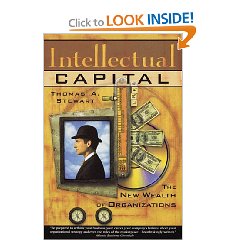
Review: Intellectual Capital–The New Wealth of Organizations (Paperback)

5 Star, Best Practices in Management, Capitalism (Good & Bad), Change & Innovation, Information Society, Intelligence (Commercial)

Amazon Page
Amazon Page

5.0 out of 5 stars Ref A for Buidling Value in the Information Age,

June 25, 2005
Thomas A. Stewart
I read the same author's The Wealth of Knowledge: Intellectual Capital and the Twenty-first Century Organization first, and then went back to get this earlier book (1998), and I actually feel that reading them in that order is better. This book has a lot of detail that is well served by the context that can be found in the later book.

For those who really wish to get a deep look at the future of building value in the age of distribution information in all languages, I recommend that both of Stewart's books be read in conjunction with the following three Nobel-level books: Margaret Wheatley, Leadership and the New Science: Discovering Order in a Chaotic World Robert Buckman, Building a Knowledge-Driven Organization and Christensen & Raynor, The Innovator's Dilemma: The Revolutionary Book that Will Change the Way You Do Business (Collins Business Essentials) My reviews of these books are both evaluative and summative, and could be helpful as short-cut, but they are no substitute for actually buying and reading the books.

The most important point in this book is that the value is no longer found in collecting just in case knowledge, but rather in connecting dots to dots, dots to people, and (the highest value) people to people. It's about connecting, not collecting. Based on this book I drew my own value triangle, VALUE appearing in the middle of the triangle, with Context being the lower left corer, Content being the lower right corner, and CONNECTION being the apex of the triangle–further refined as connecting customers, connecting contributing talents, and connecting sub-contracted sources, softwares, and services. No one is doing this today in the manner that meets the emerging needs of the marketplace.

Most interesting to me is the author's early emphasis on the Chief Financial Officer being the point of sale, not the CEO, the CTO, or the production divisions. Intellectual capital is a value-creation and profit-building exercise, and it needs to be presented as a financial campaign plan, not a technology plan, not a human resources plan, and not a sales and marketing plan.

Although the author focuses on intellectual property, and provides compelling anecdotes and links that suggest that any company in the knowledge business can increase its bottom line earnings by 20-40% if it does a better job of managing its intellectual property, I see two other emerging marketplaces in this book that the author may not have intended but certainly contributes insights to: managing shared access to external sources, to reduce the cost and increase the knowledge that companies can use to increase their competence in a global environment; and managing customer understanding and relationships in the aggregate–it is possible to take cross-selling to new heights if companies in different industries that are not competing with one another, will share customer information in new ways, thus leading to the invention of new3 offerings and new value.

A major point in this book that I believe everyone misses is that the management of intellectual property, or knowledge management, or external open source information acquisition and exploitation, is totally and utterly without value in the absence of a strategy. Collection or connecting is of the greatest value when it is done with strategic purpose, operational efficiency, and tactical effect.

There is a lot more in this book that will impact on my strategic business planning, and that I choose to not summarize here, but will instead end with three points the author makes that I consider to be important:

1) In the information age, only investments in knowledge building are really investments–traditional investments in capital goods are costs, not to be confused with investments intended to generate new value.

2) Knowledge value grows on a logarithmic scale, while goods value grows arithmetically.

3) In today's environment, careers are defined by personal skills and networking, not traditional jobs and corporate positions. The corollary of this is that individuals must self-manage their continuing education and skill acquisition, and any job that fails to provide for continuing upgrading of skills is not worth keeping.

I consider this a seminal reference.

See also, with reviews:
The Fortune at the Bottom of the Pyramid: Eradicating Poverty Through Profits (Wharton School Publishing Paperbacks)
The Wealth of Networks: How Social Production Transforms Markets and Freedom
Revolutionary Wealth: How it will be created and how it will change our lives
The Battle for the Soul of Capitalism: How the Financial System Underminded Social Ideals, Damaged Trust in the Markets, Robbed Investors of Trillions – and What to Do About It
The Politics of Fortune: A New Agenda For Business Leaders

Vote on Review
Vote on Review

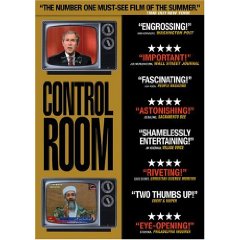
Review DVD: Control Room

5 Star, Information Operations, Media, Misinformation & Propaganda, Reviews (DVD Only)

Amazon Page
Amazon Page

5.0 out of 5 stars Al Jazeera 5, CENTCOM 1, Western Journalists 0,

June 1, 2005
Samir Khader
This is a very worthy and serious documentary. As one who spends a lot of time thinking about “strategic communication” and public diplomacy and public perception, I cannot think of a more important reference point for any US official interested in understanding where we are going wrong in the Arab and Muslim worlds.

Bottom line up front: Al Jazerra gets 5 points from me, in comparison with CENTCOM 1 (for naive earnestness), and Western journalists 0 (just generally stupid).

There are some spectacular flashes of insight in this documentary. My favorite is when one of the Al Jazeera editors says that the US cannot have it both ways–it cannot be the most powerful nation in the world, exercising that power (implicitly, capriciously and dangerously and harmfully) and at the same time expect the world to love it for doing so.

Over-all–and I am perhaps not the norm, having lived overseas most of my life as the son of an oilman, as a Marine Corps infantry officer, and as a clandestine case officer–I have to say that in the real world, Al Jazerra is wiping the deck with our ass. You may not like my opinion, but there are a couple of billion people that probably agree with that opinion, and most of them, right now, are not very respectful of the old USA.

It is not possible to be effective as a strategic communicator, or to practice public diplomacy, without first understanding what your target audience is seeing, hearing, and thinking. This DVD is a superb starting point and I have total respect for what has been presented here.

See also, with reviews:
The Looming Tower: Al Qaeda and the Road to 9/11 (Vintage)
Web of Deceit: The History of Western Complicity in Iraq, from Churchill to Kennedy to George W. Bush
Legacy of Ashes: The History of the CIA
9/11 Synthetic Terror: Made in USA, Fourth Edition
Imperial Hubris: Why the West Is Losing the War on Terror
Vice: Dick Cheney and the Hijacking of the American Presidency

Vote on Review
Vote on Review

Review: Moneyball–The Art of Winning an Unfair Game (Paperback)

5 Star, Culture, Research

Amazon Page
Amazon Page

5.0 out of 5 stars Book Provides an “Aha” Experience,

May 23, 2005
Michael Lewis
I never understood nor really liked baseball. I bought the book mostly to read about the inspired use of statistics, and the creative thinking that went into looking for the real keys to victory. I can safely say that while I may not have fallen in love with baseball, I will never find it boring again. If you have someone you want to turn into a fan, this book a superb gift option. The amount of detail in this book–for example, just the description of the strike zone and what different pitches and batters do to narrow the zone, what can be known about specific individual propensities and vulnerabilities associated with that little box, are truly inspirational.

This is a really excellent book. If we managed the national security budget the way Billy Bean managed the Oakland A's, we'd have faster better cheaper military hardware, and a lot more plowshares. I was also impressed by the way in which Billy Bean built a team, in which players who might not have been individual stars excelled at setting up others in a true team effort where the group as a whole is stronger than the sum of the parts. Others have written better reviews from a baseball fans point of view–as a non-baseball fan, I can attest to this book's being an “aha” experience.

See also:
Watching Baseball Smarter: A Professional Fan's Guide for Beginners, Semi-experts, and Deeply Serious Geeks

Vote on Review
Vote on Review

Review (Guest): The Phenomenon of Man

5 Star, Consciousness & Social IQ, Intelligence (Collective & Quantum), Intelligence (Public), Intelligence (Wealth of Networks), Philosophy, Religion & Politics of Religion, Values, Ethics, Sustainable Evolution, Voices Lost (Indigenous, Gender, Poor, Marginalized)
Amazon Page

Pierre Teilhard de Chardin

5.0 out of 5 stars The Theory of Global Human Consciousness

May 7, 2005

By “Patrick” (Los Angeles, Ca.) – See all my reviews

Pierre Teilhard de Chardin (1881-1945) was a Jesuit Priest, theologian, philosopher, and paleontologist who expanded on the concept of the noosphere originated by the Russian mineralogist and geochemist, Vladimir I. Vernadsky (1863-1945) who also originated the concept of the biosphere- the “life zone” where all biological life exists between the crust of the earth to the lower atmosphere or the “life envelope” surrounding our planet.

The “noosphere” or “thinking layer”, according to Chardin, comes about at that point in time when humans evolve to the realization of a global human consciousness and is totally aware of itself and then headed for the ultimate destination- the “Omega Point” or “Kingdom of God”. At this point, the earth is enveloped by a collective human consciousness.

Chardin uses both science and theology to support this theory and his dissertation on this is fascinating and thought provoking. Unlike most of his religious peers, he was a proponent of directional evolution and that Darwin had hit upon the proof of God's intent, that final destination of the human conscious evolution where the Creator is realized. Darwin, of course, preferred to distance himself from theological assumptions of species evolution, especially so with us humans and his religious wife.

Chardin distinguishes humans from all other life-forms because of our abilities to contemplate our existence, hence, the uniqueness of or the “phenomenon of man”. Hopefully, he concludes, that the human family will evolve to be totally conscience, intelligent and loving, cooperative, and rising far above our current chaotic existence. Amen to that lofty, but desirable goal!

The evolutionary path of the noosphere is laid out in Chardin's earth evolution and stated as: “We have been following the successive stages of the same grand progression from the fluid contours of the early earth. Beneath the pulsations of geo-chemistry, of geo-tectonic and of geo-biology, we have detected one and the same fundamental process, always recognizable-the one which was given material form in the first cells and was continued in the construction of nervous systems. We saw geogenesis promoted to biogenesis, which turned out in the end to be nothing less psychogenesis.” (p 181). And leading therefore, to “noosgenesis” or global consciousness. Finally, and due to the interconnectedness and seemingly intentional direction of life on earth, Chardin gives Earth a soul: Gaia thinking- Earth “intentionally” supports life.

No wonder then that Chardin is referenced and quoted in a mountain of science and religious works. His theories have influenced such great thinkers as: Lewis Thomas (“The Lives of a Cell”), Buckminster Fuller (“The Dymaxion Map”), the Gaia Theory- Earth as a conscious, intentional, self-regulating life-support system and expounded upon by Guy Murchie (“The Seven Mysteries of Life”) and later by James Lovelock (Gaia: The Practical Science of Planetary Medicine”), Thomas Berry (“The Dream of the Earth”) and many, many more.

Chardin traveled the world on his scientific investigations and he was present at the discovery of the Peking Man in China. Some historians have intimated that much of Chardin's travels were at the behest of the Catholic Church for they were not thrilled with his attempts to blend science and religion and the farther away from Rome he was, the better.

The church cautioned him not to publish any of his works and faithful to that edict, he left them to a friend in the U.S. to publish posthumously to avoid further conflict and retaliation from the Church- bad memories of the history of the Catholic Church's terrible treatment of scientist and thinkers whose musings drifted from repressive, suffocating church dogma, i.e., Galileo Galilei, et al.

No matter where one's leanings are on religion or science, this is a potent dissertation on bringing science and religion together for awe and respect of life and eventual peace on Earth through global consciousness.

Vote and/or Comment on Review

Review: God’s Politics–Why the Right Gets It Wrong and the Left Doesn’t Get It (Hardcover)

5 Star, Religion & Politics of Religion

Amazon Page
Amazon Page

5.0 out of 5 stars Jim Wallis for National Chaplain–Extraordinary Book,

May 4, 2005
Jim Wallis
Jim Wallis has my vote to be Chaplain to the Nation. This is an extraordinary book. Indeed, if the President has a Science advisor, I have to ask myself, why doesn't he have a Faith advisor?

I recommend this book be read together with “Faith-Based Diplomacy” by Douiglas Johnson, and “The Soul of Capitalism” by William Greider. This hard-hitting book is full of both common sense and scholarship. Over-all it slams both Right and Left–the Right for claiming that Jesus is pro-war, pro-rich, and a selective moralist; the Left for not embracing faith and God as part of the politics of America.

Early in the book I am immediately won over by the author's preliminary manifesto in his preface: we who have faith are not single-issue voters; we believe that poverty is a religious issue; that caring for God's earth is a religious issue; that war–and making peace–is a religious issue; that truth-telling is a religious issue; that human rights are a religious issue; that our response to terrorism is a religious issue; and finally, that a consistent ethic of human life is a religious issue.

Throughout this book the author returns again and again, to a theme that I am now seeing everywhere: morality matters. The author is superb at relating the power of faith and the morality of religion (not pretentious morality, but practiced morality) to the real world. On pages 105-107, if you are glancing through the book in a bookstore, he repeats key points he made a year after 9-11 on how to defeat terrorism–among his ten points a few simply leap off the page: 4. Let's define terrorism the right way, and allow no double standards. 5. Attack not only the symptoms, but also the root causes of terrorism. 6. The solutions to terrorism are not primarily military. And so on.

Poverty, economic justice, and *moral* capitalism are the underlying challenges that confront the author, and he does a really fine job in this book of showing how America will never be safe if we fail to address global as well as homeland poverty. (In this regard, see my reviews of “Working Poor” by David K. Shipler, and “Nickled and Dimed” by Barbara Ehrenreich.)

The book ends with an extraordinary list of 50 predictions for the future. This list, by itself, is worth the price of the book. #45 is consistent with the eight movements centering around collective intelligence: “All our media will be owned by two or three corporate conglomerates unless and effective movement rises up to stop this trend and restore a genuinely democratic public discourse.” I have the strong feeling that the author's faith is being tested by both the Right and the Left–indeed, in the social and economic policy arena, the author, from a religious point of view, is a perfect counter-part to the Chairman of the Council of Foreign Relations, Peter Petersen, whose book, “Running on Empty: How the Democratic and Republican Parties Are Bankrupting Our Future and What Americans Can Do About It,” is the practical counterpart to “God's Politics.”

This is a world-class, Nobel-level discourse.

See also:
American Fascists: The Christian Right and the War On America
American Theocracy: The Peril and Politics of Radical Religion, Oil, and Borrowed Money in the 21stCentury
The Left Hand of God: Taking Back Our Country from the Religious Right
Tempting Faith: An Inside Story of Political SeductionReligion Gone Bad: The Hidden Dangers of the Christian Right
Piety & Politics: The Right-Wing Assault on Religious Freedom
Dogs of God: Columbus, the Inquisition, and the Defeat of the Moors
Thank God for Evolution!: How the Marriage of Science and Religion Will Transform Your Life and Our World
The Complete Conversations with God (Boxed Set)
Faith-Based Diplomacy: Trumping Realpolitik

Vote on Review
Vote on Review

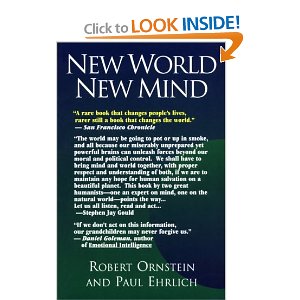
Review: New World New Mind–Moving Toward Conscious Evolution

5 Star, America (Founders, Current Situation), Best Practices in Management, Change & Innovation, Civil Society, Complexity & Resilience, Consciousness & Social IQ, Culture, Research, Democracy, Education (General), Education (Universities), Environment (Solutions), Future, Intelligence (Collective & Quantum), Intelligence (Public), Nature, Diet, Memetics, Design, Philosophy, Priorities, Survival & Sustainment, Technology (Bio-Mimicry, Clean), Truth & Reconciliation, Values, Ethics, Sustainable Evolution, Voices Lost (Indigenous, Gender, Poor, Marginalized), Water, Energy, Oil, Scarcity

5.0 out of 5 stars From 1989, Not Updated, Superb Never-the-Less

April 28, 2005

Robert E. Ornstein, Paul Ehrlich

EDIT 20 Dec 07 to add links.

This superb book was published in 1989 and is being reissued, and I am very glad it has come out again. I bought it because it was recommended by Tom Atlee, seer of the Co-Intelligence Institute, and I found it very worthwhile.

As I reflect on the book, I appreciate two key points from the book:

1) The evolution of our brains and our ability to sense cataclysmic change that takes place over long periods of time is simply not going fast enough–the only thing that can make a difference is accelerated cultural evolution, which I find quite fascinating, because cultural evolution as the authors describe it harkens to noosphere, World Brain, co-intelligence, and what the Swedes are calling M4 IS: multinational, multiagency, multidisciplinary, multidomain information sharing–what I think of as Open Source Intelligence–personal, public, & political.

2) One of the more compelling points the authors make is that not only are politicians being elected and rewarded on the basis of short-term decisions that are by many measures intellectually, morally, and financially corrupt, but the so-called knowledge workers–the scientists, engineers, and others who should be “blowing the whistle,” are so specialized that there is a real lack of integrative knowledge. I realized toward the end of the book, page 248 exactly, that Knowledge Integration & Information Sharing must become the new norm.

This is a tremendous book that is loaded with gems of insight. I have it heavily marked up. Although it integrates and reminds me of ideas ably explored in other books, such as Health of Nations, Cultural Creatives, Clock of the Long Now, ATTENTION, Limits to Growth, and Forbidden Knowledge, these two authors have integrated their “brief” in a very readable way–as one person says on the book jacket, they effectively weave together many strands of knowledge.

The annotated bibliography is quite good, and causes me to be disappointed that the publishers did not provide for the updating of the bibliography–the ideas being blended are timeless and need no update.

Two notes toward the end were quite interesting. They speculate that Japan may be the first modern nation to collapse, if it is subject to disruption of the global trade and transportation system. They also have high praise for Global 2000, an integrative work whose predictions for the 2000 period (written in the 1970's, I believe) are turning out to be quite accurate.

Finally, woven throughout the book, is the simple fact that we are now burning up our savings–consuming the Earth at a much faster rate than it can replenish itself. We are very much out of harmony with our sustaining environment, and at grave risk of self-destruction. Interestingly, they remind of the Durants last word in “The Lessons of History:” that the only revolution, the only sustainable revolution, is that which takes place in the human mind. As these authors would have it, if we do not develop a new collective mind capable of integrating, understanding, and acting sensible, for the long term, on what we can know as a collective mind, then our grandchildren will become prey for the cockroaches of the future.

At a time when the new Director of National Intelligence (DNI), Ambassador Negroponte, is seriously contemplating the establishment of a national Open Source (Information) Agency as recommended by the 9-11 Commission, to get a grip on all the historical and current knowledge, both scientific and social, that we have lost touch with, I can think of just three books I would recommend to the DNI as a foundation for his reflections: this one, Buckman's “Creating a Knowledge Driven Organization,” and Wheatley's “Leadership and the New Science.” I would end his tutorial, or perhaps inspire it, by screening Tom Atlee's video, “From Group Magic to a Wise Democracy.”

Strangely, for I tend to be very gloomy about our prospects these days, I find that this book has cheered me somewhat. I sense the possibility of a break-out through a combination of wise information acquisition and sharing policies, and the application of the new technologies that L-3, CISCO, and IBM, among others, are bringing out, technologies that put intelligence on the edge of the network, and permit the creation of infinitely scalable and shareable synthetic information exactly suited to any need at any level.

There *is* an answer to all that ails us, and these two authors discuss it in a very capable manner.

See also, with reviews:

Integral Consciousness and the Future of Evolution
The Tao of Democracy: Using Co-Intelligence to Create a World That Works for All
The Cultural Creatives: How 50 Million People Are Changing the World
Group Genius: The Creative Power of Collaboration
The Wealth of Networks: How Social Production Transforms Markets and Freedom
Global Brain: The Evolution of Mass Mind from the Big Bang to the 21st Century
World brain
Leadership and the New Science: Discovering Order in a Chaotic World
The World Cafe: Shaping Our Futures Through Conversations That Matter
THE SMART NATION ACT: Public Intelligence in the Public Interest

Vote and/or Comment on Review

Review: Phantom Soldier–The Enemy’s Answer to U.S. Firepower

5 Star, Threats (Emerging & Perennial), War & Face of Battle

Amazon Page
Amazon Page

5.0 out of 5 stars Addictive Common Sense, Trashes High-Tech Blinders,

April 28, 2005
H. John Poole
Edit of 20 Dec 07 to add links.

This author is addictive. I started with Crescent Moon, got Phantom Soldier next, and now am eagerly awaiting the Last 100 Yards. Although I do not expect to see combat in my remaining years, I have three boys that almost certainly will if things keep going as they are, and this book is frightening to any parent or voter.

His bottom line is clear: all of our expensive high-tech equipment is increasing the soldier's load (shades of SLA Marshall) at the same time that it is reducing the soldier's ability to see (one eye covered by a sensor), smell, move, and communicate. We are pursuing a very expensive top down command and control model of confrontational fire-power warfare that is rather easily bogged down by stealth adversaries patient enough to crawl for days and dig underground for months in adavance. I am reminded of the “Tunnels of Ch Chi.” The author is totally tuned in with what I think of as 5th Generation or “bottom up” warfare in which the small units do most of the sensing and thinking, and they are not simply pawns on a giant chessboard.

Much of the book is a highly readable and easily understood account of the common sense and complex thinking that allows Eastern units that are very well-trained to defeat or avoid Western units that are very well-provisioned (I am also reminded of MajGen Bob Scales “Firepower in Limited War,”, but not trained in the infantry skills needed to go man on man in stealth mode.

There is a very great deal to this author's thinking. I do not expect him to have the impact necessary on our new brigade Army or expeditionary Marine Corps, but I hope that by the time my three boys are of draft age, there are generals in power that share this author's wisdom. This is seriously good stuff that every parent and voter should be reading.

I would add, however, that there is another side of grand strategy that we are neglecting. While this author focuses on the tactical excellence that Eastern warriors can achieve, I also worry about American naivete in not understanding that some countries–China and Iran for example–are home to very strategic cultures that know how to “set the stage” with all of the instruments of national power. As I watch China infiltrate Latin America, pushing a wide range of treaties and trade deals, investments in oil and other resources, pipelines to by-pass the Panama Canal and move Venezuelan crude oil to Cartagena, Colombia, and then refined crude to ships on the coast headed for China, I have a very strong sense of foreboding. In 50 years–a fraction of the time the Chinese consider when thinking strategically (not our strong point), we may well have been marginalized. I hope not–but the same traits this author discusses at the small unit level exist in Iran and China at the top leadership level, and I recommend the book for anyone interested in either the top down threat or the bottom up threat.

See also, with reviews:
The Unconquerable World: Power, Nonviolence, and the Will of the People
The Sorrows of Empire: Militarism, Secrecy, and the End of the Republic (The American Empire Project)
Failed States: The Abuse of Power and the Assault on Democracy
Rogue Nation: American Unilateralism and the Failure of Good Intentions
Imperial Hubris: Why the West Is Losing the War on Terror
Dying to Win: The Strategic Logic of Suicide Terrorism

Vote on Review
Vote on Review
noble gold