Review: The Story of Civilization [Volumes 1 to 11] (Hardcover Set 1963-1975)

5 Star, History

History CivilizationBuy This for Later Reading, May 29, 2008

Will and Ariel Durant

I own this set. As I pass through the 55-year old mark, I keep coming back to it and will read it from start to finish one day. The price is a bargain.

If you want just a taste of the rich content, buy The Lessons of History.

Two other major works I recommend are:

The leadership of civilization building: Administrative and civilization theory, symbolic dialogue, and citizen skills for the 21st century
How to Change the World: Social Entrepreneurs and the Power of New Ideas, Updated Edition

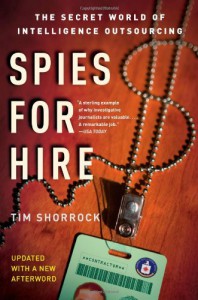
Review: Spies for Hire–The Secret World of Intelligence Outsourcing

4 Star, Intelligence (Government/Secret)

cover spies for hireUseful Contribution, Neglects Outputs & Constituencies, May 28, 2008

Tim Shorrock

Edit of 4 Jun 08 to strongly recommend Retired Reader's review as a companion to my own observations.

I sat down with this book today and found it absorbing. It is perhaps the best overview for anyone of names and numbers associated with the $60 billion (or more, perhaps as much as $75 billion) a year we waste on the 4% we can steal, and next to nothing on Open Source Intelligence (OSINT). The book loses one star for failing to integrate over 300 relevant books (see the annotated bibliographies to my first two books), and for failing to apply any visualization at all. This book is a mass of facts and figures, names and places. With or without visualization, it is a seminal reference point and recommended for all university and public libraries.

The book focuses mostly on technical waste–the inputs–and does not cover outputs nor constituencies. The reality is as General Zinni has put it so well: the IC produces 4% of what is needed, at a cost so horrendously wasteful as to warrant severe outrage among all taxpayers.

Having read the book, I can state that the author's agenda, if he has one, is to expose the risk to our civil liberties of creating a national surveillance state in which the bulk of the expertise is outside the government and subject to corruption and cronyism as well as lack of oversight.

Here are three tid-bits that strongly support the author's general intent, and some links.

1) Secret intelligence scam #1 is that there is no penalty for failure. Lockheed can build a satellite system that does not work (for NASA as well as the secret world–two different failures–or get the metrics wrong so priceless outer space research does not deploy a parachute–}and get another contract. Similarly SAIC with Trailblazer, CACI in Iraq, Blackwater murdering civilians and ramming old men in old cars out of the way, this is all a total disgrace to America.

2) “Butts in seats” means that most of our money goes to US citizens with clearances who know nothing of the real world, *and* the contractor gets 150% of their salary as “overhead.” That is scam #2.

3) Scam #3 is that the so-called policy world, when it exists, does not really care what the secret world has to say, unless it justifies elective wars, secret prisons in the US (Halliburton) and so on. Dick Cheney ended the policy process in this administration. But even without Cheney and his gang of proven liars, the dirty little secret of the secret world is that a) there is no one place where all information comes together to be made sense of; and b) less than 1% of what we collect gets looked at by a human; and c) most of the policy world could care less what Top Secret Codeword information is placed before them–as Colin Powell says so memorably in his autobiography, he preferred the Early Bird compilation of news clippings.

I have been saying since 1988 that the secret emperor is not just naked, but institutionalized lunacy. Books like this are helpful, eventually the public will hear our voice.

Here are specific tid-bits that caught my attention as I went through the book.

+ Two errors in reference to me: I was neither a committee chair nor a program director. The author does quote me accurately.

+ Early on I am impressed to note documented facts:

– 50% of the clandestine case officers at CIA are contractors

– 35% of the Defense Intelligence Agency workforce is contracted

– Virtually 100% of the National Reconnaissance Office (NRO) is contracted

– 70% of all US Intelligence Community funds are spent on external contracts rather than internal capabilities.

– Booz Allen Hamilton has 10,000 employees with Top Secret Codeword clearances

– Revolving door is gutting the agencies (and most retirements will take place between 2007 to 2012–we have no middle management, no bench).

– Total Information Awareness (TIA) program never died, it went underground

– Pentagon under Cheney, then Cheney-Rumsfeld, now Cheney-Gates appears committed to outsourcing everything except the shooting–this is very very bad for all of us

– SIGINT data stream is wagging the dog–three V's of unstructured data are volume, velocity, and variety (183 languages we don't speak) but the author cited General Tony Zinni, USMC (Ret) telling a conference that all the high-tech in the world cannot give him plans and intentions on the battlefield.

– History of outsourcing goes back to the Odeen (CEO BDM) report sponsored by the Defense Science Board, this was the beginning of trying to privatize everything possible. Combined with the Pentagon's inherent disrespect for the CIA, it made privatizing intelligence even more attractive.

– McConnell comes out of this book looking respectable, Woolsey and Tenet less so. Dempsey was not a Navy officer by career–they sent her to knife and fork school when she managed the Navy intelligence budget within GDIP, much as the USMC took care of Arnold Punaro who ultimately made one-star while being Staff Director of the SASC. Although the author excels at naming names, and he discusses failures where they are known, there is very little substantive understanding of how the US IC has collapsed on all fronts–personnel, budget, finance, facilities, global presence, global coverage, relevance to the customer, etcetera.

– CACI and SAIC come out of this book looking truly terrible, while ManTech and Booz Allen Hamilton come out as moderately competent. I have to remind myself that contractors are not evil–they do what we incentivize them to do, and right now it is OUT OF CONTROL.

– He names LtGen Ken Minihan, USAF, as the de facto ideologist for the intelligence-industrial complex, and provides a good review of how venture capital funds were created to focus specifically on secret contracts.

– John Brennan emerges from this book as the man behind the curtain, levering the International and National Security Alliance (INSA) to further the complex. I disagree with the author's characterization of the DNI and INSA alliance as unethical. I do however agree that it is unprofessional in that INSA is executing myopic orders and not contributing at all to the needed cross-fertilization and understanding of where the real innovation is happening, in Collective, Peace, and Commercial Intelligence (the latter the complete opposite of Contractor Intelligence, or butts in seats).

See also:
Legacy of Ashes: The History of the CIA
Blond Ghost
The Very Best Men Four Who Dared:The Early Years of the CIA
Blank Check: The Pentagon's Black Budget
Body of Secrets: Anatomy of the Ultra-Secret National Security Agency
None So Blind: A Personal Account of the Intelligence Failure in Vietnam

There are success stories. Here are two books on one such case, where the White House and the Pentagon chose not to act over four days:
First In: An Insider's Account of How the CIA Spearheaded the War on Terror in Afghanistan
Jawbreaker: The Attack on bin Laden and al-Qaeda: A Personal Account by the CIA's Key Field Commander

Bottom line books:
On Intelligence: Spies and Secrecy in an Open World
Collective Intelligence: Creating a Prosperous World at Peace

I put this book down wishing that the field of cognitive science would evolve more quickly. Our profession is in disarray, in confusion, seeking to substitute butts in seats and dollars for cultural, linguistic, historical, and other forms of context. We need several multinational life boats of change catalysts–such as a Multinational Decision Support Center in Tampa, taking over the rapidly vacating Coalition Coordinating Center, in order to create the world's first unclassified intelligence center dedicated to providing open decision support to all parties active in stabilization & reconstruction, humanitarian assistance, and disaster relief (both at home and abroad). The IC is, as I said in Forbes ASAP, Inside Out and Upside Down. This is not the contractor's fault. It is our fault. We are a Dumb Nation instead of a Smart Nation. Bad. Very bad.

Review: Digital Natives & Digital Immigrants

5 Star, Information Society

Digital NativesEarly Insights into the Future, May 24, 2008

Johann Günther

It's a pity this work is not more readily available. The best work right now that is available is Marc Pensky's Don't Bother Me Mom–I'm Learning!, whose 2005 article in Educational Review (December 2005/January 2006) on “Listening to the Natives,” first illuminated this huge distinction. As Pensky says, children today are no longer “little versions of us.”

Forthcoming in August 2008 is Born Digital: Understanding the First Generation of Digital Natives. The key point that I have seen in my broad reading is that the future is not here now–it will be here when the digital natives are digital adults, and overthrow the “command and control” (“do it because I say so”) regimes that are all too prone to corruption and misdirection behind closed doors.

See also:
Groundswell: Winning in a World Transformed by Social Technologies
Mobilizing Generation 2.0: A Practical Guide to Using Web2.0 Technologies to Recruit, Organize and Engage Youth
Here Comes Everybody: The Power of Organizing Without Organizations
Smart Mobs: The Next Social Revolution
Wikinomics: How Mass Collaboration Changes Everything
An Army of Davids: How Markets and Technology Empower Ordinary People to Beat Big Media, Big Government, and Other Goliaths
The Tao of Democracy: Using Co-Intelligence to Create a World That Works for All
Collective Intelligence: Creating a Prosperous World at Peace

Review: Against the Grain–Christianity and Democracy, War and Peace

5 Star, Philosophy, Religion & Politics of Religion, Values, Ethics, Sustainable Evolution
Against the Grain
Amazon Page

5 for Christian wisdom, Chapters on Iraq Questionable, May 18, 2008

George Weigel

This was my first exposure to this author, who has 14 other books to his credit and was for seven years president of the ethics and public policy center. The essays that comprise the book were written over the course of 15 years, generally as lectures at Catholic centers of learning excellence. Each has a current introduction and explanation of provenance.

Highlights of this extraordinary work:

Six big ideas:
01 Religion and its moral views are a huge part of the public dialog
02 Abortion, euthanasia, and stem-cell research destructive of embryos violate first principles.
03 Free economy empowers the poor
04 Just war tradition balances freedom, justice, & security
05 John Paul II/Second Vatican was about challenging modernity to rediscover the value of truth and love
06 Catholic Church has a “form” from Christ

The author calls on reviewers to pay attention to his introduction to the book, which is indeed a very fine summary (but no substitute for a full reading). He outlines why he titled the book “Against the Grain:”
01 Political science is not just about statistics
02 Democracy is not just procedural
03 Challenges functional pacifism
04 Challenges the amorality of RealPolitic (AMEN!)
05 Asserts the inherent Christianity of America and the constant propositions (see The Thirteen American Arguments: Enduring Debates That Define and Inspire Our Country and also The Faiths of the Founding Fathers
06 Disintegration of mainline Protestantism *combined with* the abdication of universities from teaching values opened door for Catholic reflection but the door was slammed shut by the 1960's

I have a note at this point that the book is an inspiring example of political theology, and am surprised at its stark conservatism.

The author develops a theme throughout the book, to wit that there are three major spheres: the political, the economic, and the cultural, and that it is the Church–the Catholic Church alone among all religions in having diplomatic representation across 172 nations, that is a major player in the cultural arena while having a helpful influence on the other two spheres.

At this point I am furious to discover a really crummy index, mostly names. This work is too important to allow a lazy publisher to dismiss a proper indexing job, and I recommend the author demand a proper index for the paperback edition.

Unlike A Civilization of Love: What Every Catholic Can Do to Transform the World this book is “not for Catholics only,” and I also find it a great deal more challenging, more substantive, more reflective.

The principles of Catholic social doctrine (the author steadfastly refuses to acknowledge “liberation theology” as having standing:
01 Personalism (human rights)
02 Common good (communitarianism)
03 Subsidiarity (civil society as milieu)
04 Solidarity (civic friendship–relationships–added by John Paul II. See also Groundswell: Winning in a World Transformed by Social Technologies and Collective Intelligence: Creating a Prosperous World at Peace

He cites John Paul II as saying that work is “becoming” not drudgery, and those who revere Peter Drucker will remember that he said precisely the same thing.

The author discusses how the Church “proposes”
01 Free *and* virtuous society (see my review of Forbidden Knowledge: From Prometheus to Pornography
02 Combination of democratic political community, free economy, *and* public moral culture
03 Democracy and economy are not machines that can run on their own. See the many books I have reviewed on the complete break-down of the government, predatory capitalism, and the mass media that has betrayed the public trust.
04 Freedom must be tethered to moral truths
05 Voluntary associations are vital (and citing others, freedom must characterize both a choice of faith and a choice of society)
06 Wealth is ideas, not just resources. See The Wealth of Networks: How Social Production Transforms Markets and Freedom and The Fortune at the Bottom of the Pyramid: Eradicating Poverty Through Profits (Wharton School Publishing Paperbacks).
07 Poverty in the 21st Century is about being excluded from the network that can create infinite wealth in every clime and place. AMEN!

I have another six pages of notes but am certain to run into the 100 word limit. A tiny taste of what else this author offers all of us:

Three competing political theologies today: Pragmatic Utilitarianism (Europe), Political Islamism (Caliphate), and Catholic Social Doctrine. Not sure where that leaves those discussed in American Fascists: The Christian Right and the War On America).

Quote: “The social doctrine of the Church is rarely preached and poorly catechized.” Quoting John Paul II, “Bishops don't know the social doctrine of the Church.” (pages 23 and 24).

Five specific issues
01 Need to appreciate Catholic international relations concepts and doctrine
02 Inter-religious dialog and global “social question” must be addressed
03 Emerging global economy & the environment must be addressed
04 Life issues *are* social doctrine
05 Priority of culture and deepening of civil society matters

There is a strong section, without too many damning details, about how the Church has erred in the past and today in forming inappropriate alliances with secular authorities (so has the US Government, see Breaking the Real Axis of Evil: How to Oust the World's Last Dictators by 2025)

Church's first task is to *be* the Church, not be too accommodating of political and economic norms de jure, and fully represent the Catholic Church in the ideal. This book is a superb manifestation of that ideal.

The author suggests that the Church makes three contributions in support of democracy, its natural ally:
01 Makes room for democracy by rendering unto Caesar
02 Makes democrats (citizens)
03 Enables “giving an account”

The author articulates strong feelings of betrayal in how three Supreme Court Justices in particular have sought to elevate the individual's self-determination above communal moral precepts, and he is especially damning of the Clinton Administration for seeking to make abortion-on-demand a human right worldwide.

I must close without listing the elements of the Catholic theory of international relations, or the five realities facing the Church. Buy the book (or some other reviewer, take those two chapters).

On Iraq, he is way out of his league on intelligence and policy matters. I did not allow that to detract from my appreciation of the book over-all, for his is a great mind, broadly read, and most challenging.

Vote on Review

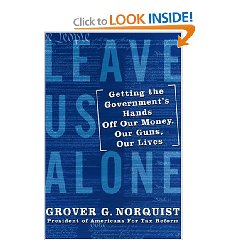
Review: Leave Us Alone–Getting the Government’s Hands Off Our Money, Our Guns, Our Lives

5 Star, Banks, Fed, Money, & Concentrated Wealth, Complexity & Catastrophe, Congress (Failure, Reform), Crime (Government), Culture, Research, Economics, Impeachment & Treason, Insurgency & Revolution, Justice (Failure, Reform), Politics, Power (Pathologies & Utilization), True Cost & Toxicity, Voices Lost (Indigenous, Gender, Poor, Marginalized)
Amazon Page

5.0 out of 5 stars Can Cause Discomfort, But This Book MATTERS

May 17, 2008

Grover Norquist

I was given this book as a gift, along with Groundswell: Winning in a World Transformed by Social Technologies and to my great surprise, being an estranged moderate Reagan Republican, I found that I am much more of a Libertarian than I realized, and this author, although he causes me great discomfort in some areas (such as privatizing Social Security), he makes complete sense. I learn he has been voted one of the 50 most powerful people in DC by GQ (2007) and I believe it. Senator McCain has better listen this time around. I urge all who are enthused with Senator Obama to read Obama – The Postmodern Coup: Making of a Manchurian Candidate. Senator Obama is NOT transparent and I consider his top foreign policy advisors to be dangerous–Dr. Strangelove (Brzezinski) has one last war with Russia left in him, and seriiousl believes he can confront the Chinese in Africa–this is lunacy (search for my Memorandum online <Chinese Irregular Warfare oss.net>.

The book lacks an index. This is a HUGE MISTAKE on the part of the publisher because there are too many important ideas in this book. The publisher should create and post online an index to this book. The publisher can also be criticized for failing to provide Library of Congress cataloguing information. This is a REFERENCE work. The author should consider holding the publisher accountable for such fundamental incompetencies that detract from the book's lasting value.

The five core reforms that he builds up to are:

1) Portable pensions

2) Competitive health care

3) Educational choice including home schooling

4) Outsourcing of all government functions possible

5) Transparency (see not only Groundswell, but also Here Comes Everybody: The Power of Organizing Without Organizations)

The author posits a stark choice between the Leave Us Alone movement, that appears to be growing daily (and included 27 secessionist movements that meet annually at a conference organized by Kirkpatrick Sale, author of Human Scale, and what he calls the Takings Group, the tax and spend elected officials both Republican and Democratic.

This is a serious reference work with an even mix of books, articles, and online citations.

There are some areas where the author could benefit from knowledge that is not yet mainstream–for example, we can blow away the Medicare unfunded obligations by negotiating prices that are 1% (ONE percent) of what we foolishly pay now, and as a recent PriceWaterHouseCooopers study documented so well, also eliminating the 50% of the medical professional that is waste, including (the author does address this–the tort lawyers like Senator John Edwards who make millions putting good doctors out of business so bad doctors can do more elective operations).

On balance–and this was my first exposure to this individual–I put the book down thinking to myself that this author deserves his reputation, and that he combines a very powerful intellect with an equally powerful moral force.

Other books I recommend:
The Thirteen American Arguments: Enduring Debates That Inspire and Define Our Nation
The Revolution: A Manifesto
Don't Start the Revolution Without Me!
Crashing the Party: Taking on the Corporate Government in an Age of Surrender
Spoiling for a Fight: Third-Party Politics in America
The Vermont Manifesto

Vote on Review

Review: Leave Us Alone–Getting the Government’s Hands Off Our Money, Our Guns, Our Lives

5 Star, Congress (Failure, Reform), Democracy, Executive (Partisan Failure, Reform)
Leave Us Alone
Amazon Page

Can Cause Discomfort, But This Book MATTERS, May 17, 2008

Grover Norquist

I was given this book as a gift, along with Groundswell: Winning in a World Transformed by Social Technologies and to my great surprise, being an estranged moderate Reagan Republican, I found that I am much more of a Libertarian than I realized, and this author, although he causes me great discomfort in some areas (such as privatizing Social Security), he makes complete sense. I learn he has been voted one of the 50 most powerful people in DC by GQ (2007) and I believe it. Senator McCain has better listen this time around. I urge all who are enthused with Senator Obama to read Obama – The Postmodern Coup: Making of a Manchurian Candidate. Senator Obama is NOT transparent and I consider his top foreign policy advisors to be dangerous–Dr. Strangelove (Brzezinski) has one last war with Russia left in him, and seriiousl believes he can confront the Chinese in Africa–this is lunacy (search for my Memorandum online <Chinese Irregular Warfare oss.net>.

The book lacks an index. This is a HUGE MISTAKE on the part of the publisher because there are too many important ideas in this book. The publisher should create and post online an index to this book. The publisher can also be criticized for failing to provide Library of Congress cataloguing information. This is a REFERENCE work. The author should consider holding the publisher accountable for such fundamental incompetencies that detract from the book's lasting value.

The five core reforms that he builds up to are:

1) Portable pensions

2) Competitive health care

3) Educational choice including home schooling

4) Outsourcing of all government functions possible

5) Transparency (see not only Groundswell, but also Here Comes Everybody: The Power of Organizing Without Organizations)

The author posits a stark choice between the Leave Us Alone movement, that appears to be growing daily (and included 27 secessionist movements that meet annually at a conference organized by Kirkpatrick Sale, author of Human Scale, and what he calls the Takings Group, the tax and spend elected officials both Republican and Democratic.

This is a serious reference work with an even mix of books, articles, and online citations.

There are some areas where the author could benefit from knowledge that is not yet mainstream–for example, we can blow away the Medicare unfunded obligations by negotiating prices that are 1% (ONE percent) of what we foolishly pay now, and as a recent PriceWaterHouseCooopers study documented so well, also eliminating the 50% of the medical professional that is waste, including (the author does address this–the tort lawyers like Senator John Edwards who make millions putting good doctors out of business so bad doctors can do more elective operations).

On balance–and this was my first exposure to this individual–I put the book down thinking to myself that this author deserves his reputation, and that he combines a very powerful intellect with an equally powerful moral force.

Other books I recommend:
The Thirteen American Arguments: Enduring Debates That Inspire and Define Our Nation
The Revolution: A Manifesto
Don't Start the Revolution Without Me!
Crashing the Party: Taking on the Corporate Government in an Age of Surrender
Spoiling for a Fight: Third-Party Politics in America
The Vermont Manifesto

Vote on Review
noble gold