Review: Bloomberg by Bloomberg

5 Star, Biography & Memoirs, Capitalism (Good & Bad)

BloombergSuperb, self-effacing, common sense, deeper insights into the company, January 11, 2008

Michael Bloomberg

I bought this book on 1 January when news first came out of the University of Oklahoma “bipartisan” gathering, but I did not have a chance to read it until this week. I went to Oklahoma, only to see this good man embarrassed by a truly rotten press conference that invited mockery. My three page trip report is at Earth Intelligence Network.

I'm going to summarize what I learned from this book,and then conclude with an observation on how Bloomberg could go to the next level while simultaneously cleaning up our government and educating the 5 billion poor free, one cell call at a time.

There is absolutely nothing in this book that is conceited or self-serving. This is straight talk from a hard worker, an Eagle Scout at a very young age, an ethical businessman, an inspired information entrepreneur. This is an honest worthy book I wish I had noticed sooner.

The author lived in a one-room studio apartment for his first 10 years, working 12 hours a day as a matter of routine, not counting his early morning jogging, where he says he gets his most creative thoughts.

It certainly helped that he had a $10M termination payment from his first job, but this book positively lights up around the combination of open workspace, open mind, how to create a company on the fly, fully integrating customer views, ignorning banks and other pyramidal consultants. The author discovered the “power of us” a quarter century before Business Week did its cover story on this topuc, 21 June 2005.

What I was not expecting, and what made the book riveting for me, is the complete well-paced coverage of how the author realized he could monetize financial data, then information about the people behind the data, and then information on the politics behind the people.

A few of my fly-leaf notes:

+ Build from scratch, don't buy over-priced companies or capabilities.

+ Trust me, or go out the door.

+ Do'ers with fires in their belly make for a great team

+ Pioneered compact low-cost workstations with English buttons

+ Excelled at rapid prototyping where good intention was better than any business plan

+ Really superb overview of how numbers can lie, how dangerous an automated numbers game can become

+ Outsiders do what's asked; insiders do what's needed.

+ Superb vision for the future of the hand-held cell phone as the single device, he knew this long before Eric Schmidt came along to help Google.

+ Corrects my long-standing mis=hearing of Marhsall McCluhan's book title, The Medium is the Massage (not Message, that was a separate quote)

+ Really excellent stories aabout how hard Bloomberg had to fight to be accredited both in Washington DC and in Tokyo as a legitimate news organization

+ “Ignorance and arrogance are a deadly combination.” I wish he had realized Oklahoma would be a dead end–bi-partisan is code for keeping the two-party spoils system. Transpartisan is where its at, visit Reuniting America, 110 million strong and growing. See the definitive book on the death of the two parties, Running On Empty: How The Democratic and Republican Parties Are Bankrupting Our Future and What Americans Can Do About It.

+ I agree with his view that computers should not be allowed in the classroom throughout elementary school.

+ Throughout the book, it is clear the author knows what I learned from Senator Daniel Patrick Moynihan, both personally and through his book, Miles to Go: A Personal History of Social Policy, Change is Hard. Specificially, big change takes 25 years (I am in year 18 of reforming secret intelligence and creating public intelligence, he is now in year 1 of reforming democracy and saving the Republic as well as moral capitalism).

+ The chapter on Management 101 is decent, sensible, and worthy of study.

+ I've spent hard time trying to do digital innovation, and the details in this book just blew me away as I followed the innovations the author led back in the 1980's when CIA tasked me with creating a “smart desktop” for clandestine operations. Had I known then about this man, I would have gone to his doorv and offered to help him put CIA out of business. There is still time.

I put the book down with both a feeling of pain–the Oklahoma debaacle should never have happened–and hope. This author embodies three big ideas: moral informed capitalism, honest informed self-governance, and educational reform.

I have three ideas I offer to anyone who can reach the author, I do not believe the book I created for him (Democracy 2008, see it at Earth Intelligence Network) was delivered to him by his staff, one reason he got humiliated in Oklahoma.

Idea #1: Fund a global “True Cost” project within the Natural Capital Institute's rapidly growing World Index of Social and Environmental Responsibility (WISER). Get Paul Hawkins in to energize everyone, and become the Moody's for true cost information (e.g. designer T-shirts with 4000 gallons of water, water bottles whose plastic required more water to make than is contained in the bottle, etc). This will change markets within 2-3 years, especially since ScanBack would allow Bloomberg to deliver this information to end-users via their cell phone at the point of sale.

Idea #2: Forget about running for President. It's a lousy job. BE the virtual president, forming a Transpartisan Sunshine Cabinet (Senators Nunn and Graham should be respectively Defense and Intelligence), and leveraging True Majority and Reuniting America to lead a national conversation firmly grounded in a balanced budget, on how to orchestrate $1 trillion a year in planning giving to eradicate the ten high level threats by harmonizing the twelve policies, while also creating the EarthGame to help the eight demographic challengers avoid our mistakes.

Idea #3: Examine Telelanguage.com and figure out how to register and put online 100 million volunteers who can use Skype, Telelanaguage, and their Internet connection to teach the 5 billion poor in any one of 183 languages, one cell phone call at a time.

The above will sound self-promoting, it is not. I have labored with 23 other co-founders to do Mike Bloomberg's staff work for the next decade, and if someone can get him to carefully consider these ideas, I give them to him freely. I don't need a job, but I do need a planet my three boys can grow up in, and I believe that if Mike Bloomberg stops trying to leverage political has-beens (with a few exceptions), and instead creates an architecture that can deliver public intelligence in the public interest, he will achieve his grand vision, faster, better, cheaper.

Thank you, those whom Dick Cheney has inspired into reading my non-fiction reviews. I never, ever, expected to be of service to the Nation in quite this way. If my reviews help us restore the Republic, of, by, and for the people, working with moral capitalists and leaders like this author and John Bogle (The Battle for the Soul of Capitalism then the author's unbridaled optemism could be warranted.

See also:
The Tao of Democracy: Using Co-Intelligence to Create a World That Works for All
Society's Breakthrough!: Releasing Essential Wisdom and Virtue in All the People
A Power Governments Cannot Suppress
All Rise: Somebodies, Nobodies, and the Politics of Dignity (BK Currents)
One from Many: VISA and the Rise of Chaordic Organization
THE SMART NATION ACT: Public Intelligence in the Public Interest
Review: Plan B 3.0–Mobilizing to Save Civilization, Third Edition

5 Star, Complexity & Catastrophe, Complexity & Resilience, Environment (Problems), Environment (Solutions), Future, Intelligence (Public), Nature, Diet, Memetics, Design, Peace, Poverty, & Middle Class, Priorities, Security (Including Immigration), Stabilization & Reconstruction, Survival & Sustainment, Values, Ethics, Sustainable Evolution

Plan 3.0The Best and Most Essential Guide, Not the Whole Picture, January 11, 2008

Lester R. Brown

I have followed Lester Brown's dedication to evaluating the state of our planet for over a decade, and wrote to the Nobel Committee urging them to recognize him, Herman Daly, and Paul Kawkins and the two Lovins instead of Al Gore. They have all done a great deal more of the heavy lifting.

I decided to purchase this book when Medard Gabel, creator of the analog World Game with Buchminster Fuller, gave me a budget for saving the planet that totals no more than $230 billion a year (at a time when we spend $1.3 trillion waging war).

I've gone through the book and consider it to be a best in class effort, a seminal work no one else on the planet could have produced. In the author's chosen area of focus, there is no other book like this one. However, some other books are easier to read and understand, such as High Noon 20 Global Problems, 20 Years to Solve Them, and others do a better job of addressing all ten high-level threats to Humanity and Earth, such as A More Secure World: Our Shared Responsibility–Report of the Secretary-General's High-level Panel on Threats, Challenges and Change.

Here are a few highlights:

+ Book is offered free online (but the hard copy is much better deal, easier to work with, mark up and return to as a reference….use the online version to search for specifics.

+ The Introduction is clear and inspiring. This book is loaded with carefully collected facts ably presented.

+ $12 per gallon of fuel in “true costs” externalized and not billed

+ One 25 gallon ethanol tank takes enough grain to feed a person for a year. This means that those in hunger going to double from 600 million to 1.2 billion, as cars compete for grain (which is nuts).

+ Food-oil axis is developing into a triple crisis: oil, food, water. As 50% live in cities, the fuel intensity of food in the face of Peak Oil is becoming a major issue.

+ Stopping the ethanol program dead in its tracks is the single best thing US Government could do, followed my more wind farms and an end to coal plants.

+ Amazon reaching a tipping point, mega-fires are foreseen (as with New York City if its 1920's water system fails and a firestorm emerges)

+ Western model will not work for China or India (or Brazil, Indonesia, Iran, Russia, Venezuela, and other Wild Cards)

+ Ice cap is melting fast, gfalciers are melting fast and causing small earthquakes.

+ 600 million refugees expected if sea level rises ten meters (33 feet)

+ Mortality has been reduced, but fertility has not, leaving persistent population issues.

+ 15 of 24 primary ecosystems degraded or pushed beyond their limits.

+ Climate has become more destructive, with 55 weather events costing $1.5 billion or more each since the 1980's.

+ Great discussion of the ecology of cities, Bioneers would resonate with all the author recommends.

+ Scarcity crossing national boundaries.

+ Excellent notes, heavy reliance on UN and other primary sources.

+ He proposes a budget of $190 billion a year to achieve our social goals and restore the Earth.

+ The only thing missing from this book are some of the positives, for example bacteria as an energy source, healing bacteria, eletrified water as a cleanser needed no other ingredients, the recovery of the Dead Sea with furrows that retain every drop of water.

I am so surprised to find only one review that I wanted to quickly add my praise for this author, while also pointing out three things that a handful of wealthy philanthropists could do tomorrow to execute this vision.

#1 We should all support the World Index of Social and Environmental Responsibility (WISER) as created by the Natural Capital Institute, and encourage colleges and universities around the world to begin loading the “true cost” information for all products and services (e.g. 4000 gallons of water in a designer T-shirt). Delivered to end-users via cell phone query at the point sale, this will dramatically affect markets.

#2 We should ask the 90 major foundations in the USA to host a summit to which all governments, non-governmental organizations, prominent wealthy individuals, and the United Nations are invited. The objective should be to create an online “Range of Gifts” Table that identifies specific contributions that can be made at every cost level, to eradicate the ten high level threats within fifteen years, by harmonizing the twelve policies such that ALL organizations and ALL individuals can opt in on a master budget that is strategically sound, operationally executable, and tactically open to all.

#3 We must absorb the wisdom of C. K. Prahalad, Alvin and Heidi Toffler, and others listed below, and recognize that the only enduring sustainable solutioin lies in educating the five billion poor, who do not have the time or the money to sit in a classroom for 18-22 years. We can create today, using Telelanguage.com, an immediate registry of 100 million volunteers with Internet access, speaking 183 languages among them, who can educate the poor–who are not stupid, just illiterate–one cell call at a time.

I believe that Reuniting America, True Majority, and WISER are reaching critical mass. All we lack now is one well endowed champion who sees that it is our collective intelligence that will solve the world's problems, and there is no need to run for President. Here are the handful of books I would recommend to Michael Bloomberg if he were to ask me today how to fulfil his vision of political, educational, and philanthropic reform.

Visit Earth Intelligence Network for free public intelligence on the ten threats, twelve policies, and eight challengers. The weekly report “GLOBAL CHALLENGES: The Week in Review,” will appeal to anyone interested in this book and its topic.

The Wealth of Networks: How Social Production Transforms Markets and Freedom
The Fortune at the Bottom of the Pyramid: Eradicating Poverty Through Profits (Wharton School Publishing Paperbacks)
Revolutionary Wealth: How it will be created and how it will change our lives
Infinite Wealth: A New World of Collaboration and Abundance in the Knowledge Era
THE SMART NATION ACT: Public Intelligence in the Public Interest
The Future of Life

Review: Day of Empire–How Hyperpowers Rise to Global Dominance–and Why They Fall

4 Star, Country/Regional, Empire, Sorrows, Hubris, Blowback

Day of EmpireDisappointing, Oversold, Original as far as it goes, January 11, 2008

Amy Chua

I like the author and gave her first book, World on Fire high marks. I found her treatment of the Chinese diaspora in that book to be quite valuable.

This book is disappointing for a number of reasons, not least of which is the treatment of “America” as a monolyth, a generic “hyperpower,” never mind any of the following:

Vice: Dick Cheney and the Hijacking of the American Presidency
Running On Empty: How The Democratic and Republican Parties Are Bankrupting Our Future and What Americans Can Do About It
The Battle for the Soul of Capitalism
The Cheating Culture: Why More Americans Are Doing Wrong to Get Ahead

I happen to be familiar with China's new strategy, a one-page memorandum can be found by looking for <steele chinese irregular warfare.> The Chinese have neutralized US weapons and mobility systems, and are waging peace on a global scale.

What troubled me about this book was the combination of glorious generalizations with a lack of specifics, for example, China right now has a potentially catastrophic combination of water and energy outages with continuing potential for a pandemic.

The eight challengers the Earth Intelligence Network has identified are Brazil, China, India, Indonesia, Iran, Russia, Venezuela, and Wild Cards like the Congo.

America is on the ropes because we are coming off a quarter century of a two party spoils system that knew all about Peak Oil in 1974, and decided to betray the public trust and ignore the problem. Similarly are water and food security, our public health, all are abyssmal because of a series of venal leaders among whom Dick Cheney stands out for evil, and young Bush for stupid.

I am also troubled because the author, while serving up an interesting overview, does not trouble to review the lessons of history from others, for example, Will and Ariel Durant or John Lewis Gaddis. Morality is a strategic asset of incalculable value. Time is the one asset that cannot be bought nor replaced. Our ignorance of history makes the past a “denied area” of little use to using the present to plan for the future.

On balance this book comes across as a one page outline fleshed out. The Technical Preface by Robert Garigue, RIP, to Information Operations: All Information, All Languages, All the Time is still the best statement published: it's about long-term education of mind of man, with morality, legitimacy, and dignity. Get that right and everything else takes care of itself. Visit Earth Intelligence Network to learn more.

I was also hoping to see more about emerging solutions and the wealth of networks. If we have one thing going for us in America, it is that 66 languages are spoken in Queens, NY, 183 languages across the Nation, and we could, if we wanted to, rapdily recruit 100 million volunteers able to educate the 5 billion poor one cell call at a time, in their own language.

I do not regret buying this book, but in my view, it delivered no more than 50% of its potential while being way too indiscriminate about the details. There is too much missing from this book. See my lists.

See also
The Search for Security: A U.S. Grand Strategy for the Twenty-First Century
High Noon 20 Global Problems, 20 Years to Solve Them
The Wealth of Networks: How Social Production Transforms Markets and Freedom
The Fortune at the Bottom of the Pyramid: Eradicating Poverty Through Profits (Wharton School Publishing Paperbacks)

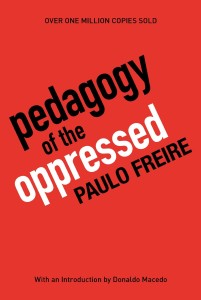
Review: Pedagogy of the Oppressed

6 Star Top 10%, Education (General), Peace, Poverty, & Middle Class
Amazon Page
Amazon Page

Critical Solutions for Five Billion Poor Including US Poor

January 7, 2008

Paulo Freire

Over a year ago 24 of us decided to co-found the Earth Intelligence Network and begin producing public intelligence in the public interest. We quickly expanded the vision to include a Transpartisan Policy Institute and a Public Budget Office. Today, for free, any citizen can get a weekly report on “GLOBAL CHALLENGES: The Week in Review.” Our free report is superior in multiple ways to the President's Daily Brief, which costs the taxpayer $1.2 billion per WEEK ($60 billion for secret intelligence, pro rated over 52 weeks).

Early on we realized that educating the five billion poor was both a non-negotiable first step, and “mission impossible” if we accepted the standard educational system that is part prison, part child care and part didactic dildo display (my lesson outline is bigger than yours).

Before I read this book, we had conceptualized a concept for educating the five billion poor “one cell call at a time,” leveraging free cell phones and 100 million volunteers covering 183 languages, each using Telelanguage and Skype to be available on demand.

Now, with this book, and also Pedagogy of Freedom: Ethics, Democracy, and Civic Courage (Critical Perspectives Series), I feel we have struck the mother lode.

A few notes and then some other links.

+ Stark critique of the “banking” system of education that deposits knowledge without teaching critical thinking or how to create new knowledge.

+ Relevant to US, not just Third World.

+ It's about class, not race. Concentration of wealth above, poverty below.

+ The author illuminates for all of us “the humanizing voaction of the individual” and the “power of thought to negate accepted limits.”

+ Modern education instills a culture of silence and lethargy. Friere's work instead inspires liberation, dignity, and the ability to change.

+ Illiterates are not stupid, they just cannot read. They *can* be empowered, taught, and energized orally.

+ Education is NOT neutral–it is either teaching for the benefit of the oppressors (producing docile factory workers) or for the benefit of the opprssed (liberating, empowering with individual volition).

+ Dehumanization is a historical reality.

+ False charity perpetuates dependenct.

+ Recognition of reality liberates BOTH the oppressed and the oppressor.

+ Oppressed must break free from “having is being” and learn that “being is enough.”

+ The oppressed cannot be “granted” freedom, it must result from an interactive dialog that liberates both sides

+ Liberation and revolution or transformation for the good of all are essentially pedagogical missions with very high ethical content.

+ Humanizing pedagogy is the anti-thesis of propaganda, manipulation, and deceit.

+ “Co-intentional” education

+ Authentic thinking can only be realized in communication with another

+ Pyramical (one-way) education enslaves, circular (multi-way)education liberates

+ Any educational system that does not respect nor elicit the student's own worldview is culturally invasive

+ Education of the five billion poor must begin by LISTENING to them.

+ “Libertarian education” STARTS with the needs and views of those to be educated.

+ Communion and communication leads to cooperation and cultural synthesis.

A few links:
The Fortune at the Bottom of the Pyramid: Eradicating Poverty Through Profits (Wharton School Publishing Paperbacks)
The Wealth of Networks: How Social Production Transforms Markets and Freedom
The Tao of Democracy: Using Co-Intelligence to Create a World That Works for All
A Power Governments Cannot Suppress
Society's Breakthrough!: Releasing Essential Wisdom and Virtue in All the People
One from Many: VISA and the Rise of Chaordic Organization
The Battle for the Soul of Capitalism

Review: Grand Strategies in War and Peace

4 Star, Strategy

Strategy KennedyGems by Kennedy, can safely skip the rest, January 7, 2008

Paul Kennedy (ed)

I've had this book in my library for many years, but finally pulled it down for a flight to Oklahoma. Bottom line: the gems from the editor in the introduction and conclusion are alone worth the price of the book, you can safely disregard virtually all else. At the end of this review I list some more useful books on grand strategy that merit being read in their entirety.

This book is 17 years old, and hence does not reflect the 4th generation through 7th generation warfare thinking of Max Manwaring, Steve Metz, myself and many others, nor does it reflect the globalization versus jihad and the class war of immoral capitalism.

Gems:

+ Grand strategy is about LONG-TERM interests, not a single Administration's “legacy.”

+ Grand strategy demands the integration of the political, economic, and military (this is not good enough. The US military uses DIME for diplomatic, informational, military, and economic, but my own matrix, documented in my early papers at OSS.Net, distinguishes among:
– Political-legal-military
– Socio-economic
– Ideo-cultural
– Techno-demographic
– Natural-geographic

More recently, to help a presidential contender, I took the ten-high level threats to humanity spelled out in A More Secure World: Our Shared Responsibility–Report of the Secretary-General's High-level Panel on Threats, Challenges and Change, reviewed all the Mandate for Change books going back 20 years, and identified the following twelve policy areas that must be harmonized over time AND (this is IMPORTANT): demonstrated to Brazil, China, India, Indonesia, Iran, Russia, Venezuela, and Wild Cards, so they do not repeat our mistakes.

The ten grand strategy LONG-TERM policies are:
– Agriculture
– Diplomacy
– Economy
– Education
– Energy
– Family
– Health
– Immigration
– Justice
– Security
– Society
– Water

+ Moral resources join human and technical and economic resources as being fundamental to ways and means.

+ Husbanding and managing natural resources for the long-term is vital.

+ Diplomacy is vital (the US spent $30B on this in 2007, against $950B on waging war–in 2008 the Department of State is being down-sized to help pay for the Iraq debacle–this is plain NUTS.

+ Flexibility and frequent adaptation are essential (as opposed to the village idiot mantra, “stay the course”)

+ A true grand strategy has at least as much to do about maintaining a prosperous peace as it does with executing a costly war.

+ Balance in all things among military and non-military, short and long term etc. is critical attribute of sound grand strategy.

+ The US is now strategically vulnerable on all fronts, not least because we allowed our corporations to externalize costs and eliminate home-front capabilities without regard to national prosperity or security.

+ The elements of grand strategy have a multiplier effect on one another. If they are left unattended, the Nation hollows out.

+ Armed forces should be able to deal with multiple contingencies, not just a worst case scenario (see my Joint Forces Quarterly article on the need for four forces after next: Big War, Small War, Peace War, and Homeland Defense.

+ The debt and future unfunded obligations that the Bush-Cheney regime have imposed on future generations are not just irresponsible (the author's view) but constitute high crimes meriting impeachment (my view).

I would love to see the editor of this book convene a grand strategy summit in early 2008, in order to place before We the People, and the varied contenders for the Presidency, a balanced budget 10 years into the future, as a foundation for a national conversation.

A few other books on strategy:
Modern Strategy
The Search for Security: A U.S. Grand Strategy for the Twenty-First Century
The Unconquerable World: Power, Nonviolence, and the Will of the People
The Sorrows of Empire: Militarism, Secrecy, and the End of the Republic (The American Empire Project)
Breaking the Real Axis of Evil: How to Oust the World's Last Dictators by 2025
Failed States: The Abuse of Power and the Assault on Democracy

Under Clinton as well as Bush, the USA made love to 42 of 44 dictators, and prostituted itself to the Saudis and the Israelis.

Under Bush-Cheney, failed states went from 75 in 2005 to 177 in 2007. It is my personal view that Bush should be locked in a closet, Cheney impeached and hanged if convicted (see my itemization of his documented crimes at Vice: Dick Cheney and the Hijacking of the American Presidency, and McCain made our caretaker president with a Democratic vice president. In grand strategy terms, Bush the idiot and Cheney the war criminal have not only burned the White House to the ground, they have burned our seed corn, mortgaged our future, alienated the entire planet, and disgraced the Republic.

Review: Teaching to Transgress–Education as the Practice of Freedom

5 Star, Education (General), Information Society, Intelligence (Collective & Quantum)
Amazon Page
Amazon Page

Extremely Good Segue to Freire, January 7, 2008

This is the third of three books on liberation pedagogy that I picked up, the other two being Pedagogy of Freedom: Ethics, Democracy, and Civic Courage (Critical Perspectives Series) and Pedagogy of the Oppressed.

This book is a collection of essays by a woman of color who studied with Freire and found in his works her own liberation and her inspiration to take his ideas and practices further.

I am shocked early on to realize that her description of black schools prior to desegregation as better, because their teachers were passionate about helping them excel, whereas in integrated schools they were treated as second class citizens and taught obedience, rings true.

I see feminist pedagogy in a new more positive light.

The author represents a unique interplay among anticolonial, critical, and feminist pedagogies.

She resonates with me when she speaks of the crisis in education; of our need for a totally renewed educational environment in which biases must be confronted and students liberated.

Her strong statement that education should be the practice of freedom is repeated in many different ways throughout the book.

She states, and I have three sons in public school who would agree, that transgressing wrong-headed boundaries is liberating and entirely called for. She discusses teachers as healers, and throughout this book I gain a deeper broader sense of the pain that minorities and women take pains to repress or conceal because the educational environment is not safe for revelation, only obedience.

I am quite taken by her discussion of the importance of wholeness in teaching, and her engaging discussion of how many professors, especially white mailes, are social misfits who think they can separate their teaching (one-way, authoritarian) without having to engage with students of be whole themselves. She is especially hard on the manner in which they treat the classroom as personal fiefdoms where they can exercise unchallenged authority.

She says that resistance must include the unconvering of lost knowledge. I am reminded of Fog Facts: Searching for Truth in the Land of Spin and Lost History: Contras, Cocaine, the Press & ‘Project Truth'.

She quotes Martin Luther King in emphasizing, as he did, that shared values and a focus on people are essential is we are to contain, in his words, “the giant triplets of racism, materialism, and militarism.”

She teaches that cultural diversity is INCLUSIVE, and it is not about substituting one culture over another in the relation pecking order. I am reminded of two books I recently reviewed, The Web of Inclusion: Architecture for Building Great Organizations and The Difference: How the Power of Diversity Creates Better Groups, Firms, Schools, and Societies.

She states that teaching that does not include explicit awareness of race, sex, or class, lacks liberating context.

She cites Terry Eagleton who says “Children make the best theorists,” for not being indoctrinated, and I am reminded of how many arguments I have lost to my 18-year-old when “because I say so” just does not suffice.

I am fascinated by her discussion of how standards can suppresses, norms can neutralize.

She spends time on the importance of theory as a space, a place, for sense-making and reconciliation.

She cites Full in noting that the boundaries between insiders and outsiders contain information rather than allowing the dissemination of knowledge. I am reminded of The Pathology of Power – A Challenge to Human Freedom and Safety.

The author offers a very effective critique of the ignorance, stereotyping, and lack of understanding with which white professors wrote about black reality.

I am not doing justice to the essays on existentialism and on black-white women in relation and in critique of one another, but she notes that resolution between them demands joint collective dialog.

As the book of essays winds down I have a few notes:

+ Habit versus voice

+ Must teach students how to LISTEN

+ Being a teacher is about BEING with people

+ Pedagogy can be, should be, political activism

+ Queens in New York City has 17,000 people speaking 66 languages

+ Class matters, and is too often left unaddressed. I am reminded of Global Class War

Her final note: Learning is a place where paradise can be created. We must learn to transgress freely, and thereby demonstrate that education IS freedom. I am reminded of Improper behavior.

I would not have appreciated this book and the author's insights as easily had I not first read t he two works by Friere that I cite above. The author honors and exceeds her model, this is a very fine book, and I would add in passing that I also found Cornell West's Democracy Matters: Winning the Fight Against Imperialism to be a Nobel-level reflection.

Very highly recommended.

Also recommended:
Radical Man: The Process of Psycho-Social Development.

Review: Pedagogy of Freedom–Ethics, Democracy, and Civic Courage

6 Star Top 10%, Democracy, Education (General), Intelligence (Collective & Quantum), Intelligence (Public), Values, Ethics, Sustainable Evolution
Amazon Page
Amazon Page

January 6, 2008

Paulo Freire

I am one of 24 co-founders of Earth Intelligence Network, building the EarthGame with inputs from the Transpartisan Policy Institute and the Public Budget Office, and our biggest insight in the past year has been to realize that the 5 billion poor do not have 18 years to go to school; but that they can be taught orally, one cell call at a time, by 100 million volunteers with Internet access and Skype. We simply have to distribute free cell phones in order to help the five billion create stabilizing wealth.

It was therefore for me personally, at the age of 55, a true joy to run across both this book and Pedagogy of the Oppressed as well as Teaching to Transgress: Education as the Practice of Freedom both of which I will review shortly.

The only two books coming close in my own reading history, apart from Chomsky, Ellul, and Marcuse, have been Radical Man: The Process of Psycho-Social Development. and Improper behavior. See also Rule by Secrecy: The Hidden History That Connects the Trilateral Commission, the Freemasons, and the Great Pyramids and Animal Farm (Signet Classics).

The translator tells us that Friere opposed the movement of gaduate studies in education toward atomization, fragmentation, and a false science, “scientism.” The translator is *damning* of the Harvard Graduate School of Education, and I believe all that he says.

The translator emphasizes that across Friere's works, he condemns false claims of neutrality and objectivity, and says clearly that education is an ethical calling that has a strong need to take a stand on what is good and right.

All three of my children have rejected rote learning, even as taught in the best public school district in America, and I am deeply sympathetic with this author's views that teaching should not be about the transfer of old knowledge but rather about the interactive sharing in learning to create new knowledge. Team leaning, learning to learn, open books testing–that is the way to go, in my view. See also Edutopia: Success Stories for Learning in the Digital Age.

We learn that Friere's first book, to set this one in context, taught that education is “that specifically human act of intervention in the world.”

I completely agree when it is stated that the transformation of education must be the foundation for the transformation of all else.

I copy a note “Education *makes* history” (as opposed to losing it).

Note from the book: Democracy from below. Human liberation. Educators inspire rather than shape. See The Tao of Democracy: Using Co-Intelligence to Create a World That Works for All.

The book emphasizes that the study of the oppressed has been squelched by those in authority, inclusive of higher graduate education studies, as an ideological act that declines to recognize that the oppressed are in fact, OPPRESSED, not just poor, lazy, stupid, or otherwise self-condemned.

Note: Curiosity + education + humanity = infinite power.” See A Power Governments Cannot Suppress.

Friere repeatedly returns to a key point, that thinking is an act of communication, and can only take place interactively. Teaching and research should comprise an endless cycle and not be a one-way street (didactic is a fancy word for “I talk, you listen.”)

Progressive teaching respects students and favors student autonomhy. As best I can tell, Evergreen College in Washington State is the gold standard for this kind of teaching.

Friere tells us that teachers who impose no standards, no discipline, are just as bad as teachers who are authoritarian and leave no room for student autonomy or curiosity.

Friere tells us that teachers must apprehend and comprend reality, and not seek to condition students into accepting their poor conditions (or corrupt governances–see Earth Intelligence Network for a range for free offerings on reality).

Friere states firmly that “RealPolitic” is inhumane and wrong. See The Health of Nations: Society and Law beyond the State.

The book closes with an elegant discussion of how education leads to decision-making that is aware and conscientious. I have long advocated the need for public intelligence, and for a relationship between how we learn and how we decide. “Intelligence” is about decision-support, not about spying.

My final two notes from this superb book:

1) To accept and respect differences (i.e. diversity) is essential to listening and learning.

2) Globalization (when combined with 44 dictators and the global class war) is oppressive in its ignorance (or concealment) of the human cost, the cost to humanity.

noble gold