Theophillis Goodyear: Two Books for Harmonization — The Way of the Truth, of Life, of Phi Beta Iota

5 Star, Nature, Diet, Memetics, Design, Philosophy, Truth & Reconciliation
0Shares
Theophillis Goodyear

I've had several translations of the I Ching Before, and this one is far superior to the rest. At first glance the advice in the various hexagrams may seem nearly the same, from one hexagram to the next; but the repetitions are examples of core Taoist philosophy, which tend to apply in almost any situation, like remaining calm, being flexible, and not letting ego battles determine one's course of action. That's what I like about this translation: it keeps reminding you to cultivate those qualities. In that sense it's almost like a Taoist master continually advising you. Of course it's not a master but the Tao itself that guides. The hexagrams simply alert you to qualities of the situation and the perspective of the Tao.

No one knows how the I Ching works, but it always seems to understand the exact situation you are consulting it about; or, that has always been true for me. Maybe it can give you insights into choosing your courses of action in the various endeavors of your life.

The I Ching or Book of Changes: A Guide to Life's Turning Points

For centuries, The I Ching or Book of Changes has been consulted for sage advice at life's turning points. When its wisdom is sought with sincerity and sensitivity, this Chinese oracle will help to promote success and good fortune and to impart balance and perspective to your life. Its everlasting popularity lies in the lessons that it teaches about how to use your positive qualities in order to attain life's greatest rewards-prosperity, understanding, and peace of mind.

The other book is “365 Tao: Daily Meditations,” by Deng Ming-Dao. Again, this book is extraordinary. I've read many books on the Tao, but none compare to this one, because the book is laid out in 365 different topics—one for each day of the year. But I haven't been reading it that way. I've been flipping through it and reading any topic that peaks my curiosity. So the book is from the position of a Taoist master discussing a range of topics. And I'm continually amazed that Taoism is essentially a philosophy of integral thinking. The ancient sages were seeing things from the perspectives of systems thinking and complexity thousands of years before contemporary Western science.

Most important about this book: it uses language that explains clearly the concepts that you and I and the other posters at phibetaiota are always trying to articulate but have difficulty putting into words. So it's an excellent aid in trying to articulate a systems perspective in respect to social issues. In that regard, I doubt there's another book like it.

Continue reading “Theophillis Goodyear: Two Books for Harmonization — The Way of the Truth, of Life, of Phi Beta Iota”

Jean Lievens: Peer2Politics on P2PValue

Innovation, Knowledge, P2P / Panarchy, Transparency
0Shares
Jean Lievens
Jean Lievens

Commons-based peer production (CBPP) is a new and increasingly significant model of social innovation based on collaborative production by citizens through the Internet.

Introduction

Commons-based peer production (CBPP) is a new and increasingly significant model of social innovation based on collaborative production by citizens through the Internet.

This project will foster the CBPP phenomenon by providing a techno-social software platform specifically designed to facilitate the creation of resilient and sustainable CBPP communities.

The design of the P2Pvalue platform will be empirically and experimentally grounded. Through a triangulation of qualitative and quantitative methods, we will elaborate guidelines for the institutional and technical features that favour value creation in CBPP.

Click on Image to Enlarge

The project focuses on three key areas of improvement over current platforms:

  • Enhancing community sustainability by adopting the governance, legal, economic, and technical infrastructures that favour value creation and resilience;
  • Supporting the contributors with systems of reward that allow value to flow back to the creators;
  • Integrating the functionalities of online social networking services and collaborative software in a privacy-aware platform based on a decentralised architecture.

Publications

Penguin: Post Iran-Contra – Clean Army, Dirty Marines + A Few Special Ops Books and DVDs

Ethics, Military
0Shares
Who, Me?
Who, Me?

Further to David Sabow: White House/Pentagon/CIA Iran Contra Drug Running — and Destruction of Senator Gary Hart to Stop Investigation see the below book, bottom line is that Army became super clean and Marines did not; and of course Army had Yellow Fruit.

Steve Emerson, Secret Warriors: Inside the Covert Military Operations of the Reagan Era (Putnam Adult, 1988)

Jim Fallows, Blank Check: The Pentagon's Black Budget (Grand Central Publishing, 1990)


Continue reading “Penguin: Post Iran-Contra – Clean Army, Dirty Marines + A Few Special Ops Books and DVDs”

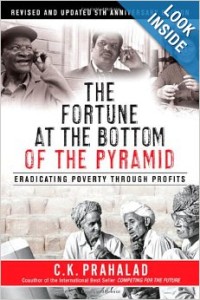
Review: The Fortune at the Bottom of the Pyramid [Updated 5tyh Anniversary Edition]

5 Star, Capitalism (Good & Bad), Change & Innovation, Economics, Intelligence (Wealth of Networks), Nature, Diet, Memetics, Design, Peace, Poverty, & Middle Class
0Shares
Amazon Page
Amazon Page

C. K. Prahalad

5.0 out of 5 stars Nobel Prize Material-Could Transform the Planet [But Most Seem to Have Missed the Point], October 24, 2013

There are some excellent and lengthy reviews of this book so I will not repeat anything that has already been said. This book review should be read together with my review of Stuart Hart's Capitalism at the Crossroads: Next Generation Business Strategies for a Post-Crisis World (3rd Edition) which points to several other related books, and Kenichi Ohmae's book, The Next Global Stage: Challenges and Opportunities in Our Borderless World (paperback) All three are published by Wharton School Publishing, which has impressed me enormously with its gifted offerings.

Here's the math that I was surprised to not see in the book: the top billion people that business focuses on are worth less than a trillion in potential sales. The bottom four billion, with less than $1000 a year in disposable income, are worth four trillion in potential sales.

In combination, Prahalad and Hart make it clear that business suffers from the same pathologies as the Central Intelligence Agency and other bureaucracies: they are in a rut.

I will end by emphasizing that I believe this author merits the Nobel Peace Prize. As the U.S. Department of Defense is now discovering, its $500 billion a year budget is being spent on a heavy metal military useful only 10% of the time. Stabilizization and reconstruction are a much more constructive form of national defense, because if we do not address poverty and instability globally, it will inevitably impact on the home front. This author has presented the most common sense case for turning business upside down. He can be credited with a paradigm shift, those shifts that Kuhn tells us come all too infrequently, but when they come, they change the world. It may take years to see this genius implemented in the real world, but he has, without question, changed the world for the better with this book, and make global prosperity a possibility.

Continue reading “Review: The Fortune at the Bottom of the Pyramid [Updated 5tyh Anniversary Edition]”

SmartPlanet: The Switching Economy Puts $5.9 Trillion Up For Grabs

03 Economy, Commercial Intelligence, Cultural Intelligence, Earth Intelligence
0Shares

smartplanet logoThe ’switching economy’ puts $5.9 trillion up for grabs

By | October 23, 2013

For companies around the world there are literally trillions of dollars worth of revenue up for grabs in what Accenture calls, in a new report, the ā€œswitching economy.ā€

Click on Image to Enlarge

According to the ninth annual Accenture Global Consumer Pulse Survey, which surveys consumer attitudes toward marketing, sales and customer service in 32 countries around the world, consumers are feeling more empowered to stop doing business with, say, a mobile phone provider or any other company if the customer service isn’t meeting their expectations.

Last year, there was a four percent jump — from 62 percent to 66 percent — in the number of people switching a company globally because of poor customer service. That’s a big increase from the 49 percent of people who switched in 2005 when the first survey was conducted.

The top five industries which see the most changes by customers are: consumer goods retailers (28 percent), retail banks (20 percent), Internet service providers (18 percent), wireless phone companies (17 percent), and landline phone companies (14 percent).

Those are the industries that have the best opportunity for taking advantage of the estimated $5.9 trillion worth of revenue that’s available worldwide from consumers switching companies.

Continue reading “SmartPlanet: The Switching Economy Puts $5.9 Trillion Up For Grabs”

4th Media: Putin Trying to Build & Secure Rail Link through DPRK + High-Speed Rail RECAP

Architecture, Design
0Shares

4th media croppedPutin Trying to Build & Secure Rail Link through DPRK(aka, ā€œNorth Koreaā€) for Moving Goods between Asia and Europe

Putin is inching closer to his goal of turning Russia into a major transit route for trade between eastern Asia and EuropeĀ by prying open North Korea, a nuclear-capable dictatorship isolated for half a century.

Click on Image to Enlarge

Russia last month completed the first land link that North Korea’s Stalinist regime has allowed to the outside world since 2003. Running between Khasan in Russia’s southeastern corner and North Korea’s rebuilt port of Rajin, the 54-kilometer rail link is part of a project President Putin is pushing that would reunite the railway systems of the two Koreas and tie them to the Trans-Siberian Railway.

That would give Putin partial control over links to European train networks 8,000 kilometers (5,000 miles) away. The route is as much as three times faster than shipping via Egypt’s Suez Canal, which handles 17,000 ships a year, accounts for about 8 percent of maritime trade — and is increasingly beset by pirates and political instability in Egypt and Syria.

Shipments to and from western Europe and Rajin will be delivered in just 14 days, compared with 45 days by ship.

Getting the two Koreas to work together on the railway and a long-stalled plan to build a pipeline to supply both Koreas with Russian natural gas is fraught with financial and political hurdles, said Fyodor Lukyanov, head of the Council on Foreign and Defense Policy research group in Moscow. They stem from North Korea’s nuclear weapons program and lingering animosity from the 1950-1953 Korean War.

ā€œRussia’s position is to get North Korea involved in profitable projects to make them realize that cooperation is better than isolation,ā€ Lukyanov said by phone from the Russian capital.

ā€œThe rail route is faster but more expensive, so it will probably become a niche product,ā€ Tasto said by phone Oct. 7. ā€œCargo trains are not mass-transportation vehicles like container ships.ā€

Continue reading “4th Media: Putin Trying to Build & Secure Rail Link through DPRK + High-Speed Rail RECAP”

SchwartzReport: Six Specifics That Make Denmark the Happiest (and Perhaps the Most Productive) Nation on Earth

08 Wild Cards, Civil Society, Collective Intelligence, Cultural Intelligence, Ethics, Government, Lessons, Peace Intelligence, Policies
0Shares

schwartzreport newLo and behold when a society is ordered on wellness and not just profit, as is the case in Denmark, we can see what results — wellness, happiness. So why aren't we doing this?

Denmark Is the Happiest Country on Earth! You'll Never Guess Why
AlterNet (U.S.)

Last month, Denmark was crowned the happiest country in the world.

‘The top countries generally rank higher in all six of the key factors identified in the World Happiness Report,ā€ wrote University of British Columbia economics professor John Helliwell, one of the report's contributing authors. ‘Together, these six factors explain three quarters of differences in life evaluations across hundreds of countries and over the years.ā€

The six factors for a happy nation split evenly between concerns on a government- and on a human-scale. The happiest countries have in common a large GDP per capita, healthy life expectancy at birth and a lack of corruption in leadership. But also essential were three things over which individual citizens have a bit more control over: A sense of social support, freedom to make life choices and a culture of generosity.

“There is now a rising worldwide demand that policy be more closely aligned with what really matters to people as they themselves characterize their well-being,” economist Jeffrey Sachs said in a statement at the time of the report's release.

Continue reading “SchwartzReport: Six Specifics That Make Denmark the Happiest (and Perhaps the Most Productive) Nation on Earth”