It gives me great personal pleasure to extend congratulations as you assume your responsibilities as Prime Minister of Israel. You have our friendship and best wishes in your new tasks. It is on one of these that I am writing you at this time.
You are aware, I am sure, of the exchange which I had with Prime Minister Ben-Gurion concerning American visits to Israel’s nuclear facility at Dimona. Most recently, the Prime Minister wrote to me on May 27. His words reflected a most intense personal consideration of a problem that I know is not easy for your Government, as it is not for mine. We welcomed the former Prime Minister’s strong reaffirmation that Dimona will be devoted exclusively to peaceful purposes and the reaffirmation also of Israel’s willingness to permit periodic visits to Dimona.
The United States deliberately allowed Japan access to the United States’ most secret nuclear weapons facilities while it transferred tens of billions of dollars worth of American tax paid research that has allowed Japan to amass 70 tons of weapons grade plutonium since the 1980s, a National Security News Service investigation reveals. These activities repeatedly violated U.S. laws regarding controls of sensitive nuclear materials that could be diverted to weapons programs in Japan. The NSNS investigation found that the United States has known about a secret nuclear weapons program in Japan since the 1960s, according to CIA reports.
“Listen to this incredible audio recording of a speech made by JFK before the American Newspaper Publishers Association where he warns the press about the secret societies that are the real power in global affairs.”
In early 2010, journalist and satirist Barrett Brown was working on a book on political pundits, when the hacktivist collective Anonymous caught his attention. He soon began writing about its activities and potential. In a defense of the group’s anti-censorship operations in Australia published on February 10, Brown declared, “I am now certain that this phenomenon is among the most important and under-reported social developments to have occurred in decades, and that the development in question promises to threaten the institution of the nation-state and perhaps even someday replace it as the world’s most fundamental and relevant method of human organization.”
By then, Brown was already considered by his fans to be the Hunter S. Thompson of his generation. In point of fact he wasn’t like Hunter S. Thompson, but was more of a throwback—a sharp-witted, irreverent journalist and satirist in the mold of Ambrose Bierce or Dorothy Parker. His acid tongue was on display in his co-authored 2007 book, Flock of Dodos: Behind Modern Creationism, Intelligent Design and the Easter Bunny, in which he declared: “This will not be a polite book. Politeness is wasted on the dishonest, who will always take advantage of any well-intended concession.”
But it wasn’t Brown’s acid tongue so much as his love of minutiae (and ability to organize and explain minutiae) that would ultimately land him in trouble. Abandoning his book on pundits in favor of a book on Anonymous, he could not have known that delving into the territory of hackers and leaks would ultimately lead to his facing the prospect of spending the rest of his life in prison. In light of the bombshell revelations published by Glenn Greenwald and Barton Gellman about government and corporate spying, Brown’s case is a good—and underreported—reminder of the considerable risk faced by reporters who report on leaks.
4.0 out of 5 starsI hate electronic books, but worth considering, June 24, 2013
I've reviewed the major books on the JFK assassination and list them at the end of this review.
First off, since the table of contents is not in Look Inside the Book, where it should be, here is that bit:
Preface
1. The 1960 Campaign and Election
2. Vietnam and the CIA
3. The Conspiracy and the Global Elite
4. Oswald and his Part in the Conspiracy
5. Why Johnson was only a Part of the Conspiracy
6. The Real Reasons
7. Repercussions
8. Conclusion
The book asks and tries to answer a few questions about the Kennedy assassination that haven't been asked often enough even after nearly 50 years.
Questions like, “Why?”, “Who benefited?”, and “Why the major cover-up?”.
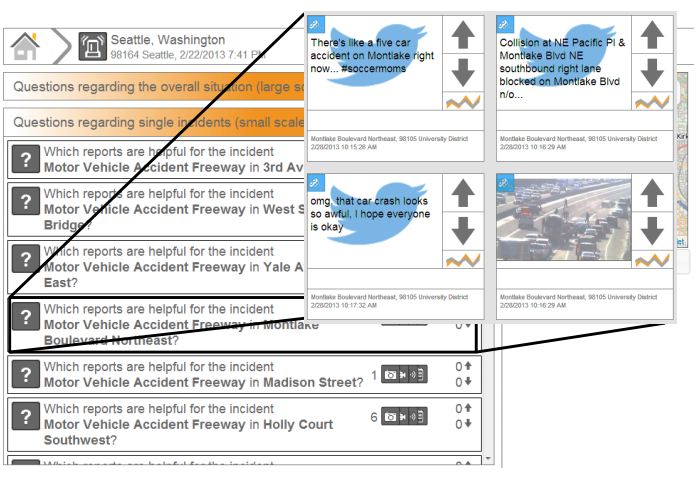
Social media is increasingly used to communicate during major crises. But what about small-scale incidents such as a car crash or fire? These “micro-crises” typically generate a far smaller volume of social media activity during a much shorter period and more bounded geographical area. Detecting these small-scale events thus poses an important challenge for the field of Crisis Computing.
Click on Image to Enlarge
Axel Schulz just published co-authored a paper on this exact challenge. In this study, he and co-authors Petar Ristoski & Heiko Paulheim ”present a solution for a real-time identifi cation of small scale incidents using microblogs,” which uses machine learning—combining text classi cation and semantic enrichment of microblogs—to increase situational awareness. The study draws on 7.5 million tweets posted in the city centers of Seattle and Memphis during November & December 2012 and February 2013. The authors used the “Seattle Real Time Fire 911 Calls” dataset to identify relevant keywords in the collected tweets. They also used WordNet to “extend this set by adding the direct hyponyms. For instance, the keyword “accident” was extended with ‘collision’, ‘crash’, ‘wreck’, ‘injury’, ‘fatal accident’, and ‘casualty’.”
An evaluation of this combined “text classi cation” and “semantic enrichment” approach shows that small scale incidents can be identified with an accuracy 89%. A copy of Axel et al.‘s paper is available here (PDF). This is a remarkable level of accuracy given the rare and micro-level nature of the incidents studied.
The Internet of Things is coming, but so far it's a fragmented mess. In order for it to work the way it's envisioned, some coopetition may be in order. The business models that reward innovation, that are open, and that are fully interoperable at all levels are the ones that will be successful. The Internet of Things will come into being only when the interoperability challenges are conquered.