James S. Turner, is the chair of Citizens for Health Action Group, the national nonprofit consumer advocacy group working to broaden health care options, create an integrative health system based on wellness, and advance the freedom to make health choices. He is the author of The Chemical Feast: The Nader Report on the Food and Drug Administration.
Mr. Turner represents businesses as well as individuals and consumer groups in a wide variety of regulatory matters concerning food, drug, health, environmental and product-safety matters. He has appeared before every major consumer regulatory agency, including the Food and Drug Administration, Environmental Protection Agency, Consumer Product Safety Commission and Federal Trade Commission, as well as the Department of Agriculture and the National Institutes of Health. Mr. Turner has served as special counsel to the Senate Select Committee on Food, Nutrition, and Health and to the Senate Government Operations Subcommittee on Government Research.
He is a graduate of The Ohio State University School of Law.
In the electoral reform arean, he is, with Don Beck, an original copnceptualizer of the term “transpartisanship” (used by the left–the right uses post-partisanship while the middle uses non-partisanship). With Larwence Chickering he has authored a transpartisan volume,Voice of the People: The Transpartisan Imperative in American Life, depicted below.
Alex Steffen has been the Executive Editor of Worldchanging since he co-founded the organization in 2003, as the next phase in a lifetime of work exploring ways of building a better future. Steffen was also the editor of Worldchanging's wildly successful first book, Worldchanging: A User's Guide for the 21st Century(Abrams, 2006), a 600-page compendium of writings from more than sixty noted leaders around the world,
Possibly the Most Important Book to America's Future, March 23, 2008
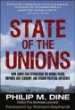
Philip Dine
I chanced upon this book at an airport bookstore, and after a long flight and several more hours at home with it, have put it down with an enormous sense of the righteous and epochal importance of this work. I have not trimmed my review to 1000 words because of the importance of this book, and the removal of the 1000 word limit from Amazon's current guidelines. This is IMPORTANT!
In the introduction to the book, Congressman Gephardt laments that union membership is down to 8% from 35%, for two reasons: good employers whose workers do not feel the need to unionize, and intimidation by bad employers who will stop at nothing to squelch any attempt to unionize.
He emphasizes the direct relationship between the health of the unions and the health of America's economy and its linch-pin middle class.
He is most provocative in suggesting that unions can and should displace employers as the providers of life-long benefits.
He concludes the introduction by lamenting the reality that employers pursue micro-profits instead of macro-benefits, and points out that in the absence of rules of law and fair trade, globalization will inevitably push the USA to labor conditions akin to those of the lowest common denominator–a return to sweatshops, no benefits, and despair across the land.
The book itself is phenomenal. The author, a very rare journalist who not only cares about labor issues but has also won the trust of labor leaders, has written what is in my mind the single most important book relevant to how every American should perceive the 2008 election. No candidate is serious about labor at this time. Our job is to change that, and to help labor, notably the AFL-CIO and the International Association of Fire Fighters (IAFF), change that by putting labor issues in the forefront of the economic discussion. John McCain, featured in the DVD Why We Fight, condones the impoverishment of regions to stimulate enlistments in the military-industrial complex of which he is a tacit leader. Hillary Clinton does not now and never will understand the working class–she set the standard for “bitch in residence” in the White House, according to my secret service colleagues, and she is as elitist and arrogant as it gets. Barack Obama remains surrounded by advisors who do not have a clue about Generation Y, collective intelligence, or how to create a holistic strategy that can address the ten threats with the twelve policies while helping the eight challengers avoid our self-induced The Fifty-Year Wound: How America's Cold War Victory Has Shaped Our World, the loss of the The Battle for the Soul of Capitalism and the rise of the two political parties that are a form of organized crime and Running On Empty: How The Democratic and Republican Parties Are Bankrupting Our Future and What Americans Can Do About It. It is in this context that I am simply blown away by extremely balanced, well-told, important review by a journalist uniquely qualified to provide us with a book-length review of where labor has failed, where labor shows promise, and how labor is America's bottom line: as he concludes the book, Labor defines who we are as a people.
+ Labor has unraveled, which harms America and its economy because Labor is historically the only force apart from honest religions and selected civil society elements that truly represents the moral imperatives of both social value and economic value. Decades of progress have been rolled back by Bush I, Clinton, and Bush II. Clinton in particular sold out Labor with NAFTA and the ease with which he allowed corporations to export entire programs to sweatshop countries at the same time that he reduced barriers to the dumping of both cheap and unsafe toys and other products whose “true cost” has not been properly calculated or presented.
+ Middle class, professionals, and women are going bankrupt, along with skilled blue collar workers, because the balance of power among labor, business, and government is gone–business rules.
+ 53% of Americans favor unionization.
+ Reagan's dismissal of the air traffic controllers was the signal act that destroyed decades of labor progress, and unleashed illegal, unethical, and unconscionable business repression of unions.
+ Service jobs are difficult to unionize because of high turnover, transient elements, low pay, high proportion of immigrants that can be intimidates, PLUS a lack of government penalties against business violators.
+ The above, combined with the government's enthusiastic support for exporting jobs, and poor labor leadership, have creating a sucking chest wound in the American economy. It could yet be fatal.
+ The author excels at recounting labor successes that have not been covered by the mainstream media, and he manages to do this in a way that is inspiring, objective, and not at all preachy or pontifical.
+ I am deeply moved by his account of how the IAFF, two lights down from my own office, used five methods to win Iowa for John Kerry:
– Turned out the residents (each bringing five citizens to caucuses)
– Used local presence EVERYWHERE to carry caucuses ignored by the other candidates
– Able to use local knowledge to recruit those whose candidates failed to pass the viability test
– Never gave up in darkest of times
– High public credibility and visibility
+ I am reminded that “Change to Win” started in 2005, John Kerry and his boffo haircut just could not communicate the need properly.
+ The author explains how Kerry earned fire fighter love and respect in his turning around mid-way to Asia to come back to a major fire that killed numerous fire fighters in his state, and then worked aggressively to pass fire fighter equipment and safety laws.
+ There is no other union that has a firehouse, fire trucks, uniformed personnel that are unarmed, and is able to sponsor chili feeds at the firehouses while handing out leaflets in uniform on every street corner, doing retail politics to all non-union voters.
+ Having set the stage with successes, the author then moves into a very important middle ground in which he anticipates the continued decline of labor (and of the American economy) unless labor can reassert its influence on the national agenda.
+ He is critical of labor for focusing only on “get out the vote” and not on putting its issues–all of which have moral authority–into the national dialog.
+ He points out that labor spent close to $100 million in the 2004 election across 32 states, and was a key factor in the democrats taking back both Houses of Congress.
+ He is forceful in discussing how the Republicans have made “cultural values” a smokescreen within which individuals vote for candidates that are inherently bad for the public wallet and public benefits. I have a note, “religion and ‘values' have trumped facts and consequences.”
+ He damns both parties: the Republicans for trying to eliminate minimum wage rights in the aftermath of Katrina, and the Democrats for taking labor for granted.
+ He says that the debate has not taken place regarding:
– deindustrialization of America
– dumping of unsafe and cheap products into our marketplace
– local impact of globalization (and of course Wal-Mart as a cancer)
– toll on families of reduced benefits
+ He is articulate in pointing out that labor must work at two levels:
– at a national level, constant forceful attention to legislation, regulation, and the filling of oversight posts
– locally on compliance and alerts
+ The author slams the Democrats for barely winning on the basis of Republican mistakes, while being completely lacking in any strategy, message, or coherent program of their own.
+ He is devastatingly effective in evaluating the failure of labor leaders to communicate to the public that wages are at the lowest point in history as a percentage of the Gross Domestic Product (GDP) while profits are at the highest point ever in history as a percentage of the GDP.
+ He is eloquent in pointing out that most Americans have forgotten (or never learned) that strong labor equates to the greatest prosperity for the greatest number.
+ He recommends these two books as antecedent works:
+ He documents how labor has failed to impact on trade agreements, the migrations of good jobs with benefits to overseas sweatshops, and the loss of entire segments of community economics.
+ The author describes a wide range of illegal and unethical business practices that repress unionization, while also describing the ineptness of the government, with the National Labor Review Board taking an average of 889 days to make a ruling–that is almost three years and in my mind is an ATROCITY.
+ Illegal firings that we know of amounted to 31,358 in 2005. Business enjoys a “culture of impunity” fueled by loopholes, ease of long delays, and feeble enforcement.
+ Labor hurt itself with its own repression in earlier decades of dissent, and its compulsion to demand strict obedience for a unified front (at the same time that businesses had similar practices)
+ The author believes that the country hungers for a renaissance of labor and its community-oriented values and benefits. I hope so, but right now, not a single candidate has a clue how to jump into this with both feet, a heart, and a brain.
+ I am totally inspired by this author, and have a note to myself: firefighters, cops, teachers, ambulance drivers and nurses: public servants driving public policy and benefits.
+ The author is sympathetic but very critical of labor's refusal to engage with most journalists, and he provides a superb overview of how badly labor deals with media and how badly media ignores labor issues that are fundamental.
+ He is most impressive in giving modern labor a relatively clean “bill of health” with most mafia connections and most strong-arm bosses now giving way to the empowerment of individual union members, open elections, and greater accountability.
+ He calls on labor to humanize, regionalize, and think big.
+ Labor should tell the story of its role in East European democratization and carry that creative role to the Second World.
+ Labor should compare and publicize the grotesque profits and compensation packages of industry, with those of the workers on whose backs those profits are unjustly earned.
I put this book down with a sense of wonder, a hard-eyed sense of the possibilities, and a very strong conviction that this author and this book have nailed the future of America as a Republic: Labor can be the king-maker at the national and state levels in 2008, and I pray that Labor will first learn the difference between transpartisan and bi-partisan (code for preserving the two party spoils system, something both McCain and Clinton absolutely want).
In that vein, I imagined a month national “open house” across police stations, fire stations, hospitals, and schools, in which Video-Teleconferencing was used to sponsor a national town-hall meeting to consider the ten threats and twelve policies, to elect a People's Cabinet, and perhaps funded by the Peter G. Peterson Foundation under the leadership of David Walker (former Comptroller General who told Congress USA is insolvent and quit when they would not act responsibly), a Public Budget Office capable of producing a balanced budget by 4 July 2008, and demanding that each candidate do the same (both appoint a Cabinet and produce a balanced budget for online examination before November 2008).
The author, in my opinion, is long overdue for recognition and promotion as the voice of labor, serving a new virtual Labor Congress that sets aside the fiefdoms and irrationality of the labor archipelago, and speaks to America with one voice and one practical agenda to restore America the Beautiful.
Together with a Few Other Books, All You Need to Know, March 21, 2008
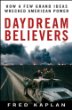
Fred Kaplan
The author is kinder to the protagonists than they merit.
I give the author high marks for making the case early on in the book that the world did NOT change after 9-11, and that what really happened was that the coincidence of neo-conservative back-stabbing and Bush's well-intentioned evangelical village idiot view of freedom and democracy.
The author does a fine job of reviewing how after 9-11 we were faced with two choices, the first, going for empire (“we make our own reality”) or revitalizing alliances. The neocons in their ignorance called for regime changes, but the author fails us here by not understanding that both political parties love 42 of the 44 dictators, those that “our” dictators.
The author has many gifted turns of phrase. One talks about how their “vision” turned into a “dream” that then met “reality” and was instantly converted into a “nightmare.”
The author adds to our knowledge of how Rumsfeld empowered Andy Marshall, and how the inner circle quickly grew enamored of the delusion that they could achieve total situational awareness with total accuracy in a system of systems no intelligent person would ever believe in.
The author highlights two major intelligence failures that contributed to the policy bubble:
1. Soviet Union was way behind the US during the Cold War, not ahead.
2. Soviet economy was vastly worse and more vulnerable that CIA ever understood.
The author helps us understand that the 1989 collapse of the Berlin War created a furor over the “peace dividend” and the “end of history” that were mistaken, but sufficient to bury with noise any concerns about Bin Laden and Saudi Arabian spread of virulent anti-Shi'ite Wahabibism from 1988 onwards.
By 1997 Marshall and Andy Krepinevich were staking everything on Unmanned Aerial Vehicles (UAV), high speed communications and computing (still not real today), and precision munitions.
The author provides a super discussion of Col John Warden's “five rings” in priority order: 1) leadership and C4I; 2) infrastructure; 3) transportation; 4) population (again, war crimes); and finally, 5) the enemy. The author is brutal in scoring the campaign designed by Col Warden a complete failure. It…did…not…work (in Gulf I).
I cannot summarize everything, so a few highlights:
+ Taliban quickly learned how to defeat US overhead (satellite) surveillance–remember, we do not do “no-notice” air breather imagery any more, except for easily detected UAVs, with mud as well as cover and concealment. .
+ Excellent account of the influence on Rumsfeld of George Tenet's failure to satisfy him during a missile defense review. It became obvious to all that the U.S. Intelligence Community a) no longer had a very high level of technical mastery on the topic; and b) was so fragmented as to make the varied analytic elements deaf, dumb, and blind–not sharing with each other, using contradictory data sets, the list goes on.
Page 187 is the page to read if you are just browsing in the bookstore:
Summarizing 2007: “Not so much a return to realism as a retreat to randomness.” Also: “Grand vision was shattered by reality. Policies were devised piecemeal; actions were scattershot, aimless.” And: “put forth ideas without strategies; policies without process; wishes without means.” Devastating.
So many other notes. Here are a tiny handful:
+ Speechwriter Michael Gersen connected with Bush on an evangelical level, wrote major speeches, in the case of a foreign policy speech, without actually consulting any adult practitioners.
+ Joseph Korbel was both Madeline Albright's father and Condi Rice's educational mentor–talk about a non-partisan losing streak!
+ American Enterprise Institute and Richard Perl used Natan (Anatoly) Sharansky to impress Cheney and subvert Bush by reframing the Israeli genocide against the Palestinians as the first 21st Century war between terrorism (the hapless Palestinians) and democracy (the Israeli's).
+ He credits Eliot Abrams with devising the unique linkage between American Jews whose numbers and influence have been declining, and the Evangelical Christians whose influence peaked with Bush-Cheney.
+ He slams General Tommy Franks for providing assurances and making promises he could not keep with respect to settling and stabilizing the towns by-passed or over-run by the US Army.
+ The author is misleading in his account of the Saudi-Powell discussions on how an election would lead to radical Islamics in charge (as opposed to despotic, perverted spendthrifts).
+ Rumsfeld Lite going into Iraq meant that a quarter million tons of ordnance was looted by insurgents, which is what cost us four years time. General Shinseki is vindicated.
+ For the first time I learn of a planned Truth and Reconciliation Commission.
+ The author introduces Ahmed Chalabi but does not fully understand this man's crimes as well as his special relationship with Iran. Iran used him to get the USA to depose the Taliban and Sadaam Hussein, , and to lure the entire US military into a quagmire.
+ Department of State, Mr. White in particular, got it right every time.
+ Legitimacy and stability must come before elections.
+ Hezbollah win in Lebanon dealt a crushing blow to the Bush delusions.
+ Bush refused to deal with Syria and Iran throughout. I am reminded of how Civil Affairs was told in the first five years of the war to blow off the tribal leaders and imams, and only now are they being allowed to get it right.
+ Useful account of three failed Public Diplomacy tenures (Charlotte Beers, Margaret Tutwiler, Karen Hughes (who waited six months so her son could leave for college–so much for the importance of that job….)
+ USA sent $230 million in aid to Lebanon, while Iran poured in $1 billion via Hezbollah (meanwhile, the Chinese do the same everywhere else).
Page 191 is glorious: Bush's strategies were “based on fantasies, faith, and a willful indifference toward those affected by their consequences.”
Page 192: the real divide is “between the realists and the fantasists.”
The author quite properly slams the Democrats for not having an original idea, plan, program, bill, budget, or moral thought.
He ends by suggesting that multinational consensus is still the true litmus test for the sensibility and sustainability of any endeavor.
On this note, I conclude that five stars are right where this book should be. Incomplete, but original and provocative. Bravo.
Getting Repetitious, A Tiny Bit More Direct This Time Around, March 21, 2008
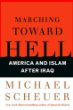
Michael Scheuer
The author was not a “spook.” He was an analyst. Analysts do not work under cover and they very rarely if ever go in harm's way.
What I admire most about this author is that he kept his integrity, as did Dick Clarke. Both stand in sharp contrast to Tony Lake and Sandy Berger and Madeline Albright in the Clinton Administration, and Dick Cheney, Colin Powell, George Tenet, and Condi Rice in the Bush Administration.
Folks have been reluctant to understand that from the first book by Anonymous, this author has been practically shouting from the rooftops:
BIN LADEN IS RIGHT. BIN LADEN HAS LIMITED OBJECTIVES.
The fact is that the US armed presence in the Middle East, first off remaining in Saudi Arabia, a violation of the promise Dick Cheney made, and second of all being loyal to the despotic, debauched Saudi “Royal” family that is consuming the national commonwealth at the expense of the people, are both legitimate grounds for any well-educated revolutionary and patriot to say ENOUGH.
I only give this book four stars because as right as the author is, the end of the book and its varied prescriptions are the only really new ground (from this author) and they are basically no more or less than any well-schooled PhD would tell you: put your own house in order, do no harm, support no despots, and mind your own business.
Bottom line: Bush is a village idiot with a semblance of integrity. Cheney is a nakely amoral war criminal who should be run out of town–he's not worth impeaching. The well-intentioned managers of the Department of State, Department of Defense, and the US Intelligence Community do not have a clue about how to create a long-term global strategy to create a prosperous world at peace. They are trapped in pyramidal organizations and have all–without exception–lost the ability to think for themselves. Thus does the Republic stagger to its demise.
Merits Reprinting and Slight Updating, March 20, 2008
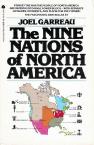
Joel Garreau
I thought I had reviewed this long ago, but evidently not. It is still very relevant to understanding and nurturing America today, and I would be very glad to see the publisher commission a slight update and then reprint this superb work.
As America strives to migrate from a disasterous and nearly fatal two-party spoils system and an Executive that is both corrupt and delusional, those who seek to lead America into a brighter future need to understand America in a new and more nuanced way. It is not about left or right. This book has been on continuing value to me as a point of reference, and I recommend it very highly in its existing state, more so if renewed.
The nine nations, each unique, are:
1. The empty quarter (which global warming will open up)
2. Quebec
3. Ecotopia (a model for the rest of us)
4. The breadbasket (which wastes water on excess foot and grows corn for fuel and cattle that is inedible and wastes more water)
5. New England
6. The Foundry (mid-Atlantic coast)
7. Dixie
8. MexAmerica
9. The Islands (of the Caribbean, where Cuban sugar cane sap could power 30-35 million cars, while Cuban health care would inform our own).