Bees can solve complex mathematical problems which keep computers busy for days, research has shown.
Bees can solve complex mathematical problems which keep computers busy for days, research has shown.
Full Story Online
The insects learn to fly the shortest route between flowers discovered in random order, effectively solving the “travelling salesman problem” , said scientists at Royal Holloway, University of London
The conundrum involves finding the shortest route that allows a travelling salesman to call at all the locations he has to visit. Computers solve the problem by comparing the length of all possible routes and choosing the one that is shortest.
Bees manage to reach the same solution using a brain the size of a grass seed.
Phi Beta Iota: This is one reason why we continue to believe that Human Intelligence (HUMINT) is vastly superior to Signals “Intelligence” (SIGINT) which we have come to think of as grotesquely expensive out of control unprocessed noise of little intelligence value. Of course, HUMINT without intelligent management is not intelligent at all, but our going in proposition is that HUMINT and Open Source Source Intelligence (OSINT) allow intelligent management to do much more with much less in the way of dollars, time, and footprint.
Phi Beta Iota: Extracts are provided. This is an important document that confirms the total abdication by Congress and the Executive of their Constitutional duties with respect to the public interest. The USA is owned and operated by Wall Street for its benefit, and We the People have been completely disenfranchised at the same time that the Commonwealth has been looted.
EXTRACT:
No matter how much Obama talks about his “tough” new financial regulatory reforms or offers rote condemnations of Wall Street greed, few believe there’s been real change. That’s not just because so many have lost their jobs, their savings and their homes. It’s also because so many know that the loftiest perpetrators of this national devastation got get-out-of-jail-free cards, that too-big-to-fail banks have grown bigger and that the rich are still the only Americans getting richer.
This intractable status quo is being rubbed in our faces daily during the pre-election sprint by revelations of the latest banking industry outrage, its disregard for the rule of law as it cut every corner to process an avalanche of foreclosures. Clearly, these financial institutions have learned nothing in the few years since their contempt for fiscal and legal niceties led them to peddle these predatory mortgages (and the reckless financial “products” concocted from them) in the first place. And why should they have learned anything? They’ve often been rewarded, not punished, for bad behavior.
EXTRACT:
The much acclaimed new documentary about the global economic meltdown, “Inside Job,” has it right. As its narrator, Matt Damon, intones, our country has been robbed by insiders who “destroyed their own companies and plunged the world into crisis” — and then “walked away from the wreckage with their fortunes intact.” These insiders include Dick Fuld and four other executives at Lehman Brothers who “got to keep all the money” (more than $1 billion) after Lehman went bankrupt. And of course Robert Rubin, who encouraged Citigroup to step up its investment in high-risk bets like Countrywide’s mortgage-backed securities. Rubin, now back as a rainmaker on Wall Street, collected more than $115million in compensationduring roughly the same period Mozilo “earned” his half a billion. Citi, which required a $45 billiontaxpayers’ bailout, recently secured its own slap-on-the-wrist S.E.C. settlement — at $75 million, less than Rubin’s earnings and less than its 2003 penalty ($101 million) for its role in hiding Enron profits.
It should pain the White House that its departing economic guru, the Rubin protégé Lawrence Summers, is an even bigger heavy in “Inside Job” than in the hit movie of election season, “The Social Network.” Summers — like the former Goldman Sachs chief executive and Bush Treasury secretary Hank Paulson — is portrayed as just the latest in a procession of policy makers who keep rotating in and out of government and the financial industry, almost always to that industry’s advantage. As the star economist Nouriel Roubini tells the filmmaker, Charles Ferguson, the financial sector on Wall Street has “step by step captured the political system” on “the Democratic and the Republican side” alike. But it would be wrong to single out Summers or any individual official for the Obama administration’s image of being lax in pursuing finance’s bad actors. This tone is set at the top.
Asked in “Inside Job” why there’s been no systematic investigation of the 2008 crash, Roubini answers: “Because then you’d find the culprits.” With the aid of the “Manhattan Madam” (and current stunt New York gubernatorial candidate) Kristin Davis, the film also asks why federal prosecutors who were “perfectly happy to use Eliot Spitzer’s personal vices to force him to resign in 2008” have not used rampant sex-and-drug trade on Wall Street as a tool for flipping witnesses to pursue the culprits behind the financial crimes that devastated the nation.
EXTRACT:
Even as the G.O.P. benefits from unlimited corporate campaign money, it’s pulling off the remarkable feat of persuading a large swath of anxious voters that it will lead a populist charge against the rulers of our economic pyramid — the banks, energy companies, insurance giants and other special interests underwriting its own candidates. Should those forces prevail, an America that still hasn’t remotely recovered from the worst hard times in 70 years will end up handing over even more power to those who greased the skids.
We can blame much of this turn of events on the deep pockets of oil billionaires like the Koch brothers and on the Supreme Court’s Citizens United decision, which freed corporations to try to buy any election they choose. But the Obama White House is hardly innocent. Its failure to hold the bust’s malefactors accountable has helped turn what should have been a clear-cut choice on Nov. 2 into a blurry contest between the party of big corporations and the party of business as usual.
Phi Beta Iota: The Tea Party is an unwitting circus act fully funded and controlled by the New York mandarins. The lack of responsible alternatives on the left or the right, combined with the naivete of the public in thinking that the Tea Party is anything other than a side show, could lead–we never thought we would say this–to a new Administration and Congress even more ineffective than the last two. The further American governance moves from the truth, the deeper our grave.
A recent article in Christian Science Monitor on military health care costs identified, in microcosm, the battle we face in the coming years in defending the military community’s sunk investment in its future.
Full Story Online
After citing all DoD’s arguments that it’s being “eaten alive” by “unsustainable” military health care cost increases, the reporter had the courtesy of quoting me on the other side of the argument:
“’There’s a fundamental difference between social insurance programs open to every American and military benefits earned by decades of service and sacrifice,’ said Steve Strobridge, director of Governmental Relations for MOAA.
“What Mr. Strobridge raises here is a moral issue: Should the military be treated differently than nonmilitary America when it comes to pay and benefits? The armed forces put their lives, limbs, and mental health on the line for the safety of the country, or they potentially do. On a practical level, you need strong benefits to recruit and maintain a strong, all-volunteer military.”
And then came this kicker:
“But here’s another moral angle: Sacrifice goes with the territory of being in the armed services, and the military budget needs serious cutting. Should sacrifice not also extend to the defense of the nation’s financial health if it’s in critical danger?”
And there’s the problem. Sacrifices already endured are assigned no value. It’s the budget shrug: “They volunteered, didn’t they?”
Every 15 years or so, that indifference leads to cuts that eventually wreck retention — and then national leaders have to pull out all the stops and spend even more to solve the military manpower crisis they refused to prevent.
The real issue is, “How much is it worth for the country to be able to defend itself?”
Phi Beta Iota: With all due respect to MOAA, the real issue is NOT “what price defense” but rather “how best to defend.” There are three simple solutions to the military and and benefits problem that do NOT require reductions:
1. Restore the universal draft including immigrants and including a mid-career “sabatical” between military and private sector. This bonds the nation–one boot camp, three choices: Armed Forces, Peace Corps, Homeland Service.
2. Establish Constitutional honest government tht does not lead the Republic into elective wars for ideological and private reasons on the basis of (most recently) 935 documented lies. The same honest government can be expected to end the acquisition of things we do not need (e.g. missile defense in Poland, J-22, new nuclear submarine) at costs we cannot afford.
3. End the fiction that future Medicare costs re unfunded. They are only unfunded because a corrupt Congress in cahoots with a corrupt Administration (both parties) has forbidden price negotiation. The minute we restore honest government current and future Medicare costs come down to 1% (ONE percent) of what we pay now.
Thomas Jefferson: A Nation's best defense is an educated citizenry.
Russell Ackoff: Stop trying to do the wrong things righter; do the right things.
Robert Steele: The truth at any cost reduces all other costs.
Many boomers will answer the question, “What work, exactly?” with, “Start a business.” Some of us will do it because it's something we've always wanted to do, others because we can't find work and need to create it. But hanging out a shingle is suddenly on the upswing, especially among people over 50.
Just ask the folks at the Ewing Marion Kauffman Foundation, the world's largest foundation dedicated to entrepreneurship. Their research shows that the average age of first-time entrepreneurs is now between 55 and 64. “The United States is on the cusp of an entrepreneurship boom — not in spite of an aging population, but because of it.”
Phi Beta Iota: This posting hit us like a thunderbolt. Combine it with the literature on “Wealth of Networks” and the literature on “Cognitive Surplus” and you have a nation-wide “gold mine. This is HUGE.
In so many fields, owing to the Internet-driven democratization of knowledge, we learn that that the power associated with hoarded knowledge has been abused, and the position of leadership – the priesthood – associated with the acquisition of knowledge has been leveraged to manipulate and deceive. “Everything you know is wrong!”
David Freedman has a great article in the Atlantic about medical deception, called “Lies, Damned Lies, and Medical Science,” which focuses on Dr. John Ioanniddis’ dedication to exposing bad science in medicine.
He’s what’s known as a meta-researcher, and he’s become one of the world’s foremost experts on the credibility of medical research. He and his team have shown, again and again, and in many different ways, that much of what biomedical researchers conclude in published studies—conclusions that doctors keep in mind when they prescribe antibiotics or blood-pressure medication, or when they advise us to consume more fiber or less meat, or when they recommend surgery for heart disease or back pain—is misleading, exaggerated, and often flat-out wrong. He charges that as much as 90 percent of the published medical information that doctors rely on is flawed. His work has been widely accepted by the medical community; it has been published in the field’s top journals, where it is heavily cited; and he is a big draw at conferences. Given this exposure, and the fact that his work broadly targets everyone else’s work in medicine, as well as everything that physicians do and all the health advice we get, Ioannidis may be one of the most influential scientists alive. Yet for all his influence, he worries that the field of medical research is so pervasively flawed, and so riddled with conflicts of interest, that it might be chronically resistant to change—or even to publicly admitting that there’s a problem.
At e-Patients.net, Peter Frishauf writes a response to the Atlantic article, called “Fixing those Damn Lies.” How do we fix them? The Atlantic piece discusses Ioannidis’ suggestions to change the culture of medical research, and reset expectations. It’s okay to be wrong in science – in fact, it’s almost a requirement. The scientific method is about testing and proving hypotheses – proving can be “proving wrong” as well as “proving right.” Either way, you’re learning, and extending science.
Frishauf also mentions how medicine and science should embrace the Internet “and figure out a way to better incorporate patient self-reported and retrospective data in trials,” which is one goal of participatory medicine. He also suggests “giving up on tenure-tied-to-the-peer-reviewed-literature, and embracing a moderated form of pre and post-publication peer review,” something that came up in discussion when I spoke at the Central Texas World Future Society Tuesday evening. (More about this in an earlier e-Patients.net post by Frishauf.)
Knowledge is not a citadel or ivory tower, but a network that we could all be working, challenging, and improving.
Billions of people participate in online social activities. Most users participate as readers of discussion boards, searchers of blog posts, or viewers of photos. A fraction of users become contributors of user-generated content by writing consumer product reviews, uploading travel photos, or expressing political opinions. Some users move beyond such individual efforts to become collaborators, forming tightly connected groups with lively discussions whose outcome might be a Wikipedia article or a carefully edited YouTube video. A small fraction of users becomes leaders, who participate in governance by setting and upholding policies, repairing vandalized materials, or mentoring novices. We analyze these activities and offer the Reader-to-Leader Framework with the goal of helping researchers, designers, and managers understand what motivates technology-mediated social participation. This will enable them to improve interface design and social support for their companies, government agencies, and non-governmental organizations. These improvements could reduce the number of failed projects, while accelerating the application of social media for national priorities such as healthcare, energy sustainability, emergency response, economic development, education, and more.
Recommended Citation
Preece, Jennifer and Shneiderman, Ben (2009) “The Reader-to-Leader Framework: Motivating Technology-Mediated Social Participation,” AIS Transactions on Human-Computer Interaction (1) 1, pp. 13-32
Available at: http://aisel.aisnet.org/thci/vol1/iss1/5
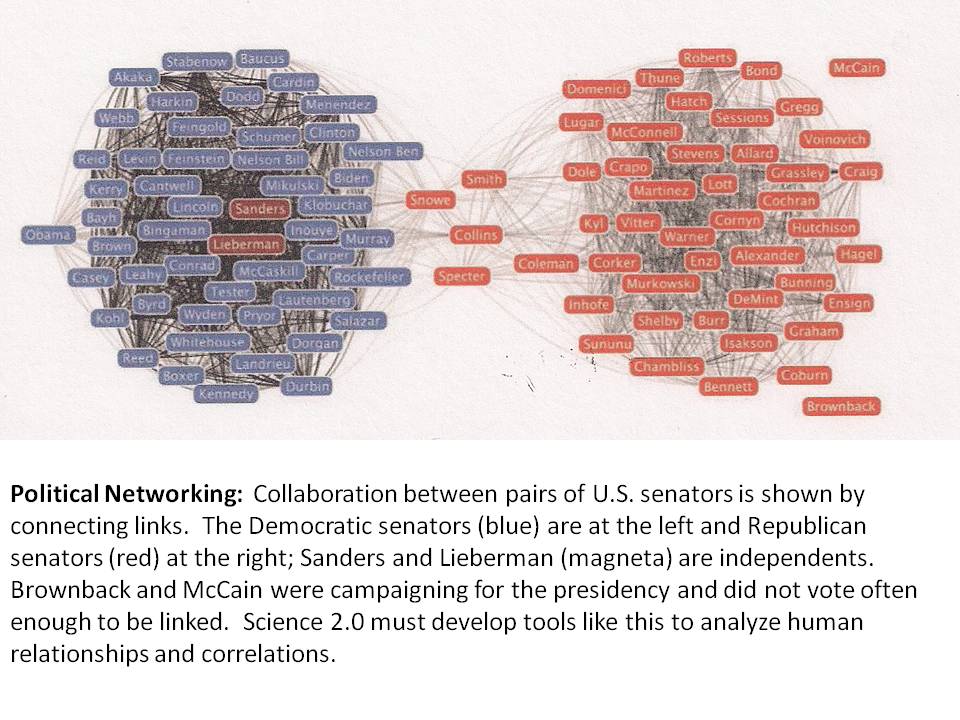
Phi Beta Iota: Eugene Garfield gave us citation analysis via the Institute for Scientific Information, and Dick Klavans and company have given us the (fragmented) web of knowledge. Top commercial intelligence practitioners have long known that published experts can lead to unpublished experts without which ground truth cannot be determined. If citations are the “things” that can be measured, “relationships” or “transactions” are the intangibles between the spaces, the Ying of the Yang. This article is important in part because it coincides with MajGen Robert Scales, USA (Ret) view that WWI was about chemistry, WWII was about physics, WWIII was about information, and WWIV is about human factors.





 Julia Moulden