Peter Drucker, the founder of the discipline of modern management, asserted that making knowledge workers productive was the key to economic survival for the developed economies. Though knowledge workers use their minds to make a living, are they ever taught to use their minds more effectively? This webinar discusses my decade-old mindfulness program at the Drucker School of Management designed to teach managers to manage themselves.
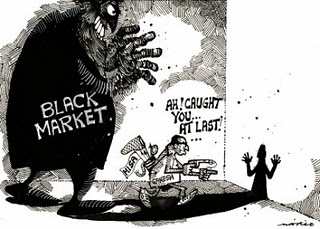
Forget China: the $10 trillion global black market is the world's fastest growing economy — and its future.
Robert Neuwirth
Foreign Policy, 28 October 2011
It wasn't a matter of technology. David is not an inventor or an engineer, and his insights into his country's electrical problems had nothing to do with fancy photovoltaics or turbines to harness the harmattan or any other alternative sources of energy. Instead, 7,000 miles from home, using a language he could hardly speak, he did what traders have always done: made a deal. He contracted with a Chinese firm near Guangzhou to produce small diesel-powered generators under his uncle's brand name, Aakoo, and shipped them home to Nigeria, where power is often scarce. David's deal, struck four years ago, was not massive — but it made a solid profit and put him on a strong footing for success as a transnational merchant. Like almost all the transactions between Nigerian traders and Chinese manufacturers, it was also sub rosa: under the radar, outside of the view or control of government, part of the unheralded alternative economic universe of System D.
Phi Beta Iota: The old estimate was $2 trillion a year, of which half went to bribes paid to government officials. To put this in a larger context, governments have failed to adapt and failed to represent the bulk of their populations — they have been captured at the upper levels by lobbyists, “experts” and the elite 1%, and at lower levels by common one to one bribes. Hence, in the new economy, the 99% are routing around government, and creating their own hybrid forms of governance, generally driven by information and reality instead of ideology and greed. It can be said that the illegal economy is more honest than the “legalized crime” economy.
Occupy Wall Street is an exceptional sociocultural hack. Grabbing eyes & hearts, they’re making it OK to protest again in America. After 911 the normative pressure around dissent & protest shifted, making it very un-American to disagree with and or show criticism of The U S of A. Occupy is quickly becoming view-fodder for the mainstream media. Spin it any way you like but OWS is grabbing the spotlight globally. Expect the election cycle to raise it as a common talking point – a good reason Occupy can safely find heat indoors for the Winter, come back swinging in Spring. This normative shift allows the many many folks who aren’t yet willing or simply can’t come sleep in the streets to be active & connected sympathizers helping spread the word, defend the narrative, and get downtown at 2am on a Thursday to stand against an expected police action. Social media invites participation at all scales.
The ultimate goal of the US is to take the resources of Africa and Middle East under military control to block economic growth in China and Russia, thus taking the whole of Eurasia under control, author and historian William F. Engdahl reveals.
The crisis with the US economy and the dollar system, the conduct of the US foreign policy is all a part of breakdown of the entire superpower structure that was built up after the end of WWII, claims Engdahl.
“Nobody in Washington wants to admit, just as nobody in Britain a hundred years ago wanted to admit that the British Empire was in terminal decline,” claims the author, noting that “All of this is related to the attempt to keep this sole superpower not only intact, but to spread its influence over the rest of the planet.”
William F. Engdahl believes the uprisings in the Middle East and North Africa is a plan first announced by George W. Bush at a G8 meeting in 2003 and it was called “The Greater Middle East Project”.
I have yet to see my nearest large occupation, Boston, or the precursor of all U.S. occupations, Wall Street. Instead, I have been on the road for the past six weeks in Thesselonika and Athens Greece; Istanbul and Diyarbikar Turkey; Lexington, Kentucky; London, England; Dublin, Ireland; and in Barcelona, Madrid, and Valencia Spain.
In all these places, I talked with diverse individuals at many meetings and popular assemblies. I met people involved in occupations, as well as audiences assembled by my hosts to hear about participatory economics. Beyond addressing assigned topics, my own priority was to learn about local movements. I repeatedly asked what folks struggling for many months wished to say to other folks first embarking on similar paths.
EXTRACT:
Another factor that was initially exciting but later became tedious, was seeking consensus. At first it was novel. It implied trust, which felt good. It implied shared intentions, which felt inspiring. But after awhile, seeking consensus became tortured, a time waster, and its reason for being the only decision making approach became steadily less compelling.
Much has been said about the Occupy movement's lack of demands and vision. Some say it will have no impact unless it makes demands and organizes to make sure those demands are met.
Others respond that the People should just take charge of their democracy rather than petitioning official powers-that-be to do this and that. Still others say that any list of demands – any effort to focus OWS more narrowly and explicitly – could weaken the movement because Occupy Together is a broadly inclusive initiative that's about (a)changing whole systems and/or (b)creating microcosms of a better society in the occupation zones and/or (c) stimulating transformational conversations out in society at large and/or (d) passionately building and forcefully demonstrating the Power of the People to resist illegitimate, corrupt authority.
Others note that the disturbing lack of demands spreads OWS' surprising impact through a “blank slate effect” – OWS becomes a mystery or a mirror into which diverse individuals and groups project their various desires, hopes, frustrations, and agendas. Furthermore, that mystery helps by enhancing the movement's uncommon anarchic power that makes it so hard for authorities and others to figure out how to control, undermine or use it. Others insist that a shared vision – articulating what the 99% actually want – would be much more powerful than focusing on a laundry list of demands that many 99%ers might well disagree with. Simultaneously, many Occupiers are chronically frustrated with all this talk and want Action!! Their more thoughtful colleagues reply that pulling so many diverse people together in consensus requires taking the time to hear each other and generate collective wisdom.
The 2012 election is now in play, and the Republican wing of the war party is gearing up to blame President Obama for America’s failed wars (who, while not entirely blameless, is hardly the architect of defeat) and the accompanying national humiliation. This email is about an opening shot that just appeared in the Weekly Standard.
One of my closest friends, retired Marine Colonel XXX, forwarded the attached analysis of the US defeat in Iraq. (I use the word ‘analysis’ charitably) It was written by Fred Kagan, his wife, and another person, neocons all. The Kagans are among one of America’s most vocal advocates preventative war, especially the invasion of Iraq, and were “architects” of the so-called “surge” (which is Versailles-speak for a relatively modest, time-consuming escalation, whereas in traditional military parlance, the word ‘surge’ implies a massive increase, like a doubling or tripling, of effort over a very short period of time).