Patrick Meier: Crisis Mapping Climate Change, Conflict, Aid in Africa

Advanced Cyber/IO, Blog Wisdom, Civil Society, Earth Intelligence, Geospatial, Peace Intelligence
Patrick Meier

Crisis Mapping Climate Change, Conflict and Aid in Africa

I recently gave a guest lecture at the University of Texas, Austin, and finally had the opportunity to catch up with my colleague Josh Busby who has been working on a promising crisis mapping project as part of the university’s Climate Change and African Political Stability Program (CCAPS).

Josh and team just released the pilot version of its dynamic mapping tool, which aims to provide the most comprehensive view yet of climate change and security in Africa. The platform, developed in partnership with AidData, enables users to “visualize data on climate change vulnerability, conflict, and aid, and to analyze how these issues intersect in Africa.” The tool is powered by ESRI technology and allows researchers as well as policymakers to “select and layer any combination of CCAPS data onto one map to assess how myriad climate change impacts and responses intersect. For example, mapping conflict data over climate vulnera-bility data can assess how local conflict patterns could exacerbate climate-induced insecurity in a region. It also shows how conflict dynamics are changing over time and space.”

The platform provides hyper-local data on climate change and aid-funded interventions, which can provide important insights on how development assistance might (or might not) be reducing vulnerability. For example, aid projects funded by 27 donors in Malawi (i.e., aid flows) can be layered on top of the climate change vulnerability data to “discern whether adaptation aid is effectively targeting the regions where climate change poses the most significant risk to the sustainable development and political stability of a country.”

If this weren’t impressive enough, I was positively amazed when I learned from Josh and team that the conflict data they’re using, the Armed Conflict Location Event Data (ACLED), will be updated on a weekly basis as part of this project, which is absolutely stunning. Back in the day, ACLED was specifically coding historical data. A few years ago they closed the gap by updating some conflict data on a yearly basis. Now the temporal lag will just be one week. Note that the mapping tool already draws on the Social Conflict in Africa Database (SCAD).

This project is an important contribution to the field of crisis mapping and I look forward to following CCAPS’s progress closely over the next few months. I’m hoping that Josh will present this project at the 2012 International Crisis Mappers Conference (ICCM 2012) later this year.

Phi Beta Iota:  Now imagine a global database on corruption that is updated daily and then hourly, anonymously sourced as needed, calling out corrupt officials by name, date, time, and place.
Eagle: Drums of War — Israel-Iran AND US-Uganda

Commercial Intelligence, Corruption, Government, Military, Peace Intelligence
300 Million Talons...

Brent At $126 As Israel Security Cabinet Votes 8 To 6 To Attack Iran

According to Israel's NRG, in a just completed cabinet vote, for the first time Netanyahu has gotten a majority (8 over 6) supporting an Iran attack. NRG also notes that at this point Israel has decided to not wait until the US elections in November before proceeding with sending crude to the stratosphere. From NRG (google translated): “Israeli political sources believe that Prime Minister Benjamin Netanyahu a majority Cabinet support Israeli military action against Iran without American approval….He announced that he would not hesitate to perform the operation without the approval of President Obama mentioned the precedent of the decision to attack the Iraqi reactor, Prime Minister Menachem Begin, and with the comments heard yesterday some cabinet ministers say privately that “It sounds like a speech preparation for attack.

US Launches PR Campaign for Ugandan Oil Intervention

Phi Beta Iota:  Oil and Oil Futures are the common denominator; Israeli aggression in expanding the settlements while everyone is watching Iran are the very important sideshow.  It is a real shame when the public cannot trust its government to know the truth, much less tell the truth.  This is about bets on oil futures.  Can the US Government determine who gains from oil going up another $20 a barrel in March?   Can the public do this on its own?

Chuck Spinney: Investigating NATO’s War Crimes Against Libya

02 China, 04 Inter-State Conflict, 05 Civil War, 06 Russia, 07 Other Atrocities, 08 Wild Cards, 09 Justice, 10 Security, 11 Society, DoD, Government, Law Enforcement, Military, Non-Governmental, Officers Call, Peace Intelligence
Chuck Spinney

Investigations Around Libya

NATO’S Craven Coverup of Its Libyan Bombing

by VIJAY PRASHAD, Counterpunch, March 15, 2012

Ten days into the uprising in Benghazi, Libya, the United Nations’ Human Rights Council established the International Commission of Inquiry on Libya. The purpose of the Commission was to “investigate all alleged violations of international human rights law in Libya.” The broad agenda was to establish the facts of the violations and crimes and to take such actions as to hold the identified perpetrators accountable. On June 15, the Commission presented its first report to the Council. This report was provisional, since the conflict was still ongoing and access to the country was minimal. The June report was no more conclusive than the work of the human rights non-governmental organizations (such as Amnesty International and Human Rights Watch). In some instances, the work of investigators for these NGOs (such as Donatella Rovera of Amnesty) was of higher quality than that of the Commission.

Due to the uncompleted war and then the unsettled security state in the country in its aftermath, the Commission did not return to the field till October 2011, and did not begin any real investigation before December 2011. On March 2, 2012, the Commission finally produced a two hundred-page document that was presented to the Human Rights Council in Geneva. Little fanfare greeted this report’s publication, and the HRC’s deliberation on it was equally restrained.

Nonetheless, the report is fairly revelatory, making two important points:

Continue reading “Chuck Spinney: Investigating NATO's War Crimes Against Libya”

Venessa Miemis: Social Media and the Evolution of Consciousness

Cultural Intelligence

This is my favorite talk I’ve given so far. No notes, no real prep… just sharing my views about the web, the co-evolution of humanity and our technologies, and where we might be taking ourselves.

“Fall Conference 2011 Introduction and Social Media and the Evolution of Consciousness, Presented on 10/15/11, Venessa Miemis

Venessa Miemis is a writer and digital ethnographer, exploring how social media is transforming communication, collaboration, and commerce in a network society. She is currently Executive Director for Contact, a participatory festival that highlights opportunities for new forms of p2p culture, governance, and collective action. Her recent projects include The Future of Facebook, a 6 part video series, and Open Foresight, a methodology for engaging experts and the public to create collaborative visions of the future together. She authors the blog, Emergent by Design.”

@ Austen Riggs Social Media Conference

Berto Jongman: Humanitarian Aid & Forgotten Conflicts

04 Inter-State Conflict, 05 Civil War, 06 Genocide, 07 Other Atrocities, 08 Wild Cards, Budgets & Funding, Civil Society, Cultural Intelligence, IO Deeds of Peace, Non-Governmental, Peace Intelligence, Policies
Berto Jongman

Some important connections drawn between aid, corruption, and positive change; and also important omissions — conflicts out of the news where paying attention could make a difference.

Singling Out Forgotten Conflicts

The ISN Blog, 15 March 2012

A popular method for identifying which conflicts necessitate more attention from the international community is to estimate the difference between supply and demand of humanitarian assistance in these conflicts. Supply and demand, however, are very hard to measure in emergencies. This has led to the development of several indicators used to measure ‘forgotten conflicts’.

These indicators are often applied on an annual basis and are intended to generate media attention (to increase donations) and/or support donor operations (to comply with impartiality). Have these efforts been successful? Have they effectively singled out and buttressed forgotten conflicts? Looking back on the past decade, in this blog post I’ll assess which conflicts received the least (and most) attention from international actors.

Continue reading “Berto Jongman: Humanitarian Aid & Forgotten Conflicts”

Event: 20 Mar 1200-1330 Religion, Terror, and Error – U.S. Foreign Policy and the Challenge of Spiritual Engagement, by Dr. Douglas M. Johnston

Cultural Intelligence, Peace Intelligence

Religion, Terror, and Error: U.S. Foreign Policy and the Challenge of Spiritual Engagement, by Dr. Douglas M. Johnston, president and founder, International Center for Religion and Diplomacy

Date & Time:
Tuesday, March 20th, 2012
12:00 – 1:30 p.m.

How should the United States deal with the jihadist challenge and other religious imperatives that permeate today's geopolitical landscape? Religion, Terror, and Error: U.S. Foreign Policy and the Challenge of Spiritual Engagement argues that what is required is a longer‐term strategy of cultural engagement, backed by a deeper understanding of how others view the world and what important to them. The means by which that can be accomplished are the subject of this book.

This work achieves three important goals. It shows how religious considerations can be incorporated into the practice of U.S. foreign policy; offers a successor to the rational‐actor model of decision‐making that has heretofore excluded “irrational” factors like religion; and suggests a new paradigm for U.S. leadership in anticipation of tomorrow's multipolar world. In describing how the United States should realign itself to deal more effectively with the causal factors underlying religious extremism, this innovative treatise explains how existing capabilities can be redirected to respond to the challenge and identifies additional capabilities that will be needed to complete the task.

Continue reading “Event: 20 Mar 1200-1330 Religion, Terror, and Error – U.S. Foreign Policy and the Challenge of Spiritual Engagement, by Dr. Douglas M. Johnston”

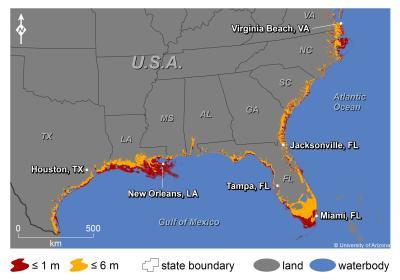
Reference: Flooding of the USA Coasts — Where, When?

03 Environmental Degradation, Articles & Chapters, Earth Intelligence, IO Impotency
Click on Image to Enlarge

2012 Rising Sea Levels Seen as Threat to Coastal U.S. (New York Times, 13 March 2012)

About 3.7 million Americans live within a few feet of high tide and risk being hit by more frequent coastal flooding in coming decades because of the sea level rise caused by global warming, according to new research.

By far the most vulnerable state is Florida, the new analysis found, with roughly half of the nation’s at-risk population living near the coast on the porous, low-lying limestone shelf that constitutes much of that state. But Louisiana, California, New York and New Jersey are also particularly vulnerable, researchers found, and virtually the entire American coastline is at some degree of risk.

Click on Image to Enlarge

2011 Rising Seas Will Affect Major US Coastal Cities by 2100, New Research Finds

2007 Nation Under Siege: Sea Level Rise at Our Doorstep [2030 Impact Study Best Use of Google in Color to Depict 1 Meter, 3 Meter, and 5 Meter Rise in Sea Level]

2003 (est) Does Sea Level Rise Matter to Transportation Along the Atlantic Coast?

2000  Maps of Lands Vulnerable to Sea Level Rise Modeled [Best for close-up vulnerability maps]

1989 The Effects of Sea Leavel Rise on U.S. Coastal Wetlands

Phi Beta Iota:  There are multiple bottom lines on this continuing saga.

Continue reading “Reference: Flooding of the USA Coasts — Where, When?”

noble gold