Journal: Yemen and the “Great Game”

02 China, 03 India, 05 Iran, 08 Wild Cards, 10 Security, Communities of Practice, Ethics, Peace Intelligence, Threats
Chuck Spinney

The real motives behind the increasing US involvement in Yemen are obscure, to put it charitably. M.K. Bhadrakuma, retired Indian diplomat, presents a complex and fascinating — and no doubt controversial — hypothesis in this regard. Bhadrakuma, a prolific writer, is an astute observer of the Central and South Asia, and judged by his writings, he is by no means a toady of the Indian government.

Chuck

UPDATED to add critique of the below article by a colleague of Chuck Spinney's (below the fold).

Full Story Online

Obama's Yemeni odyssey targets China

By M K Bhadrakumar     Asia Times    9 January 2010

It's all about China
Most important, however, for US global strategies will be the massive gain of control of the port of Aden in Yemen. Britain can vouchsafe that Aden is the gateway to Asia. Control of Aden and the Malacca Strait will put the US in an unassailable position in the “great game” of the Indian Ocean. The sea lanes of the Indian Ocean are literally the jugular veins of China's economy. By controlling them, Washington sends a strong message to Beijing that any notions by the latter that the US is a declining power in Asia would be nothing more than an extravagant indulgence in fantasy.
Continue reading “Journal: Yemen and the “Great Game””

Reference: Intelligence-Led Peacekeeping

Analysis, Budgets & Funding, Collective Intelligence, Communities of Practice, DoD, Earth Intelligence, Ethics, Geospatial, InfoOps (IO), Key Players, Methods & Process, Peace Intelligence, Policies, Policy, Real Time, Reform, Strategy, Threats, United Nations & NGOs
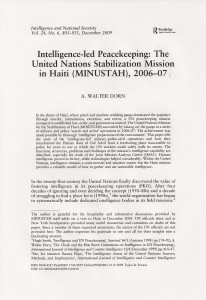
Dorn on UN PKI Haiti FINAL

Professor Walter Dorn is the virtual Dean of peacekeeping intelligence scholarship, going back to the Congo in the 1960's when Swedish SIGINT personnel spoke Swahli fluently and the UN stunned the belligerents with knowledge so-gained.  This is the final published version of the article posted earlier in author's final draft.

The UN is now ready for a serious discussion about a United Nations Open-Source Decision-Support Information Network (UNODIN) but a Member nation must bring it up, as the Secretary General has kindly informed us in correspondence.

In the absence of US interest, we are asking Brazil, China, and India to bring it up.  Should a UNODIN working group be formed, it will certainly include African Union (AU), Union of South American Nations (UNASUR), and Shanghai Cooperation Organization (SCO) counterpart groups, as the regional networks will do the heavy lifting and be the super-hubs for the UN (this is in contrast to a US DoD-based system in which military-to-military hubs would be established to do two-way reachback among the eight tribes in the respective nations).  Both concepts are explored in the new book, INTELLIGENCE FOR EARTH and in two DoD briefings that are also relevant to the QDR.

For Sale: The Original True Cost T-Shirt

03 Economy, Civil Society, Collective Intelligence, Commerce, Commercial Intelligence

Home Page for True Cost T-Shirt

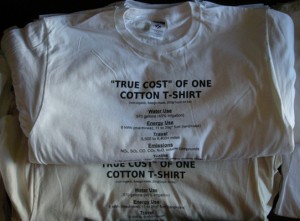
For the past year the Executive Director of Earth Intelligence Network, “JZ” Jason Liszkiewicz has been pursuing a self-designed project to understand, deeply and in detail, the “true cost” of a plain cotton t-shirt.  Click on either photo to read all about it and if you wish, to order one of these examples of citizen intelligence in action.

True Cost T-Shirt Home Page

Journal: Comment on DIA Potential

Ethics, Key Players, Methods & Process, Military, Mobile, Officers Call, Peace Intelligence, Policies, Real Time, Reform, Strategy, Threats
Richard Wright

The QDR slides got me thinking about the fact that DIA could be a really first rate intelligence agency and an effective counter to ODNI and CIA for the SecDef, JCS, and the military services, especially field commanders.

Although badly executed, DIA has two vitally important missions: support to military operations; and support to military strategy formulation. Unfortunately, DIA has always suffered from unimaginative senior leadership and the worst form of military thinking whereby rank trumps truth and an incompetent major trumps a competent lieutenant.

If DIA is going to achieve its potential and rally to provide the best intelligence possible to the SecDef, JCS, and service field commanders it needs to break free from the military hierarchical thinking and its influences on intelligence judgments.

In point of fact DIA has and has always had an excellent group of military and civilian analysts working there although there is a constant churn due to service requirements and limited prospects for civilians.

So what does DIA need? It needs an influx of original (out of the box) strategists who can visualize and articulate the multi-level threats to U.S. National Security, who understand the phenomenon of globalization and its effect on DOD strategic thinking, and can effectively relate such 21st Century phenomenon as trans-national asymmetric warfare to U.S. force and command structures.

Perhaps most importantly, DIA needs to build a capability to exploit the fact that increasing amounts of information relative to DOD concerns that are actually available from open sources. At the same time DIA needs to introduce much more effective information management systems to support its intelligence production.

Phi Beta Iota: This  comment is repeated from the QDR OSINT thread.  We've been saying this for 21 years.  Perhaps we should have shouted.   The two DoD OSINT briefings and the future of OSINT material are now circulating among presidential staffs of a handful of other countries.  They get it, we don't.  How sad is that?

Reference: UN Checklist for Small Arms

04 Inter-State Conflict, 05 Civil War, 10 Security, Key Players, Non-Governmental, Peace Intelligence
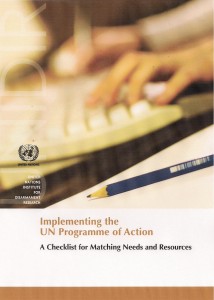
UN Small Arms Checklist

UNIDIR (United Nations Institute for Disarmament Research) has produced a superb checklist approach to the mission of reducing the proliferation of small arms, which kill and maim and orphan tens of millions at a time.  The Director of UNIDIR at the time, Dr. Patricia Lewis, was the first UN official in modern times to contemplate the need for a UN-sponosred World Brain.  2003 Lewis (UNIDIR) Creating the Global Brain: The United Nations.

Continue reading “Reference: UN Checklist for Small Arms”

Journal: MILNET Headlines

Peace Intelligence

Interview With Admiral Mullen by Fareed Zakaria, CNN   Transcript and YouTube

Interview with General Patraeus by Christine Amanpour, CNN  Story

There's ‘Work To Be Done,' 9/11 Commission Chairs Say (Lee Hamilton, Thomas Kean)

The war of new words: Why military history trumps buzzwords (Willam F. Own)

Let's Take Bureaucracy Out Of Intelligence (John Bolton)

Beating the Dead Terrorist Horse (Victor Davis Hanson)

Continue reading “Journal: MILNET Headlines”

Worth a Look: Open Design

Collaboration Zones, Methods & Process, Mobile, Policies, Real Time, True Cost, Worth A Look

Wikipedia Page

Open design is the development of physical products, machines and systems through use of publicly shared design information. The process is generally facilitated by the Internet and often performed without monetary compensation. The goals and philosophy are identical to open source, but reside in a different paradigm.

Phi Beta Iota: The emergent Open Design community is a bit too focused on products, i.e. open source hardware.  Open Design can and should apply to all processes, all services, all products.  Unlike the assembly line focus on the Industrial Era, Open Design would integrate 360 degree cultural values (e.g. organic food to slow food to food-based dialog) and fully integrate the humanities with the mechanics to achieve Consilience.