Josh Kilbourn: Endgame – 2012 Forecast [W.E. Pollock]

01 Agriculture, 03 Economy, 07 Health, 09 Justice, 10 Security, 11 Society, 12 Water, Analysis, Budgets & Funding, Civil Society, Commerce, Corporations, Corruption, Cultural Intelligence, General Accountability Office, Government, IO Deeds of War, Money, Banks & Concentrated Wealth, Office of Management and Budget, Power Behind-the-Scenes/Special Interests, Threats, Waste (materials, food, etc)

We are going to move from denial to realization.  Physical world events will drive the process of realization. The primary trend is between stability and instability. We are moving from a multi-class system running from Super Elite to Unperson into a model of have's and have-nots, the unpersons. Labor has become a problem because less than 500 million are involved in life support activities thereby leaving more than 7 billion people very vulnerable to dependency (and treated as expendable containers). We are watching a redistribution process bound towards divestiture as more people become unpersons. Destruction of paper assets, debt collapse, bank failure, and war are all part of the redistribution process. With more unpeople, it becomes easier to reduce population through death and abuse. Our current economic structure has at least six trajectories of support; the physical world, human capital, transportation, technology, rule of law,and money.

Fukishima, Katrina, Gulf of Mexico oil spill — all examples of entire populations treated as “unpersons.”

See Also:

VIDEO: Fukushima – Total Cost (33)

W. E. Pollock Web Site

John Bogle: ENOUGH – Speculation Bad Investment Good

03 Economy, 07 Other Atrocities, 09 Justice, 10 Transnational Crime, Civil Society, Commerce, Commercial Intelligence, Corporations, Corruption, Government, Money, Banks & Concentrated Wealth, Power Behind-the-Scenes/Special Interests

MARK JEWELL

Associated Press, 22 December 2011

EXTRACTS:

Bogle says he's paying close attention to tax policies he considers unfair, including one that's favorable to the fund industry and investors with taxable accounts. The top rate for dividends and long-term capital gains is historically low at 15 percent, as a result of the extension of Bush era tax cuts that Congress and President Barack Obama agreed to a year ago. In contrast, top earners pay 35 percent on regular income. He doesn't like that disparity.

. . . . . . .

As for capital gains, there ought to be some distinction between capital made by people who start businesses, and contribute value to society, and capital made by gamblers on Wall Street, some of whom win. Earned capital income should carry the regular dividend rate, but capital income gains by trading, and particularly short-term trading, should pay a higher tax, even than the present ordinary income rate.

. . . . . . .

Q: What's your take on the Occupy movement?

A: I'm happy to say that my current income puts me in the 99 percent group. So maybe I'm not so happy, I don't know.

This movement has brought to the surface some very serious problems in our country about disparities in opportunity and income. So many young people are having a terrible time getting a job.

Young people have great idealism, and the Occupy movement has been a bit unrealistic at times. So what? I can't imagine a worse America if our younger generation didn't have great idealism. I salute them for their enthusiasm, and their mission.

The negative side is that they just pushed too hard for too long. It's very difficult for any movement without any seeming leadership — other than a good idea — to have any sense of taste or judgment. Who's to say, ‘This is going too far'? In some places, it's just gone on too long, and it's been too disruptive. So I think it's good that we've been cleaning up the plazas where the Occupy movement set up.

Read full interview.

See Also (Steele Reviews in Each Case):

John Bogle, The Battle for the Soul of Capitalism

William Greider, The Soul of Capitalism: Opening Paths to a Moral Economy

Matt Taibbi, Griftopia: A Story of Bankers, Politicians, and the Most Audacious Power Grab in American History

Marcus Aurelius: Hackers to Attack Feds Over Manning?

07 Other Atrocities, 09 Justice, 11 Society, Civil Society, Cultural Intelligence, DoD, Government, Law Enforcement, Media
Marcus Aurelius

Feds involved in Manning prosecution enter hackers' crosshairs

By Aliya Sternstein

NextGov, 12/20/2011

A government-hired forensics specialist and an Army investigating officer could face online backlash from WikiLeaks supporters who are unhappy with this week's prosecution of a U.S. soldier accused of releasing confidential government files to the anti-secrets website, a computer engineer affiliated with hacktivist group Anonymous said.

Read full article.

Continue reading “Marcus Aurelius: Hackers to Attack Feds Over Manning?”

John Steiner: Who Is the Government “For”?

03 Economy, 09 Justice, 11 Society, Civil Society, Commerce, Commercial Intelligence, Corruption, Cultural Intelligence, Government
John Steiner

The Defining Issue: Not Government's Size, But Who It's For

Robert Reich

Huffington Post, 19 December 2011

The defining political issue of 2012 won't be the government's size. It will be who government is for.

Americans have never much liked government. After all, the nation was conceived in a revolution against government.

But the surge of cynicism now engulfing America isn't about government's size. It's the growing perception that government isn't working for average people. It's for big business, Wall Street, and the very rich instead.

In a recent Pew Foundation poll, 77 percent of respondents said too much power is in the hands of a few rich people and corporations.

Read rest of article.

Michael Ostrolenk: Should Corporations Have People Rights?

03 Economy, 07 Other Atrocities, 09 Justice, 10 Transnational Crime, 11 Society, Civil Society, Commerce, Commercial Intelligence, Corruption, Counter-Oppression/Counter-Dictatorship Practices, Government, IO Deeds of War, Law Enforcement
Michael Ostrolenk

Corporations are artificial creations of the state and receive special protections from the state. Thus, claims attorney and author Jeff Clements, corporations should not have the same Constitutional rights as individuals even though some argue that they are simply organized associations of individuals.

In this interview with Michael Ostrolenk, Mr. Clements outlines his belief that many of the abuses of crony capitalism are allowed by corporations exploiting these illegitimate “rights.”

He also exposes how tobacco industry attorney turned Supreme Court Justice, Lewis Powell, helped to spearhead the creation of a constitutional right to corporate “speech” which was recently strengthened by theCitizens United decision.  Read more about this issue (and buy his new book Corporations Are Not People) at Mr. Clement’s website.

Listen to Interview

Chuck Spinney: Democracy & Truth or Tyranny & Lies?

04 Inter-State Conflict, 07 Other Atrocities, 08 Wild Cards, 10 Security, 11 Society, Civil Society, Corruption, Cultural Intelligence, DoD, Gift Intelligence, Government, IO Deeds of War, Military, Officers Call
Chuck Spinney

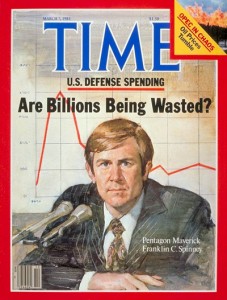
My close friend Mike Lofgren writes an important essay describing the nature of ‘truth' in the Orwellian echo chamber that is closing the American mind in the 21st Century.

Chuck Spinney
The Blaster

DECEMBER 20, 2011
by MIKE LOFGREN, Counterpunch

According to the Congressional Research Service, the United States has appropriated $806 billion for the direct cost of invading and occupying Iraq. Including debt service since 2003, that sum rises to approximately $1 trillion. The White House estimates the number of U.S. military wounded at 30,000; the web site icasualties.org states that U.S. military fatalities from the Iraq war now stand at 4484. It is impossible to estimate precisely the numbers of Iraqi civilian deaths, but they are frequently cited as being in excess of 100,000. There are now around two million internally displaced Iraqis in a country of 30 million inhabitants. As United States armed forces (but not up to 17,000 State Department employees, contractors and mercenaries) leave the country, Iraq is plunging into a sectarian and ethnically-fueled political crisis. Even if it survives that crisis and remains a unitary state, it will almost certainly be pulled closer to the orbit of Iran, our bogeyman du jour.

In view of the crippling costs both human and financial as well as the strategic and moral disaster the invasion of Iraq precipitated, what sort of verdict do you think our leaders – leaders representing a presidential administration ostensibly opposed to the invasion and promising hope and change – bother to offer us? While junketing in Turkey on December 17, Secretary of Defense Leon Panetta told the press the following:

“As difficult as [the Iraq war] was, I think the price has been worth it, to establish a stable government in a very important region of the world.”

One’s only reaction to this statement is to blink in disbelief and wonder: is Panetta that stupid, or does he think that we, the supposedly self-governing citizens of this country, are that stupid?

Read rest of article.

Jon Lebkowsky: Adriana Lukas – how to avoid hierarchies – the five laws of heterarchy

11 Society, Blog Wisdom, Civil Society, Cultural Intelligence
Jon Lebkowsky

Adriana discusses her thinking about heterarchy, including initial thoughts about five laws of heterarchy.

A heterarchy is a system of organization replete with overlap, multiplicity, mixed ascendancy, and/or divergent-but-coexistent patterns of relation. Definitions of the term vary among the disciplines: in social and information sciences, heterarchies are networks of elements in which each element shares the same “horizontal” position of power and authority, each playing a theoretically equal role.

“Hierarchies seem to be like oxygen: they’re all around us, pervasive, visible only to those who study them. Hierarchies are the most efficient system for management and distribution of scarce resources… given that the physical world is defined by scarcity of all sorts, it goes a long way toward explaining hierarchy as our default organizational structure….There is potential to come up with alternatives to our hierarchical organizational defaults, and I think that would be good news for all those trapped in stifling and disempowering organizations.”