Below is a brilliant synopsis of America's defeat in Iraq. The author Patrick Seale, whom I had the pleasure of meeting last summer, is one of the leading authorities on the Middle East. Seale lays out the costs incurred and the unintended grand-strategic consequences of the US invasion of Iraq, and he reminds of us of its fraudulent origins. Contrast Seale's analysis with the self-serving pap peddled by Fredrick Kagan et al. in Weekly Standard that caused Col. XXX to do his atomic puke (distributed in my previous blaster).
The most disturbing point made by Seale, at least to me, is his observation that the people and politics of the United States show no signs of wanting to determine who is responsible for the Iraq catastrophe or to hold them to account. Without accountability and punitive as well as corrective action, the very idea of a representative republic becomes a sham, and the Constitution becomes a sick joke. Given the escalating danger in the Middle East, not mention our dangerous economic times, the absence of any self-correcting mechanism in the political OODA loops of people or government in the United States is a scary thing indeed, not only to the United States but also for the entire world — think of US politics as no-nothingism with nukes.
Can America chance course? Nothing is less likely. It is widely predicted that if the Republican Mitt Romney wins the White House, the pro-Israeli neocons will be back in power in Washington. Their target this time will be Iran.
Phi Beta Iota: A superb article that names names. It is very likely that Occupy Wall Street is going to blow its one chance to demand an Electoral Reform Act of 2012, and that the next “president” will again be a puppet to Israel, extremist influences, and Wall Street. Romney is a suit – a corrupt suit. Obama is the same. The US Government no longer represents the US public, but Occupy Wall Street is so busy doing intense kum-ba-ya they are ignoring the one thing everyone can agree on: it's time to dump the two-party tyranny in the toilet and reset US democracy with open ballot access and the other nine elements of the Electoral Reform Act of 2012.
Occupy Wall Street is an exceptional sociocultural hack. Grabbing eyes & hearts, they’re making it OK to protest again in America. After 911 the normative pressure around dissent & protest shifted, making it very un-American to disagree with and or show criticism of The U S of A. Occupy is quickly becoming view-fodder for the mainstream media. Spin it any way you like but OWS is grabbing the spotlight globally. Expect the election cycle to raise it as a common talking point – a good reason Occupy can safely find heat indoors for the Winter, come back swinging in Spring. This normative shift allows the many many folks who aren’t yet willing or simply can’t come sleep in the streets to be active & connected sympathizers helping spread the word, defend the narrative, and get downtown at 2am on a Thursday to stand against an expected police action. Social media invites participation at all scales.
Much has been said about the Occupy movement's lack of demands and vision. Some say it will have no impact unless it makes demands and organizes to make sure those demands are met.
Others respond that the People should just take charge of their democracy rather than petitioning official powers-that-be to do this and that. Still others say that any list of demands – any effort to focus OWS more narrowly and explicitly – could weaken the movement because Occupy Together is a broadly inclusive initiative that's about (a)changing whole systems and/or (b)creating microcosms of a better society in the occupation zones and/or (c) stimulating transformational conversations out in society at large and/or (d) passionately building and forcefully demonstrating the Power of the People to resist illegitimate, corrupt authority.
Others note that the disturbing lack of demands spreads OWS' surprising impact through a “blank slate effect” – OWS becomes a mystery or a mirror into which diverse individuals and groups project their various desires, hopes, frustrations, and agendas. Furthermore, that mystery helps by enhancing the movement's uncommon anarchic power that makes it so hard for authorities and others to figure out how to control, undermine or use it. Others insist that a shared vision – articulating what the 99% actually want – would be much more powerful than focusing on a laundry list of demands that many 99%ers might well disagree with. Simultaneously, many Occupiers are chronically frustrated with all this talk and want Action!! Their more thoughtful colleagues reply that pulling so many diverse people together in consensus requires taking the time to hear each other and generate collective wisdom.
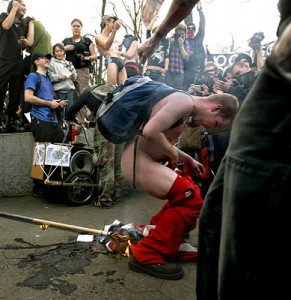
What a stark difference from the Tea Party movement. Patriots holding American flags have orderly events with poignant messages about liberty and freedom and then leave in an orderly fashion. Contrast that with the Occupy Wall Street miscreants! Arrests, rapes, flag burnings, pro-communist chanting, garbage, incessant drumming, filth, profanity and lots and lots of losers who still don’t really know why they’re there!
Phi Beta Iota: We find this upsetting and disgusting. Mindful of the protection of free speech, and mindful of the deep legitimate grievances that most (99%) of US citizens and even global citizens have against what the US Government has done in our name, the flag does not represent the US Government, it represents We the People. Occupy Wall Street (OWS) is a mix of four parts: anarchists and undercover provocateurs; local only; alternative direct democracy; and electoral reform act and other tangible change agents seeking a national unity approach. OWS is already facing twin challenges from police departments over-funded by the Department of Homeland Security (using borrowed money), and a massive corporately-funded disinformation campaign seeking to cast them as irresponsible and even dangerous. As a movement, we find OWS to be as responsible as it is possible to get–they have the intelligence and the integrity that the US Government lacks. However, they have not learned the art of counter-intelligence and internal security, and will continue to suffer from this kind of gratuitous and totally uncalled for stomach-turning crap (pun intended).
Below is an excellent interview with Anthony DiMaggio in Counterpunch. DiMaggio author ofThe Rise of the Tea Party, due out in November 2011. He uses the “propaganda model” developed by Noam Chomsky and Edward Herman in their bookManufacturing Consent to document and explain the Tea Party’s organizational dynamics for manufacturing dissent, and he compares these dynamics to those of the Occupy Wall Street movement.
Before reading the interview, consider please the following: The forces powering the rage of the Tea Party — the stagnation of incomes and the increasingly unequal distribution of income — were around long before the Tea Party erupted on the national scene.
Click on Image to Enlarge
That the distribution of income had shifted in a very fundamental way toward the wealthy and especially the super-wealthy at the expense of the bottom 80% of the working population was clearly demonstrated in a classic study by Emanuel Saez and Thomas Piketty (Quarterly Journal of Economics, February 2003, updated in 2009), and subsequently confirmed by many other others, including just last week, on 25 October 2011, by the Congressional Budget Office.
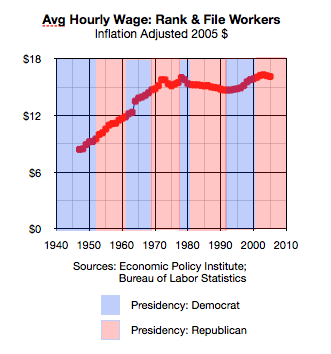
It has also clear for years that inflation-adjusted wage growth that underpinned the improved living standards of great American dream machine sputtered out during the 1970s (see chart below).
So, it is simply beyond dispute that a fundamental change in the income distribution has taken place since the late late 1970s. That change is also correlated with the wave of deregulation, tax cutting, defense spending increases (with a slight interregnum following the Soviet Union’s collapse), and deindustrialization/globalization that took off after 1980 during the Reagan Administration and accelerated during the Clinton and Bush II Administrations.
Phi Beta Iota: Keep an open mind. This is deeply serious and directly relevant to understanding the convergence of the honest right, the honest left, and OccupyWallStreet.
What Lenin meant to convey was that the Soviets were not the ordinary class organisation, whose purpose, according to the Mensheviks and Social-Revolutionists, was to fight only for the economic demands of the working class within the framework of bourgeois society. In his opinion such Soviets would be doomed in advance. In fact, no Soviets were needed for such a purpose. In his view, the Soviets were organisations for the seizure of state power, and for transforming the workers into the ruling class. That is why he again and again told the Petrograd workers in the course of 1916: ‘Ask yourselves a thousand times whether you are prepared, whether you are strong enough; measure your cloth nine times before you cut. To organise Soviets means to declare a war to a finish, to declare civil war upon the bourgeoisie, to begin the proletarian revolution.’
The OWS formations carry such potential, albeit (likewise) in an embryonic state. Their internal democratic structures are the key to this, and that is the part that should be replicated. As assemblies of people are constituted among more and more communities (and the accomplishment of this is extremely important to insuring that the internal democracy of each group is replicated in the aggregation of all such groups, in whatever form that ultimately takes, should it develop that far), both the possibility of coordinate mass action and the potentiality of an alternative political structure that represents all segments of the population emerges. The lesson from Lenin as applied to OWS is to recognize both the positive and negative potential that it represents and to both engage it and shape it to fit the needs of all communities. In the United States in particular, given the historically dominant role of racism in the social order, that means ensuring that the construct that is springing into existence before our eyes is made to become responsive to the direction of the traditionally oppressed communities, particularly communities of color.
Assuming that the most important task is to address the racist nature of this society and to prevent this from being replicated in whatever emerges from the present activities, it would seem that, as the best defense is a good offense, the oppressed communities here (and elsewhere, as this is becoming a global phenomenon) must organize as never before, and in a way that is compatible – in form and substance – with the present model, and which will thus insure that the voices and self-determined interests of these communities will find full expression.
More from Dan DeBar: My thinking on this is not fully developed, but, if you can spare 58 minutes and suffer some of the fits-and-starts of my thought process in the process, I did go into some depth in this video – – which starts off a bit slow, but eventually gets across a good picture of my thinking on the matter. As I felt I got deflected somewhat by the host from my main point – that of the centrality of the issue of racism to any solution of the problems being articulated by, or serving as the catalyst for, the OWS “movement” – I fleshed that out a bit more in this video.
Below is the proposal passed by the Occupy Oakland General Assembly on Wednesday October 26, 2011 in reclaimed Oscar Grant Plaza. 1607 people voted. 1484 voted in favor of the resolution, 77 abstained and 46 voted against it, passing the proposal at 96.9%. The General Assembly operates on a modified consensus process that passes proposals with 90% in favor and with abstaining votes removed from the final count.
Phi Beta Iota: The Oakland Occupy General Assembly is certainly within its rights to declare a General Strike, but there is a very clear line between a non-violent voluntary General Strike and a punitive attack on main street business. The entire matter of how best to conduct a General Strike that immobilizes politicians and banks while bringing business to small and main street businesses is one meriting deliberation.