Reference (2003): Augmented Social Network

Advanced Cyber/IO, Augmented Reality, Civil Society, Collective Intelligence, Cultural Intelligence, Ethics, InfoOps (IO), IO Mapping, Methods & Process, Policies, Reform, Serious Games, Standards, Threats, White Papers
Venessa Miemis

NEW: Archived & Expanded at P2P Foundation/ASN

this paper covers a lot of the ground we've been discussing here [at Google Group Next Net] about what kind of intentions a ‘next net' would facilitate. worth a read.

Augmented Social Network: Building Identity and Trust into the Next-General Internet by Ken Jordan, Jan Hauser, Steven Foster

as presented at the Planetwork conference on “Networking a Sustainable Future” in San Francisco on June 6, 2003

as published First Monday, Volume 8, Number 8 – 4 August 2003

Phi Beta Iota: The current approaches to “identity” are vestiges of the industrial-era commoditization of humans and the fragmentation of the commons.  In the 1990's the Hackers Conference (Silicon Valley) discussed trust and identity authentication in combination with anonymnity (or better, invisibility).

Massimo Pigliucci on Ignorance Today

04 Education, 11 Society, Civil Society, Cultural Intelligence, IO Sense-Making
Who, Me?

Ignorance Today

Massimo Pigliucci

2011-04-22

NEW YORK – Ignorance is the root of all evil, according to Plato, who also famously gave us a still-current definition of its opposite: knowledge. For Plato, knowledge is “justified true belief.” That definition is worthy of consideration as we reflect on the perils of ignorance in the twenty-first century.

Plato thought that three conditions must be met in order for us to “know” something: the notion in question must actually be true; we must believe it (because if we do not believe something that is true, we can hardly claim that we know it); and, most subtly, it must be justifiable – there must be reasons why we believe the notion to be true.

Consider something that we all think we know: the earth is (approximately) round. This is as true as astronomical facts get, particularly because we have sent artificial satellites into orbit and seen that our planet is indeed roundish. Most of us (except for a lunatic fringe of flat-earthers) also believe this to be the case.

What about the justification of that belief? How would you answer if someone asked you why you believe that the earth is round?

Continue reading “Massimo Pigliucci on Ignorance Today”

Reference: Opening the World–Social networks and the formation of free [prosperous] communities

Advanced Cyber/IO, Budgets & Funding, Civil Society, Collective Intelligence, Collective Intelligence, Counter-Oppression/Counter-Dictatorship Practices, Cultural Intelligence, Ethics, Gift Intelligence, InfoOps (IO), International Aid, Key Players, Methods & Process, microfinancing, Mobile, Policies, Real Time, Strategy, Threats, Tools
Click on Image to Enlarge

37-Slide Briefing

Openworld.com

35 Facts on Average American Economy

03 Economy, 07 Other Atrocities, Civil Society, Corruption, Cultural Intelligence
Who, Me?

35 Facts That Show Just How Much The Average American Has Been Destroyed By This Economy

The economic statistics that you are about to read are incredibly shocking, but they are also very, very real.  Tonight there are going to be millions of men and women all across America that cannot sleep because they are consumed with anxiety about their financial problems.

Click here to see the facts >

Read rest of cover story….

Call for mandatory sustainable reporting

Advanced Cyber/IO, Civil Society, Commerce, Commercial Intelligence, Earth Intelligence, Ethics, Government, InfoOps (IO), Key Players, Methods & Process, Open Government, Policies, Reform, Standards, Strategy, Threats

Call for mandatory sustainable reporting

By Ruth Sullivan

Financial Times, April 24 2011

Sustainability experts have called on global regulators to ask companies to report on their sustainable policy and performance, disclosing results in a similar way to financial reporting.

“A ‘report or explain’ approach could persuade more companies to report rather than explain why they don’t,” said Teresa Fogelberg, deputy chief executive of the Global Reporting Initiative (GRI).

. . . . . .

About 4,000 global companies report their sustainability performance, using reporting guidelines recently updated by the GRI.

These focus on 79 issues including consulting stakeholders on important topics, human rights, the impact on local communities and gender matters.

Rest of article….

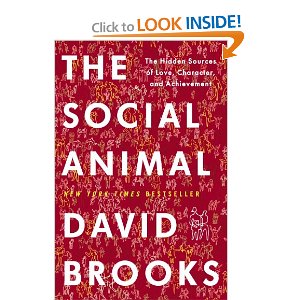
VIDEOS: David Brooks The Social Animal

Civil Society, Cultural Intelligence
Amazon Page

Phi Beta Iota: The videos are vastly better than the book at cutting to the chase.  In our view his subtitle was poorly chosen–this is not about love, it is about trust and emotional or spiritual intuition.  On that point, as a supporting note, see our review of The Hidden Wealth of Nations as well as our review of Pedagogy of Freedom–Ethics, Democracy, and Civic Courage.

.

David Brooks: The social animal (TED)

David Brooks: “Social Animal”? (CBS)

From THE SOCIAL ANIMAL by David Brooks (Animation)

See Also:

Economics of Happiness: Going Local

Reference: Happiness Ten Precepts

Reference: Trust and Networks

Journal: Statecraft, Soulcraft, & Well-Being

Review: Making Learning Whole–How Seven Principles of Teaching can Transform Education

Review (Guest): Cognitive Surplus–Creativity and Generosity in a Connected Age

Review: Reality Is Broken–Why Games Make Us Better and How They Can Change the World

Review: Building Social Business–The New Kind of Capitalism that Serves Humanity’s Most Pressing Needs

What Presidents Don’t Know About Education Plus RECAP of 6 Star Plus Books Relevant to Creating a Smart Nation with a Strategic Narrative that WORKS

Seth Goden: The [Public] Realization is Now

Civil Society, Cultural Intelligence
Seth Godin Home

I of II:  The [public] realization is now

New polling out this week shows that Americans are frustrated with the world and pessimistic about the future. They're losing patience with the economy, with their prospects, with their leaders (of both parties).

What's actually happening is this: we're realizing that the industrial revolution is fading. The 80 year long run that brought ever-increasing productivity (and along with it, well-paying jobs for an ever-expanding middle class) is ending.

It's one thing to read about the changes the internet brought, it's another to experience them. People who thought they had a valuable skill or degree have discovered that being an anonymous middleman doesn't guarantee job security. Individuals who were trained to comply and follow instructions have discovered that the deal is over… and it isn't their fault, because they've always done what they were told.

This isn't fair of course. It's not fair to train for years, to pay your dues, to invest in a house or a career and then suddenly see it fade.

For a while, politicians and organizations promised that things would get back to normal. Those promises aren't enough, though, and it's clear to many that this might be the new normal. In fact, it is the new normal.

I regularly hear from people who say, “enough with this conceptual stuff, tell me how to get my factory moving, my day job replaced, my consistent paycheck restored…” There's an idea that somehow, if we just do things with more effort or skill, we can go back to the Brady Bunch and mass markets and mediocre products that pay off for years. It's not an idea, though, it's a myth.

Some people insist that if we focus on “business fundamentals” and get “back to basics,” all will return. Not so. The promise that you can get paid really well to do precisely what your boss instructs you to do is now a dream, no longer a reality.

It takes a long time for a generation to come around to significant revolutionary change. The newspaper business, the steel business, law firms, the car business, the record business, even computers… one by one, our industries are being turned upside down, and so quickly that it requires us to change faster than we'd like.

It's unpleasant, it's not fair, but it's all we've got. The sooner we realize that the world has changed, the sooner we can accept it and make something of what we've got. Whining isn't a scalable solution.

Tomorrow: part II—the opportunity

See Also:

The Substance of Governance

2010 INTELLIGENCE FOR EARTH: Clarity, Diversity, Integrity, & Sustainability

noble gold