Historical Backgrounder on Libya

05 Energy, 08 Wild Cards, 10 Security, Civil Society, Cultural Intelligence, Government, IO Sense-Making, Military, Peace Intelligence
Chuck Spinney Recommends...

The author of this long but very useful historical analysis on the history of Libya is also the author of Violent Politics: A History of Insurgency, Terrorism, and Guerrilla War, from the American Revolution to Iraq, one of the very best books I have ever read on the subject of guerrilla warfare.

Whence Libya?  Why Libya?  Whither Libya?

William R. Polk, March 31, 2011

Since the Libyan regime was established by a coup d’état in 1969,  Americans and Europeans — with a three-year intermission from 1986 to 1988 — found it acceptable enough to recognize it, sell it arms and buy its petroleum.  In that one interval, on April 15, 1986, the American government under President Ronald Reagan attempted to kill Colonel Muammar Qaddafi by bombing his residence and did wound his wife and kill about 75 Libyans including his adopted daughter.  Two years later, Qaddafi retaliated by bombing an American airliner.  That attack killed 270 people including 190 Americans among whom were at least four intelligence officers.  These were just the major events; there were many others.  Of course, Americans and Libyans took very different views of them.  But both sides eventually smoothed over their angers, and relations again became profitable and “correct” on both sides, as they remained until early this year.

So, what is the basis of those attitudes and the causes of those actions?  Who are the Libyans anyway?  And what is the position of Qaddafi among them?  What motivates the Libyans?  What governs their action?  And what is likely to be the outcome of the revolt, the regime’s resistance to it and the Western intervention?

With the prejudice of a historian, I find that seeking answers to these questions requires at least a glance at the past.  That is the aim of this essay.

Read the essay….

9-11 Goes Credible: Consciousness Rising

07 Other Atrocities, 11 Society, Advanced Cyber/IO, Civil Society, Collective Intelligence, Collective Intelligence, Counter-Oppression/Counter-Dictatorship Practices, Cultural Intelligence, Ethics, InfoOps (IO), Journalism/Free-Press/Censorship, Misinformation & Propaganda, Money, Banks & Concentrated Wealth, Politics of Science & Science of Politics, Power Behind-the-Scenes/Special Interests, Secrecy & Politics of Secrecy, Waste (materials, food, etc)
John Steiner

“9/11” goes credible

FYI….as received.

John, a few yrs back you were posting doubts about the official explanations (both Norad and Nist have changed their stories) of 9/11, but not in a long time. I can imagine many reasons to abandon the discussion, like not upsetting some of your readers, but I just wanted to point out that back then the debate was dominated by speculation, but that in recent years the Truth movement has been professionalized by such orgs as Architects and Engineers for 9/11 Truth (some 1500 members risking their careers), Pilots for 9/11 Truth, Firefighters for 9/11 Truth, Scholars for 9/11 Truth, etc., as well as peer-reviewed scientific articles. I'd be interested in your thoughts on the subject nowadays.

Continue reading “9-11 Goes Credible: Consciousness Rising”

Moving beyond teachers and bosses

03 Economy, 04 Education, 11 Society, Advanced Cyber/IO, Civil Society, Cultural Intelligence, Ethics, InfoOps (IO), Methods & Process

Seth Godin Home

Moving beyond teachers and bosses

We train kids to deal with teachers in a certain way: Find out what they want, and do that, just barely, because there are other things to work on. Figure out how to say back exactly what they want to hear, with the least amount of effort, and you are a ‘good student.'

We train employees to deal with bosses in a certain way: Find out what they want, and do that, just barely, because there are other things to do. Figure out how to do exactly what they want, with the least amount of effort, and the last risk of failure and you are a ‘good worker.'

The attitude of minimize is a matter of self-preservation. Raise the bar, the thinking goes, and the boss will work you harder and harder. Take initiative and you might fail, leading to a reprimand or termination (think about that word for a second… pretty frightening).

The linchpin, of course, can't abide the attitude of minimize. It leaves no room for real growth and certainly doesn't permit an individual to become irreplaceable.

If your boss is seen as a librarian, she becomes a resource, not a limit. If you view the people you work with as coaches, and your job as a platform, it can transform what you do each day, starting right now. “My boss won't let me,” doesn't deserve to be in your vocabulary. Instead, it can become, “I don't want to do that because it's not worth the time/resources.” (Or better, it can become, “go!”)

The opportunity of our age is to get out of this boss as teacher as taskmaster as limiter mindset. We need more from you than that.

Continue reading “Moving beyond teachers and bosses”

Cyber-IO: A New Form of Governance?

Advanced Cyber/IO, Civil Society, Collective Intelligence, Cultural Intelligence, InfoOps (IO), Methods & Process, Mobile, Technologies
Patrick Meier

Information and Communication Technology in Areas of Limited Statehood: A New Form of Governance?

I recently had the distinct pleasure of participating in a fascination workshop on “Information and Communication Technology in Areas of Limited Statehood: A New Form of Governance?” The workshop was organized by the Frei Universität’s program on Governance in Areas of Limited Statehood and co-directed by Professors Gregor Walter-Drop and Steven Livingston.

. . . . . .

My colleague Gregory Asmolov made the link explicit during his excellent presentation on “Russian Wildfires and Alternative Modes of Governance: The Role of Crowdsourcing in Areas of Limited Statehood.” Here’s a summary:

“Because of it’s geographical size, high degree of corruption, and reliance on an extraction economy, governance by government in Russia is often weak and ineffective. Russian political expert Liliya Shevtzova goes so far as to claim that the current regime is an imitation of governance. The 2010 wildfires demonstrated the limited capacity of the state to provide effective emergency response. Information technologies, and crowdsourcing platforms in particular, fulfill the gap of the limited statehood. At the same time, however, the Russian government is also trying to use ICT to increase its claims to effective governance.”

Read full posting….

Phi Beta Iota: This post is much more than a post.  To the best of our (naturally limited) knowledge, this is the first and the best statement that clearly distinguished among “imitation governance,” spontaneous “self-governance,” and the role that information technology plays in making a mockery of the first and a reality of the second.

The End of Engagement in Afghanistan

07 Other Atrocities, 10 Security, 11 Society, Civil Society, Corruption, Cultural Intelligence, InfoOps (IO), IO Impotency, Military, Misinformation & Propaganda, Peace Intelligence, Strategy
Who, Me?

A War College case study for Col Pfaff:

“This Is not the Beginning of the End for the International Community in Afghanistan — This is the End”

A bit more on that story we brought you earlier about the horrific killings in Afghanistan which followed lunatic Pastor Terry Jones' Qu'ran-burning stunt.

I wrote this a while back:

Those reactionaries within our own society who are pushing the Clash of Civilizations are mirror-images of the terrorists that inspire their hyperbolic fear; they're just as xenophobic, just as irrational and, ultimately, are just as great a threat to our security. Both have to be challenged aggressively before they give birth to another, even bloodier generation of culture warriors.

This latest spasm of bloodletting seems like a perfect example. Radical Cleric Terry Jones burns some Qu'rans in an intentional provocation, extremists in Afghanistan kill some people, which ultimately emboldens people like Terry Jones, and so on. A vicious cycle, with the vast majority of people in the middle.

But over at the must-read UN Dispatch, Una Moore, an international development professional based in Afghanistan, says that there's a lot more going on with this attack:

Continue reading “The End of Engagement in Afghanistan”

Citizen Intelligence on Food & Health Fraud

01 Agriculture, Civil Society, Collective Intelligence, Commerce, Commercial Intelligence, Corruption, Earth Intelligence, Government, IO Impotency
John Steiner

Expose Foul Conditions at Factory Farms? Go to Jail!

March 29, 2011

Alliance for Natural Health

Iowa and Florida are considering bills that make it illegal to film or photograph inside factory farms without permission. Are the CAFOs afraid their unhealthy conditions and animal cruelty will be exposed?  Help us put a stop to this madness!

Two weeks ago we reported on the way the FDA is blocking journalistic freedom of speech through the information embargoes they impose. Freedom of speech is taking another hit, this time from state legislatures.  Read more….

* Fight Healthcare Monopolies

* Food and Supplements Are Not Drugs

* Protect Our Children

* Real, Not Phony Food Safety

* Stop Censoring Medical Science

Phi Beta Iota: It appears that some governments now believe that they have a right to legislate the censorship of truth.  Arsenic and antibiotics and other toxins associated with the industrialization of agriculture are a major cause of human illness, deformity, allergies, and other unnatural conditions.  This is all part of the “true cost” paradigm for the redesign of society to emphasize the wellness of humans and the sustainability of the Earth.  Governments so foolish as to deny that the truth at any cost reduces all other costs should be voted out of office or ignored.  Truth is a public power, a public good, and a public right.

Ushandi Moves Forward with Crisis Mapping Check-In

Advanced Cyber/IO, Analysis, Civil Society, Earth Intelligence, Gift Intelligence, InfoOps (IO), IO Mapping, Mobile, Non-Governmental, Peace Intelligence, Real Time
Michael Ostrolenk Recommends...

Crisis Mapping Meets Check-in

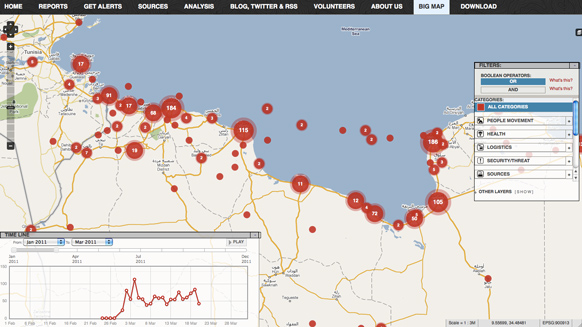
New features could make a Web tool that has helped track events in Japan and the Middle East even more useful.

Monday, March 28, 2011, By David Talbot

MIT Technology Review

EXTRACT:  The new feature is known as “check-in,” also used by social sites like Foursquare—in that case as a way of alerting friends to your presence at a particular location.

Click on Image to Enlarge

For Ushahidi, this is “a pretty powerful step forward,” says Ethan Zuckerman, a board member of the nonprofit, and a senior researcher at the Berkman Center for Internet & Society at Harvard University. “Adding check-in to this equation allows me to pull my data apart from the whole. That makes maps usable for multiple purposes—group reporting as well as tracking of my own movements.”

Enabling such tracking simply requires a GPS-equipped phone to allow a quick log-in to record whereabouts

noble gold