Journal: Financial Crime versus Financial Sense

03 Economy, 07 Other Atrocities, 11 Society, Analysis, Budgets & Funding, Civil Society, Collective Intelligence, Commerce, Commercial Intelligence, Corporations, Corruption, Ethics, Government, Methods & Process, Misinformation & Propaganda, Money, Banks & Concentrated Wealth, Policy, Power Behind-the-Scenes/Special Interests, Reform, Strategy
Chuck Spinney Recommends....

Financial Crime

December 7, 2010

From the Deficit Panic to the TARP Financial Collapse

Tales of Economic Apocalypse

By DEAN BAKER, Counterpunch

In short, the horror story collapses as soon as anyone gives it any serious thought. The Wall Street gang can hardly be faulted for trying cheap scare tactics for pushing its agenda; after all it worked so brilliantly with the TARP two years ago. At the time the plot line was that unless we immediately gave all our money to the Wall Street banks, with no questions asked, then the whole economy would collapse.

Dean Baker is the co-director of the Center for Economic and Policy Research (CEPR). He is the author of Plunder and Blunder: The Rise and Fall of the Bubble Economy and False Profits: Recoverying From the Bubble Economy.

Read entire analysis.

Financial Sense

Joseph Stiglitz outlines a very sensible approach for placing the United States on a pathway toward correcting the problems paralyzing our political economy.  Of course, his ideas will never be seriously considered by the let-them-eat-cake oligarchs now running Versailles on the Potomac, because to put this plan into action, someone must smash the Hall of Mirrors that is distorting what passes for reality in our collective OODA Loops.  CS<

This Budget Would Never Pass

A five-part plan to cut the deficit, narrow inequality, and strengthen the economy—and why special interests would block it.

By Joseph E. Stiglitz, Slate, Monday, Dec. 6, 2010

Technically, reducing a deficit is a straightforward matter: One must either cut expenditures or raise taxes. It is already clear, however, that the deficit-reduction agenda, at least in the United States, goes further: It is an attempt to weaken social protections, reduce the progressivity of the tax system, and shrink the role and size of government— all while leaving established interests, like the military-industrial complex, as little-affected as possible.

Precis:  history includes massive increase in defense expenditures, growth in inequality, underinvestment in public sector including infrastructure, and growth in corporate welfare.  Remediation demands increased spending on high-return public investments, cut in military expenditures “not just funding for the fruitless wars, but also for the weapons that don't work against enemies that don't exist;” eliminate corporate welfare; create a fairer and more efficient tax system; 5% increase in taxes actually paod (focus on top 1%).

This article comes from Project Syndicate

Joseph E. Stiglitz, a Nobel laureate in economics, is University Professor at Columbia University. The paperback version of his latest book, Freefall: Free Markets and the Sinking of the Global Economy, with a new afterword, was published in October.

Read entire analysis.

Phi Beta Iota: The Deficit Commission has not produced any supporting documentation.  The public intelligence available, of which the above is a small sample, is overwhelming in suggesting that the deficit commission is a criminal fraud being perpetuated on the American public.  Wall Street and the two-party tyranny appear to believe that the public is both stupid and permanently inert, and that they can get away with this.  Time will tell.  We condemn it–and note that Joseph Stiglitz was appointed Director of the Office of Management and Budget (OMB) in the Virtual Cabinet at Huffington Post.  We trust him.

See Also:

Journal: Simpson-Bowles Deficit Reduction All Lies?

Journal: Rug Mechants & Tax Traps

Journal: Navy Sinks, Congress Throws Money

Journal: Smoke, Mirrors, and Hades Burning on the Hill

Reference: Wall Street Does NOT Produce Value

Event: 16–19 Jan 2011 Honolulu, Hawaii; Pacific Telecommunications Council 2011, Connecting Life 24/7

02 China, 03 Economy, 03 India, Commerce, Commercial Intelligence, Corporations, Geospatial, Mobile, Technologies
event link

PTC'11: Connecting Life 24/7

will examine how telecom is changed and challenged by always-connected users with new requirements and preferences, the transformation of the value chain, changing regulatory concerns, and new demands for high-performance infrastructure.

PTC'11 Program Highlights

Monday, 17 January 2011

Carrier Transformation
Ihab Tarazi, VP, Global Network Planning, Verizon, USA
Joe Weinman, Communications, Media, and Entertainment, Hewlett-Packard (HP), USA
A Conversation with…
Vincent Paquet, Product Manager, Google Voice, Google, Inc., USA
A Conversation with…
Mark Dankberg, CEO & Chairman, ViaSat, Inc., USA
Data Centers
Jarrett Appleby, CMO, Equinix, USA
A Conversation with…
Scott Puopolo, VP, Global Service Provider Practice, Cisco Internet Business Solutions Group (IBSG), Cisco, USA
Mobile Impacts
Vivek Jhamb, CEO – Carrier Business, Vodafone, India
Suresh Sidhu, Chief Officer, Enterprise & Global, Dialog Axiata PLC, Sri Lanka
Shaping the Telecommunications Future: National Broadband Policies
Blair Levin, Communications & Society Fellow, Aspen Institute, USA
Masaaki Sakamaki, President, MCS Advisory LLC, Japan
Hongren Zhou, Executive Vice Chairman, Advisory Committee for State Informatization, People’s Republic of China
Featured Session 1: Wholesale Featured Session 2: Satellite Broadband: The Asian Perspective
Marc Halbfinger, CEO, PCCW Global, Hong Kong SAR, China Adrian Ballintine, CEO, NewSat, Australia
Stephen Ho, CEO, CPCNet, Hong Kong SAR, China Nongluck Phinainitisart, President, Thaicom, Thailand
Will Hughs, President & CEO, Telstra International – Americas, USA Mark Rigolle, CEO, O3b, USA
Neil Montefiore, CEO, StarHub Ltd., Singapore William Wade, CEO, AsiaSat, Hong Kong SAR, China

Continue reading “Event: 16–19 Jan 2011 Honolulu, Hawaii; Pacific Telecommunications Council 2011, Connecting Life 24/7”

Reference: How the Oligarchs Took America

07 Other Atrocities, 09 Justice, 11 Society, Commerce, Corporations, Corruption, Government, Misinformation & Propaganda, Money, Banks & Concentrated Wealth, Power Behind-the-Scenes/Special Interests

How the Oligarchs Took America

Beverly & Pack/Flickr

Creating a country of the rich, by the rich, and for the rich.

— By Andy Kroll

There is a war underway. I'm not talking about Washington's bloody misadventures in Afghanistan and Iraq, but a war within our own borders.  It's a war fought on the airwaves, on television and radio and over the Internet, a war of words and images, of half-truth, innuendo, and raging lies. I'm talking about a political war, pitting liberals against conservatives, Democrats against Republicans. I'm talking about a spending war, fueled by stealthy front groups and deep-pocketed anonymous donors.  It's a war that's poised to topple what's left of American democracy.

Read the full article…..

Phi Beta Iota: A detailed and devastating article that recommends the book, Winner-Take-All Politics, and places the beginning of today's economic divide with President Jimmy Carter, not Ronald Reagan.  We place it further back, in the 1920's, when Carnegie and Rockefeller structured the role school system and also oversaw the destruction of all public transportation systems they could buy and then liquidate.  It provides details on the specific organizations and their leading lights unleashed by the Citizens United decision of the Supreme Court, and decision that in our view should suggest the need to first fire Congress and then pass legislation overturning all Supreme Court decisions permitting corporate “personality” and its requisite privileges that could be reserved for individual citizens.

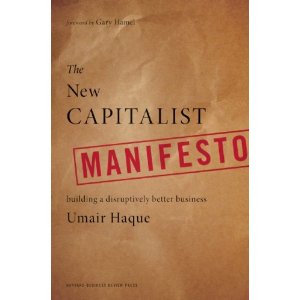
Worth a Look: The New Capitalist Manifesto

02 China, Commerce, Commercial Intelligence, Worth A Look
Amazon Page

The Worst Trade in the World

It's often said that America's an uncompetitive economy–unable to produce stuff that satisfies global demand. Hence, a yawning current account deficit.

I'd say the reality's harsher. America's caught in a toxic, self-destructive relationship with the globe's second most significant economy. In short, it's making the worst trade in the world.

See tables of what US exports to China (good stuff) and what China exports back to the US (mostly bad stuff).

Amazon Pre-Publication (4 January 2011) Review:

Product Description

Welcome to the worst decade since the Great Depression. Trillions of dollars of financial assets and shareholder value destroyed; worldwide GDP stalled; new jobs vanishingly scarce. But this isn’t just a severe recession. It’s evidence that our economic institutions are obsolete—a set of ideas inherited from the industrial age that no longer work for business, people, society, or the future.

In The New Capitalist Manifesto, economic strategist Umair Haque argues that business as usual has outgrown the old paradigm of short-term growth, competition at all costs, adversarial strategy, and pushing costs onto future generations. These outworn assumptions are good for creating only “thin” value—gains that are largely illusory and produce diminishing returns every year.

For “thick” value—enduring, meaningful, sustainable advantage that deeply benefits the larger society—Haque details five new cornerstones of prosperity in the twenty-first century:

•Loss advantage: From value chains to value cycles
•Responsiveness: From value propositions to value conversations
•Resilience: From strategy to philosophy
•Creativity: From protecting a marketplace to completing a marketplace
•Difference: From goods to betters

The New Capitalist Manifesto makes a passionate, razor-sharp economic case that these methods will produce a more enduring prosperity for business as well as society.

About the Author

Umair Haque is the Director of the London-based Havas Media Lab and heads Bubblegeneration, a strategy lab that helps discover strategic innovation. He studies the economics of the future: the impact that new technologies, management innovations, and shifting consumer preferences will exert tomorrow on the industries and markets of today.

See Also:

Worth a Look: Book Reviews on Bio-Economics

Worth a Look: Book Reviews of Capitalism Reincarnated

Worth a Look: Book Reviews on China

Worth a Look: Book Reviews on Civilization-Building

Worth a Look: Book Reviews on Collective Intelligence

Worth a Look: Book Reviews on Common Wealth

Worth a Look: Book Reviews on Conscious, Evolutionary, Integral Activism & Goodness

Worth a Look: Book Reviews on Dialog for Truth & Reconciliation

Journal: ONE Party–the Wall Street Party–“Owns” USA

03 Economy, 07 Other Atrocities, 10 Transnational Crime, 11 Society, Civil Society, Commerce, Corporations, Corruption, Government, Money, Banks & Concentrated Wealth, Power Behind-the-Scenes/Special Interests

Jock Gill

The documentary film “Inside Job” makes it perfectly clear that there is only one party in DC:  The Wall Street Party.  With five Wall Street minders for every elected official in DC, why are we surprised?  There are of course a few exceptions, but their legislative record suggest they are essentially ineffective.

The Wall Street Party has constructed a circular tautology that incorporates 1] Wall Street; 2] Government; 3] Academia, and 4] The Press — the American Gang of Four.

It is no surprise that the Wall Street Party has a principle goal of privatizing wealth via tax cuts for themselves, while socializing the pain and suffering by slashing public spending for security in employment, health and education.

Tautologies, such as the ones that prop up the Wall Street Party, are constructed for the sole purpose of being unarguably true and are by design incapable of disproof.  A prime example of the Wall Street Party's abuse of reality is their hijacking and distortion of the works of Adam Smith.

Of course tautologies are false reality distortion bubbles.  They can only paper over the diversion from reality just so long. Then they fail in a big way.  A prime example of this would be the former USSR.

The best way to deal with this is most likely an open source refutation [refudiation?] of the claims of the Wall Street Party.

Phi Beta Iota: Reprinted from Facebook with permission of the author.

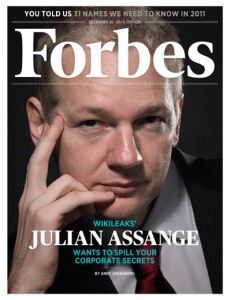
Reference: WikiLeaks Interview in Forbes–Promoting Business Ethics

03 Economy, 07 Other Atrocities, 11 Society, About the Idea, Commerce, Commercial Intelligence, Corporations, Cultural Intelligence, Ethics, Historic Contributions, InfoOps (IO), Journalism/Free-Press/Censorship, Money, Banks & Concentrated Wealth, Officers Call, Power Behind-the-Scenes/Special Interests, Privacy, Reform
Andy Greenberg

Nov. 29 2010

Fascinating article, including leaks in the pipeline (banks), whistleblowers, censorship, his story, trying to stop leaks, spying, untrustful competitors, secrecy, war, field of intelligence, etc.  … “our primary defense isn’t law, but technology…courage is contagious” (p.8) —  JAS

Forbes Cover Story . . . Forbes Transcript

Following is an excerpt from page 5 regarding moving in the direction of ethical business — JAS

Forbes Cover Story

What do you think WikiLeaks mean for business? How do businesses need to adjust to a world where WikiLeaks exists?

WikiLeaks means it’s easier to run a good business and harder to run a bad business, and all CEOs should be encouraged by this. I think about the case in China where milk powder companies started cutting the protein in milk powder with plastics. That happened at a number of separate manufacturers.

Let’s say you want to run a good company. It’s nice to have an ethical workplace. Your employees are much less likely to screw you over if they’re not screwing other people over.

Then one company starts cutting their milk powder with melamine, and becomes more profitable. You can follow suit, or slowly go bankrupt and the one that’s cutting its milk powder will take you over. That’s the worst of all possible outcomes.

The other possibility is that the first one to cut its milk powder is exposed. Then you don’t have to cut your milk powder. There’s a threat of regulation that produces self-regulation.

It just means that it’s easier for honest CEOs to run an honest business, if the dishonest businesses are more effected negatively by leaks than honest businesses. That’s the whole idea. In the struggle between open and honest companies and dishonest and closed companies, we’re creating a tremendous reputational tax on the unethical companies.

No one wants to have their own things leaked. It pains us when we have internal leaks. But across any given industry, it is both good for the whole industry to have those leaks and it’s especially good for the good players.

But aside from the market as a whole, how should companies change their behavior understanding that leaks will increase?

Do things to encourage leaks from dishonest competitors. Be as open and honest as possible. Treat your employees well.

I think it’s extremely positive. You end up with a situation where honest companies producing quality products are more competitive than dishonest companies producing bad products. And companies that treat their employees well do better than those that treat them badly.

Would you call yourself a free market proponent?

Absolutely. I have mixed attitudes towards capitalism, but I love markets. Having lived and worked in many countries, I can see the tremendous vibrancy in, say, the Malaysian telecom sector compared to U.S. sector. In the U.S. everything is vertically integrated and sewn up, so you don’t have a free market. In Malaysia, you have a broad spectrum of players, and you can see the benefits for all as a result.

How do your leaks fit into that?

To put it simply, in order for there to be a market, there has to be information. A perfect market requires perfect information.

There’s the famous lemon example in the used car market. It’s hard for buyers to tell lemons from good cars, and sellers can’t get a good price, even when they have a good car.

By making it easier to see where the problems are inside of companies, we identify the lemons. That means there’s a better market for good companies. For a market to be free, people have to know who they’re dealing with.

The InterviewYou’ve developed a reputation as anti-establishment and anti-institution.

Not at all. Creating a well-run establishment is a difficult thing to do, and I’ve been in countries where institutions are in a state of collapse, so I understand the difficulty of running a company. Institutions don’t come from nowhere.

It’s not correct to put me in any one philosophical or economic camp, because I’ve learned from many. But one is American libertarianism, market libertarianism. So as far as markets are concerned I’m a libertarian, but I have enough expertise in politics and history to understand that a free market ends up as monopoly unless you force them to be free.

WikiLeaks is designed to make capitalism more free and ethical.

But in the meantime, there could be a lot of pain from these scandals, obviously.

Pain for the guilty.

Do you derive pleasure from these scandals that you expose and the companies you shame?

It’s tremendously satisfying work to see reforms being engaged in and stimulating those reforms. To see opportunists and abusers brought to account.

———————————

Thanks to: Dan Drasin via John Steiner.

Journal: WikiLeaks Next Round BANKS

03 Economy, 07 Other Atrocities, 09 Justice, 10 Transnational Crime, Commerce, Commercial Intelligence, Corporations, Corruption, IO Multinational, IO Secrets, Money, Banks & Concentrated Wealth
DefDog Recommends...

WikiLeaks plans to release thousands of internal documents from a major
U.S. bank in early 2011, Forbes magazine reported on Monday.

“You could call it the ecosystem of corruption,” Assange told Forbes
during an interview in London, but refused to provide details about the
bank.

MORE @
http://www.thehindu.com/news/international/article923432.ece?homepage=true

Phi Beta Iota: Our hope for the round after banks would be massive leakage from the Republican National Committee and the Democratic National Committee.  This “open everything” meme is way cool.  Think of it as tough love.

Facebook Question and Answer

Jonathan Kan So, do WikiLeaks make your Open Source Intelligence dream comes true?

The short answer is no–WikiLeaks is the lowest form of open source raw sewage–BUT WikiLeaks is serving an enormous purpose in demonstrating without equivocation that “rule by secrecy” is unethical, inept, and not in the public interest.  It is a catalyst for change, not change itself.  For change the game, see Tom Atlee on politics (search Tom Atlee Change the Game) and for substance see my M4IS2 Briefing to South America, at www.tinyurl.com/SteeleCHILE.  Pass it on.  The revolution has started without a single politician being involved.

noble gold