Pierre Sprey Skewers Chuck Spinny & Stephen Walt — Big Oil, Wall Street, and Military-Industrial Complex Destroying USA

03 Economy, 10 Security, 11 Society, Blog Wisdom, Civil Society, Commerce, Commercial Intelligence, Corruption, Cultural Intelligence, IO Deeds of War, Military, Power Behind-the-Scenes/Special Interests, Strategy
Pierre Sprey

My good friend Pierre Sprey took issue with my characterization of Steven Walt's critique of US grand strategy as being excellent subject to two omissions.  Attached herewith are Pierre's comments — they are spot on, and I stand corrected on my characterization of “excellent” … or perhaps more accurately … I stand clearly and fairly skewered.  😉

Chuck Spinney
Cap Ferrat, France

Comments by Pierre Sprey:

Chuck,

Although I appreciate that Mr. Walt's heart is in the right place–particularly regarding his admirably staunch opposition to the malign influence of the Israelis, the neocons and “W”–his essay's concept of US grand strategy for the last two decades is just as shallow as the crap from the NYT, the WSJ, the Post and the Council on Foreign Relations. He commits the two fundamental errors common to nearly all foreign policy pundits, errors that inevitably reduce their beard-stroking discussions of “grand strategy” to silliness:

1. He assumes that the US has a foreign policy or a grand strategy when in fact it has none. The US government's actions, like every other country's, are dominated by its domestic politics. And those politics dominate every move made with regard to other countries.

2. He ignores the three most powerful–and most permanent–domestic influences on America's actions abroad: Big Oil, Wall Street and the MICC. Anybody who ignores these three in recounting U.S. actions abroad is either a) hopelessly out of touch, or b) is serving the interests of the defense, financial or oil establishments, or all three.

Aside from these two crippling errors in his reasoning, Mr. Walt's fulsome praise for the success of the USG's “offshore balancing”–that is, the Big Oil (and MICC) inspired policy of setting Iran and Iraq at each other's throats since the 1940s–shows either profound ignorance or profound Kissingerian cynicism.

One last piece of silliness in the Walt essay, quite common to journalists and historians seeking a “hook” for their American Empire story, is the idea of the August 2, 1990 “turning point”, a date that marks the beginning of the decline in our allegedly successful empire. Such hooks only mask the inescapable spread of rot within empires, usually starting at birth.

With Mr. Walt's help, I am coming to believe all public discussions of grand strategy should be greeted with howls of derisive laughter.

Pierre

Post Under Discussion:

Chuck Spinney: Madness in White House, K Street Thrives

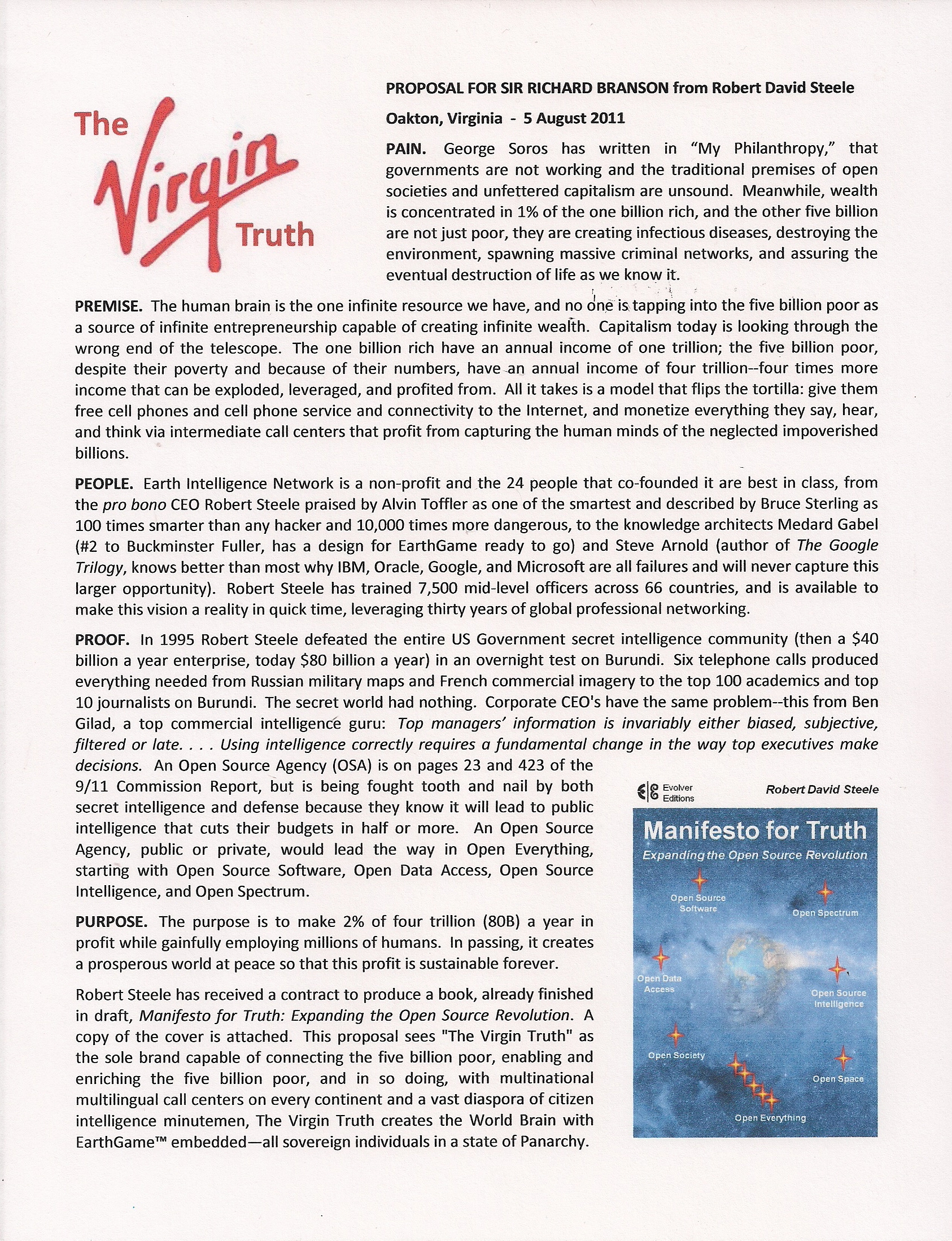
Robert Steele: The Virgin Truth (Old)

Advanced Cyber/IO, Commerce, Earth Intelligence, Ethics, Fact Sheets, Hacking, InfoOps (IO), Key Players, Methods & Process, Mobile, Policies, Real Time, Reform, Strategy, Threats

OBE See Instead: 2012 Robert Steele for Richard Branson: The Virgin Truth 2.6

Robert David STEELE Vivas

There is a very talented author, journalist, and speaker, Mike Southon, who publishes in the Financial Times.  One of his articles, “Perfect Pitch,” 7 March 2009 was instrumental in crafting the below one-page “pitch.”  Mike's four web sites:

www.ft.com/mikesouthon
www.yoodoo.biz
www.mikesouthon.com
www.beermat.biz

Short Persistent URL for this post (The Virgin Truth):

http://tinyurl.com/Steele4Branson


Click on Image to Enlarge

One-Pager Online Updated

Koko: Bloomberg & Soros Do Wrong Thing Righter

01 Poverty, 03 Economy, 06 Family, 11 Society, Budgets & Funding, Civil Society, Commercial Intelligence, Cultural Intelligence, Gift Intelligence, Government, IO Deeds of Peace, Methods & Process, Reform
Koko

Can George Soros, Michael Bloomberg save New York's troubled young men?

CSM, 4 August 2011

New York Mayor Michael Bloomberg announced a $127.5 million plan Thursday to help young black and Hispanic men. The effort includes money from financier George Soros and his philanthropy.

Education

Socioeconomic and Health issues

Employment

Incarceration

Read more….

Koko signs:  Smart men both, but neither of them has a holistic understanding of system design.  In the jungle, connectivity matters.  King of the Reflexive Practice Jungle, Dr. Russell Ackoff, would say this is a magnificent example of doing the wrong thing righter.  Paying to connect these young men to a broken system makes no sense–funding them to build a new system to displace the broken one–now that is reflexivity.  Good intentions, bad design.  We have just two questions.

1.  Has anyone asked the young men what they want?

2.  In the context of a city failing the resilience test and likely to experience near-catastrophic unemployment in the middle class over the next ten years, is there a strategy for resilience?

See Also:

Continue reading “Koko: Bloomberg & Soros Do Wrong Thing Righter”

Koko: S&P Wrist Slap Downgrade–USG Lacks Integrity

Corruption, Government
Koko

U.S. Rating Cut by S&P on Deficit Reduction Pact

Bloomberg, 5 August 2011

The U.S. had its AAA credit rating downgraded for the first time by Standard & Poor’s on concern spending cuts agreed on by lawmakers to raise the nation’s borrowing limit won’t be enough to reduce record deficits.

Read more….

Koko do math: Cut 1.5 trillion over 10 years; continue to borrow $1 trillion a year, net debt INCREASE $8.5 trillion over ten years.  Congress and the White House have known the Republic is insolvent since then Comptroller General David Walker briefed them to that effect in 2007.

Koko signs: “Reality bats last.”

 See Also:

Restoring Truthiness:  Full Summary Focusing on Irresponsible Governance

Serious Games for Serious Civic Engagement

Advanced Cyber/IO, Civil Society, Collective Intelligence, Government, Policies, Serious Games, Threats

   Serious Games for Serious Civic Engagement

Use The Power of Collaborative, Serious Games to Engage Citizens and  

  Resolve Our Budget Crises


It’s no secret. We’re broke. Local governments, state governments, the U.S. Federal Government and many international governments are all facing budget shortfalls, spending cuts and reduced services. All of us — ordinary citizens, elected officials, civic and community leaders — know that we must make dramatic changes and tough choices to solve this crisis. But how do we engage our communities in identifying and prioritizing the best possible solutions? How do we create more engaged and informed citizens?

Our Answer?  Fix Broke(n) Governments through Serious Games

On January 29, 2011, The Innovation Games® Company designed and produced an in-person serious game to help more than 100 citizens, community leaders and city officials in San Jose, CA collaboratively prioritize possible cuts to the city budget.

Instead of polling residents individually, our specially designed Innovation Game®, the San Jose Budget Games, created an opportunity for ordinary citizens to negotiate with one another, listen to their neighbors and create budgets that reflected not only their own but others viewpoints. Civic leaders left the San Jose Budget Games with both a clear and actionable list of the proposals citizens could compromise on and also a record of why they had found common ground—and the game results have impacted the actual city budget.

Our experience with the city of San Jose has convinced us that games are a powerful tool for civic engagement: Thus we’re seeking funds to extend our existing in-person version of Budget Games into an online version.  Instead of engaging hundreds of citizens, we want to powerfully connect tens of thousands or even millions of motivated citizens with their elected officials—and we need your help to get this done.

Read more….

UN + Start-Up Seek to Get Poor Online with Cell Numbers

01 Poverty, 03 Economy, 04 Education, 06 Family, 07 Health, 09 Justice, 11 Society, Advanced Cyber/IO, Civil Society, Collective Intelligence, Ethics, Gift Intelligence, Hacking, Key Players, Mobile, Non-Governmental, Real Time

Startup Aims to Get the Poor Online With Phone Numbers

By Stephen Lawson, IDG News

U.K. startup Movirtu plans to help 3 million or more people in poor countries use mobile services by giving them personal phone numbers, not phones.

Working with a U.N.-affiliated initiative called Business Call to Action (BCtA), Movirtu will offer the numbers, which it calls mobile identities, through commercial carriers in developing countries in Africa and South Asia. People in those countries who typically borrow phones from others will be able to log into the carrier's network and use their own prepaid minutes and bits of data.

The service is called Cloud Phone, though it operates within a carrier's own infrastructure rather than on the Internet as a classic cloud service would. Having a personal mobile identity can save users money in two ways, according to Ramona Liberoff, executive vice president of marketing, strategy and planning at Movirtu. First, they can use mobile services without buying a phone, which is a luxury even at US$15 or $20 for people making $1 or $2 per day.

Second, the cost of prepaid service from a carrier typically is less than what consumers in those countries pay someone to borrow a phone, she said. Though it's customary in many of these countries to lend a phone to someone in need, the borrower is also expected to pay the lender for the usage. The average savings from using regular prepaid service instead is estimated at about $60 per year, Liberoff said.

The service will help people to use mobile banking, insurance and farming assistance services as well as make phone calls, Liberoff said. Some of these services currently can only be delivered to individuals and not to someone sharing a phone. Personal mobile identities could be a boon to NGOs (non-governmental organizations) that want to use mobile technology.

Read more….

See Also:

Continue reading “UN + Start-Up Seek to Get Poor Online with Cell Numbers”

Koko: Politics Needs Citizen Juries for Integrity

Civil Society, Collective Intelligence, Cultural Intelligence, Ethics
Koko

Politics is too important to be left to politicians – time for citizens’s juries

By Katie Ghose, Chief Executive of the Electoral Reform Society

Left Foot Forward, BC, 5 August 2011

A farmer, a school teacher, a politician just who would you trust to set the rules of politics?

That’s the question being posed this week with the launch of the In the Public Interest campaign. The call for a publicly funded ‘Citizens Jury’ to apply a “public interest first test” is a refreshing answer to the problem of entrenched elites and the failure of self-regulation. It’s a welcome reminder that we simply can’t leave banking to the bankers, journalism to the journalists or indeed politics to the politicians.

Read more….

See Also:

Reference: Electoral Reform–1 Page 9 Points 2.2

Seven Promises to America–Who Will Do This?