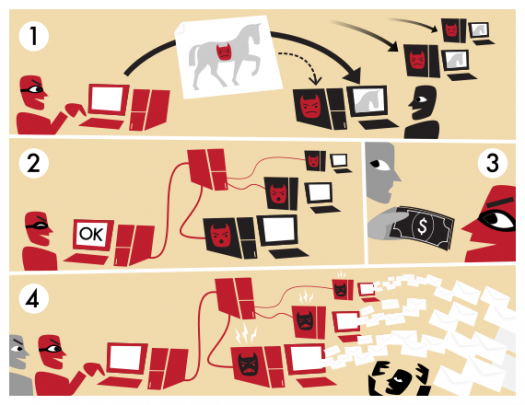
Today in cyber threats: more than four million Windows PCs have been commandeered by a botnet that cybersecurity experts are calling nearly “indestructible.” Known as TDL-4 (it’s the fourth iteration of the malicious program), this particular little nuisance hides in places security software rarely checks and speaks with other infected machines and their overseers in a novel encrypted code. Some are calling it the most sophisticated threat out there today. Watch your back, Stuxnet.
Phi Beta Iota: Apart from the known fact that the US Government ignored documented warning from Winn Schwartau, Jim Anderson, Bill Caelli, and Robert Steele in 1994, what we have here is the culimination of fifteen years in which governments continue to operate as Industrial Era hierarchies, choosing secrecy to protect incompetence rather than multinational sharing to achieve resilience–they are as a result inept beyond belief. The cloud–given the plethora of proprietary and therefore generally insecure hardware and software–is not going to be cleaned up on the present course, where spam is 75% of all email despite the best (isolated) efforts of all concerned. M4IS2, anyone?
(Reuters) – Thrown by a mounting series of extreme events over the past four years, global policymakers and investors are being urged to think long and prepare more systematically for the worst.
. . . . . . .
Part of the problem today is that the latest wave of globalization was led solely by transnational corporations and their interwoven supply chains and by financial markets' 24/7 worldwide blizzard of electronic transactions.
While this greatly facilitated the transmission of shocks worldwide, it was not matched by countervailing global governance and regulation to keep this activity in check or mitigate its most socially- or systemically-threatening aspects.
More information on the OECD’s Future Global Shocks project is available at: www.oecd.org/futures, including case studies on cyber attacks, pandemics, geomagnetic storms, social unrest and financial crises.
Released Wednesday by the sponsoring Watson Institute of Brown University, a new multi-author study of the costs of the post-9/11 wars is available. Most prominently, the study finds the appropriations thus far to have been between $2.3 and 2.7 trillion; with an additional $884 to $1,334 billion to already have been incurred for future costs for veterans and their families. This would make a total, incurred thus far, of from $3.2 Trillion to $4.0 trillion. (Find a summary of these costs at http://costsofwar.org/article/economic-cost-summary.) It is important to note that these are basically budget costs to the federal government, not the broader economic costs to the economy or other costs to state and local governments.
The study also addresses still other expenses, such as the human costs in terms of civilian dead, the wounded, refugees, and more.
There is certainly some you will find to disagree with, but it is clear that advocates of the various conflicts who pretend the costs have been only the $1 trillion that President Obama articulated last week are feeding the nation grotesquely inaccurate information. Others, like departing SecDef Gates, who pretend that DOD spending is not a major factor in the size of our deficit are not particularly skilled in “math,” an elementary skill for government types that Secretary Gates has chosen to deride and to leave to others to perform.
I participated in the Costs of War study; see my paper on the DOD . It makes two basic points on p. 14:
1) “… while [the Congressional Research Service] and others have done long, hard, and excellent work to capture the identifiable appropriations to the Pentagon for the Post-9/11 wars, the $1.2 trillion CRS has, for example, identified in current dollars is problematic, but the fault is not with CRS, CBO, or GAO. The available figures have gaping holes and problems in them because of the sloppy, inept and misleading accounting of the costs by the Defense Department and Congress.”
2) “The $667 billion in 2011 dollars ($617 billion in current dollars) appropriated to the Defense Department's base budget since 2001 as a result of the wars, while squandered, should be included in any comprehensive attempt to capture the total cost of the wars. These amounts would bring the total DOD costs of the wars to $1.98 Trillion in constant 2011 dollars and $1.82 trillion in current dollars.”
A Reuters story below summarizes the overall “Costs of War” study.
(Reuters) – When President Barack Obama cited cost as a reason to bring troops home from Afghanistan, he referred to a $1 trillion price tag for America's wars.
Staggering as it is, that figure grossly underestimates the total cost of wars in Iraq, Afghanistan and Pakistan to the U.S. Treasury and ignores more imposing costs yet to come, according to a study released on Wednesday.
The final bill will run at least $3.7 trillion and could reach as high as $4.4 trillion, according to the research project “Costs of War” by Brown University's Watson Institute for International Studies.
Phi Beta Iota: Emphasis added above. Brown, like Rutgers, is a hotbed of left-leaning intellectuals who probably wonder how a Democratic President could have become a neo-fascist war-monger. The answer is simple: corruption has no ideology. It is pervasive. Interestingly, the wire services (AP, Reuters, AFP, Bloomberg on occasion) and Russian Television as well as Al Jazeera, are emerging from this period as examples of integrity in action.
Given that the Greeks invented democracy, it's only fitting that they're now being given the chance to reinvent it. And yes, I know we Greeks have a reputation for mythmaking and drama — but, as I found out during my trip to Greece last week, those really are the stakes.
Until I went over and witnessed what's happening, I too had become convinced that the real issues were the ones the media were obsessively covering: the effects of a potential sovereign default on the Euro and worries about the crisis spreading to other European countries.
But here's the bigger issue: Can a truly democratic movement break the stranglehold of corrupt elites and powerful anti-democratic institutional forces that have come to characterize not just the politics of Greece, but most Western democracies, including our own? Greece is only an extreme example of an unfolding seismic social shift that is challenging democracies the world over.
What happens in Greece might very well tell us whether democracy will recover from the crisis of legitimacy exacerbated by the financial crisis or whether it will shrink — undermined by the very forces that brought on the crisis in the first place.
It's way too early to tell whether the forces of democracy will prevail, but I came away extraordinarily moved and heartened by the courage, passion, engagement and dedication I witnessed during a trip in which three different perspectives converged.
Internet prime mover Vint Cerf echoes what I’ve been hearing from other architects of the TCP/IP network: we should focus on building much fatter pipes, and get away from the enforced/legacy scarcity and build gigabit broadband networks. Nothing here about the cost of providing gigabit access, nothing here about the fact that much of the (rural) U.S. has no access to broadband at any speed. What policies do we need to have pervasive gigabit broadband, urban and rural, in the U.S.? Who will pay for the buildout? [Link]
I’m aware of open spectrum… I’m in other conversations with various wonks & engineers who’re discussing bandwidth, spectrum, etc. Of course we could have a much different scene if we weren’t constrained by markets and politics. People how can see one sense of the obvious often miss another, which is that the world we’re in is not an ideal world, and the ideals we can conceive are not necessarily easy or even possible to implement. I pay less attention to the “next net” list we’re both on because so much of it is fantasy and masturbation.
I own a nice home in rural Texas but I can’t live there because I can’t even get 500kbps. I thought it was amusing that Vint is arguing for gigabit bandwidth when most of the U.S. is dark and there’s too little monetary incentive to bring light to the darkness. Of course I think we need a public initiative to make it happen, but in this era “public” is a dirty word. I halfway expect to see all roads become toll roads; a world where only the elite can travel, and only the elite will have broadband access. Though aging, I’m struggling to remain part of the elite… *8^)
Robert David STEELE Vivas
Robert Steele Comments:
Open Spectrum was part of my comment to Jon, but much more pointedly, I observed that Vint went to the dark side with Google, and has completely neglected both the Dutch model that Gordon Cook has documented so ably, and the desktop analytics as well as the back office M4IS2 processing that is required to create the World Brain and Global Game. I do not wish to publish the Operation Cloudburst memorandum that is before Microsoft, but now that Office 365 is out the way is open for some SERIOUS human-centric, data-centric, intelligence-capable M4IS2 innovation (Microsoft BI, Access, and MySQL are baby steps). Google, IBM, and Oracle are all great in their respective niches, but no organization–including Microsoft–is trained, equipped, and organized to create a global grid that is Open Everything. This is my specific calling in my last 25 years of productive work.
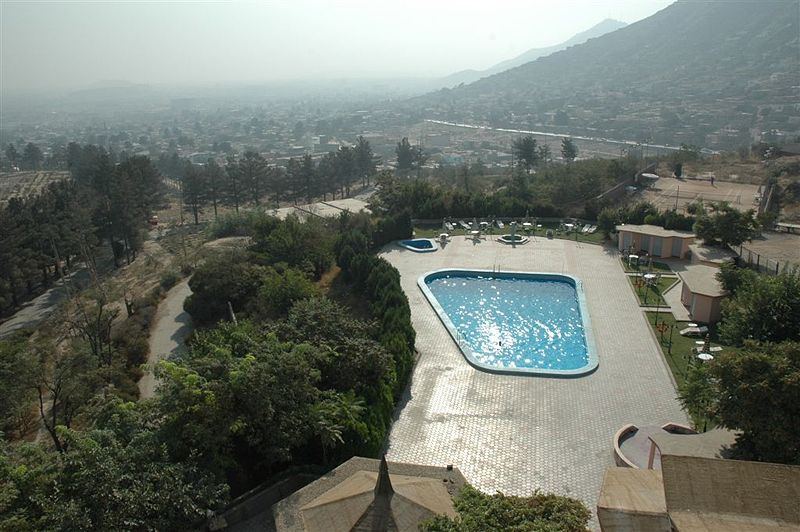
UPDATED to add photo. Guards at the front door, no guards across the totally exposed back end. Sheraton San Salvador was attacked from the ravine. Deja vu.
Gunmen and suicide bombers strike the tightly secured Intercontinental Hotel in Kabul, which has large foreign clientele. It was not immediately known how many people were killed or wounded.
Phi Beta Iota: Well-intentioned professionals like to say that if the US only has enough will to persist, it can prevail against any enemy. That is not correct. When the US engaged in elective wars and lacks legitimacy in the eyes of the occupied public, it will inevitably lose. When the US Government is delusional and ignoring the harsh realities at home, it loses its domestic legitimacy. Events like the Tet Offensive, or the increasing attacks in the heart of Kabul, accentuate the cognitive dissonance among all parties. This will not end well for the US.
While the U.S. government may be described as a massive wealth transferring scheme, looting the middle class for the elite, I’d suggest that ‘wealth’ and ‘elite’ are not precisely correct. The transformation in Western power structures over past three centuries is such that the ‘elite’ was formerly indistinguishable from the government, which is the hallmark of feudal government; whereas now, the locus of power is the government itself, not any particular group of people.
We still find the old system at work in dictatorships – Libya, N. Korea – in which the government is indistinguishable from a small group of people and for whom wealth accumulation is the primary goal.
But wealth isn’t the primary goal of western governments; they have a nearly unlimited ability to create their own wealth (debt and printing money) – or destroy it (debt and printing money). The primary concern of these supposedly post-feudal governments is stability and power, and their primary means to securing these ends is patronage.
Patronage existed in feudal governments, but it was a means to an end (wealth accumulation), and not the end in itself. As such, it’s then not surprising that the primary purpose of most government endeavors – the education and court systems, intelligence communities, healthcare – is to employ the greatest number of people, thus securing widespread government support. Critical mass is reached when a simple majority of the voters earn >50% of their income from government sources – there are people who work for a living and people who vote for a living, and once the latter reaches >50%, the former becomes politically irrelevant.