Reference: Open Source Civilization

03 Economy, 04 Education, 06 Family, 11 Society, About the Idea, Civil Society, Collective Intelligence, Cultural Intelligence, Earth Intelligence, Ethics, IO Multinational, IO Sense-Making, Peace Intelligence
Open to See the Future

Phi Beta Iota: We cannot say enough good things about these folks.  This is righteous good stuff–eight times cheaper than industrial offerings, virtually no “true cost” externalities, interchangeable parts, human scale, the whole enchilada.

Tip of the Hat to Brandin Watson at Facebook.

Journal: Building Information Modeling as the Core of Sustainable Design Impacts on 40% of Global Energy Consumption

Analysis, Augmented Reality, Budgets & Funding, Commercial Intelligence, Communities of Practice, Computer/online security, Geospatial, InfoOps (IO), Intelligence (government), IO Mapping, IO Multinational, IO Sense-Making, Methods & Process, Policies, Reform, Strategy, Threats
Published October 27, 2010

OAKLAND, CA — Building information modeling can be a valuable tool for architects, engineers and contractors that allows them to explore different design options, see what projects will look like and understand how a structure will perform long before it's built.

BIM, as it's known in the industry, also can help building owners and operators throughout a structure's lifecycle by providing visual context to performance-related data, retrofit plans and other projects intended increase energy efficiency.

In a webcast on Tuesday moderated by GreenBiz.com Executive Editor Joel Makower, representatives for design software giant Autodesk, DPR Construction and the consulting engineering firm Glumac talked about “How Building Information Modeling Solutions Transform Sustainable Design.”

– – – – – – –

Increased costs of energy, ongoing challenges posed by the economy and concerns about sustainability, market demands, occupany and eventual regulation of carbon output combine to make building owners, operators and managers increasingly aware of how their properties perform — and compare with others.

Those issues and the availability of state and federal incentives are powerful drivers to improve portfolios. “Not surprisingly, large multinational companies are getting their buildings in order,” Deodhar said.

Examples include Walmart, which will retrofit 500 buildings this year, Marriott, whose hotel chain includes 275 hotels that bear the Energy Star label, and Starbucks, which by the close of the year will begin to seek LEED certification for all new company-owned stores around the world.

Globally, buildings account for about 40 percent of energy consumption and more than 200 million buildings are candidates for efficiency improvements, Deodhar said. But optimizing a building's environmental performance requires incorporating interrelated factors, such as location, orientation, internal systems, how the building is used and other variables, into design.

Read full article (long and valuable)

Phi Beta Iota: This is the kind of project we had in mind for DIA/DO (Directorate of Open Sources & Methods).  Apart from DoD being the biggest gorilla on the planet where any improvement can be measured in billions of dollars, this is the tip of the “true cost” iceberg and a success here could be immediately extended to every aspect of acquisition across all mobility, weapons, and other systems, over to the rest of the federal government, down to state and local, and out to the world.   In the 21st Century design is intelligence, intelligence is design, and intelligent design, not weapons, is the influencer most likely to achieve the desired outcome.

Journal: Technology Can Save Feds $1T in 10 Years

03 Economy, 09 Justice, 10 Security, Computer/online security, Government
content by Greener World Media

By GreenerComputing Staff at Greener World Media

Tue Oct 26, 2010 1:00am EDT

Throughout this highly charged election season, government spending and the federal deficit have been a linchpin of political arguments. At the same time, a gridlocked Congress means that very little has been accomplished despite all the debate.

But a report published earlier this month highlights seven ways that, using existing technologies, the federal government could save $100 billion dollars a year for the next 10 years, not-insignificant portion of the current federal deficit.

The report, “One Trillion Reasons,” was published by the Technology CEO Council, a group chaired by IBM CEO Samuel Palmisano. It lays out how technologies from data center management to fraud-fighting tools can improve efficiency and productivity in the government.

– – – – – –

Initiative 1: Consolidate Information Technology Infrastructure
Initiative 2: Streamline Government Supply Chains
Initiative 3: Reduce Energy Use
Initiative 4: Move to Shared Services for Mission-Support Activities.
Initiative 5: Apply Advanced Business Analytics to Reduce Improper Payments.
Initiative 6: Reduce Field Operations Footprint and Move to Electronic Self-Service.
Initiative 7: Monetize the government's assets

Read Full Article

Download Report (10 Page PDF)

Tip of the Hat to Bob Gourley at LinkedIn.

NIGHTWATCH Extract: Somalia Anti-Piracy Update

08 Wild Cards, 10 Security, 10 Transnational Crime, Cultural Intelligence, Law Enforcement, Military, Peace Intelligence

Somalia anti-piracy patrol: Update. The Danish navy says it sank a Somali pirate boat in the Gulf of Aden. Spokesman Kenneth Nielsen said Wednesday that the command and control ship HDMS Esbern Snare intercepted a suspicious boat Tuesday, confiscated weapons and fuel, and detained six pirates. The Danes then used explosives to mine and sink the boat. The suspected pirates were later released since officials said no crime had been committed.

Earlier Wednesday, the European Union's anti-piracy force said pirates attacked but failed to hijack a French-flagged ship off the coast of Tanzania. The Danish navy ship is part of NATO's anti-piracy operation in the region.

European Union's anti-piracy force says the pirates are holding 19 ships and more than 420 hostages.

NIGHTWATCH Comment: After several years of trying, the some 40 ships on anti-piracy patrols have made scant progress against the pirates but have maintained skills.

NIGHTWATCH KGS Home

Secrecy News Headlines

10 Security, 10 Transnational Crime, Corruption, Government, IO Multinational, Law Enforcement, Methods & Process

**      ODNI ISSUES NEW SECURITY STANDARDS FOR INTEL FACILITIES

**      INFORMATION SHARING: FEAST OR FAMINE

**      POLYGRAPH TESTING AGAINST BORDER CORRUPTION

Phi Beta Iota: As long as the IC persists in sticking with the TS/SCI “all or nothing” approach to information, it will continue to fail in serving the  needs of virtually all of the current and all of the unrecognized but potentially legitimate customers for its proven sources and methods.  The Open Source Agency under diplomatic auspices, that includes both the 50 community intelligence networks managed by the National Guard as well as the Multinational Decision Support Centre with regional multinational Stations, are necessary first steps if intelligence is to be useful into the future.

Regarding the polygraph, it works and has been hugely successful within the International Commission Against Impunity in Guatemala (CICIG) and within the Government of Guatemala itself, with two major caveats: 1) polygraph results must be reported directly to the leadership by the polygraphers, we have seen polygraphs manipulated or fabricated by security managers intent on achieving specific personnel or political or budget goals; and 2)  out of area polygraphers are essential–in Central America, and we suspect in the Southwest border region as well, most local polygraphers have been employed by and well compensated by and are deathly afraid of, the narco-traffickers who know how to use the polygraph to keep their own ranks free of penetrations and betrayal from within.  A global cadre of polygraphers under deep cover is needed.

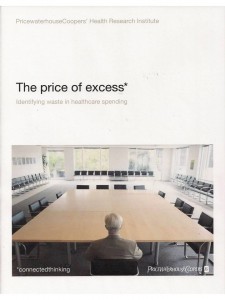
2010 Reference: HEALTH–The Price of Excess (PWC)

07 Health, Analysis, Budgets & Funding, Commerce, Commercial Intelligence, Methods & Process, Reform, Waste (materials, food, etc)
Free with Registration Online

EXCERPT:  Our research found that wasteful spending in the health system has been calculated at up to $1.2 trillion of the $2.2 trillion spent in the United States, more than half of all health spending. Defensive medicine, such as redundant, inappropriate or unnecessary tests and procedures, was identified as the biggest area of excess, followed by inefficient healthcare administration and the cost of care necessitated by conditions such as obesity, which can be considered preventable by lifestyle changes.

Phi Beta Iota: PriceWaterhouse Coopers hit it out of the park with this study, and we are even more pleased that after we pointed out the unreadability of the orange print/gray scale text as originally posted, they have now posted a solid black very readable version.  It is free with registration and we urge all who have an interest of any sort in Health to get this document, print it, and send this link on to others.  It is “Ref A” for our forthcoming Sense-Making Summit '11: Public Health.

Worth a Look: National Dialog & Deliberation Resources

About the Idea, Civil Society, Collective Intelligence

What are the web sites for meeting facilitators to learn about best practices and new resources?

Well the NCDD site of course! Our main blog (www.thataway.org) keeps people updated on news & opportunities in dialogue, deliberation, public engagement, facilitation, etc. And our resource center (www.ncdd.org/rc) provides info about over 2500 resources (guidebooks, videos, articles, etc.).

And our main NCDD Discussion list (http://ncdd.org/rc/item/4434) has 1100 subscribers and really showcases the know-how and intellectual generosity of people in our community of practice. All are invited to subscribe.

Sandy Heierbacher at LinkedIn

Director, National Coalition for Dialogue & Deliberation (NCDD)

Links: