
The truth at any cost lowers all other costs — curated by former US spy Robert David Steele.

Huh?
The U.S. Intelligence Community's Kodak Moment
The game is changing rapidly. Can Washington's intelligence community keep up?
Josh Kerbel
National Interest, 15 May 2014
Josh Kerbel is the Chief Analytic Methodologist at the Defense Intelligence Agency. He writes often and openly on the intersection of government (especially intelligence) and globalization. The views expressed in this article are his alone and do not imply endorsement by the Defense Intelligence Agency, the Department of Defense or the US Government.

In 2012, the once-mighty Eastman-Kodak company declared bankruptcy. It was an event that should have reverberated strongly with the United States Intelligence Community (IC)—and not just due to the obvious connection between imaging and spying. Rather, it should have resonated because in Kodak the IC could have glimpsed a reflection of itself: an organization so captivated by its past that it was too slow in changing along with its environment.
To understand the IC’s similar captivation and lethargy—to remain focused on classified collection in an era of increasingly ubiquitous, useful and unclassified data—one must first understand the type of problem around which the modern IC business model remains designed: the Soviet Union. The Soviet Union was fundamentally a collection problem. That is to say, it was a closed system (i.e., a discrete entity) with clear edges and a hierarchical governance structure. Given that nature, knowing what was happening in the Soviet Union required the use of classified means of collection—most of which the IC alone possessed.

Consumers: ‘We don't need our stuff'
By Bruce Horovitz
USA Today, May 12, 2014
Consumers across the globe say they want less stuff.
Half of them say they’d happily live without most of the items they own in a global survey of 10,574 adults ages 16 and up in 29 nations. The survey, titled “The New Consumer and the Sharing Economy,” was done by the communication giant Havas Worldwide and will be released Tuesday.
Seventy percent of those surveyed said that overconsumption puts the planet at risk.
“Every step of the way, they are practicing less is more — and savoring the less,” says Andrew Benett, global CEO of Havas Worldwide.
Sixty-five percent of those surveyed said society would be better off if people shared more and owned less.

Only fifteen years after Abe Lederman said the same thing at OSS!
The solutions to all our problems may be buried in PDFs that nobody reads
What if someone had already figured out the answers to the world's most pressing policy problems, but those solutions were buried deep in a PDF, somewhere nobody will ever read them?
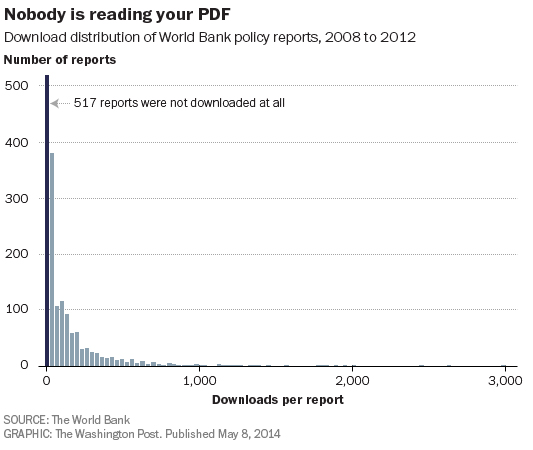
According to a recent report by the World Bank, that scenario is not so far-fetched. The bank is one of those high-minded organizations — Washington is full of them — that release hundreds, maybe thousands, of reports a year on policy issues big and small. Many of these reports are long and highly technical, and just about all of them get released to the world as a PDF report posted to the organization's Web site.
The World Bank recently decided to ask an important question: Is anyone actually reading these things? They dug into their Web site traffic data and came to the following conclusions: Nearly one-third of their PDF reports had never been downloaded, not even once. Another 40 percent of their reports had been downloaded fewer than 100 times. Only 13 percent had seen more than 250 downloads in their lifetimes. Since most World Bank reports have a stated objective of informing public debate or government policy, this seems like a pretty lousy track record.
Secrecy as part of the existing DNA — and a major cancer.
When General Stanley McChrystal started fighting al Qaeda in 2003, information and secrets were the lifeblood of his operations. But as the unconventional battle waged on, he began to think that the culture of keeping important information classified was misguided and actually counterproductive. In a short but powerful talk McChrystal makes the case for actively sharing knowledge.
QUOTE: “In a tightly coupled world, it's hard to predict who will need what information.”
QUOTE: “Change from ‘who needs to know' to ‘who doesn't know.'”
QUOTE: “Information is only of value if you give it to people who have the ability to do something with it.”
As the information age and big data colonize everything in life – expanding now into reality itself – we face an erosion not only of privacy but of choice. Even as we think we have greater choice and power, really important choices and power are being subtly stolen from us by folks who don't want us to know or do anything about it. We need to take back our lives while we still can.
“Dark Google”, privacy and power
Dear friends,
Sir Francis Bacon and Thomas Hobbes told us that “Knowledge is power.” We need to integrate their insight with Sir John Acton's observation that “Power tends to corrupt, and absolute power corrupts absolutely.”
In this runaway Information Age we need to realize that one-way concentrations of knowledge power are dangerous when they are not answerable, not responsive to oversight and feedback. The article below, “Dark Google”, makes this point powerfully regarding Google and the NSA. The author, Harvard's Shoshana Zuboff, is eminently qualified to issue this warning.
Continue reading “Tom Atlee: “Dark Google,” privacy and power”

Right thing, doing finally.
The Next Startup Craze: Food 2.0
Silicon Valley investors and startups are trying to improve our food. Do they bring anything to the table?
EXTRACT:
Hampton Creek Foods and other startups have big dreams of restructuring the food supply so that it uses less land, water, energy, and other resources. In doing so, they are taking on corporate giants such as ConAgra, General Mills, and Kraft that spend billions on research and technology development.
Such ambitions have run up against considerable challenges in industries such as clean tech. But those involved in the new food binge might prefer a different example. Hampton Creek’s CEO, Josh Tetrick, wants to do to the $60 billion egg industry what Apple did to the CD business. “If we were starting from scratch, would we get eggs from birds crammed into cages so small they can’t flap their wings, shitting all over each other, eating antibiotic-laden soy and corn to get them to lay 283 eggs per year?” asks the strapping former West Virginia University linebacker. While an egg farm uses large amounts of water and burns 39 calories of energy for every calorie of food produced, Tetrick says he can make plant-based versions on a fraction of the water and only two calories of energy per calorie of food — free of cholesterol, saturated fat, allergens, avian flu, and cruelty to animals. For half the price of an egg.
